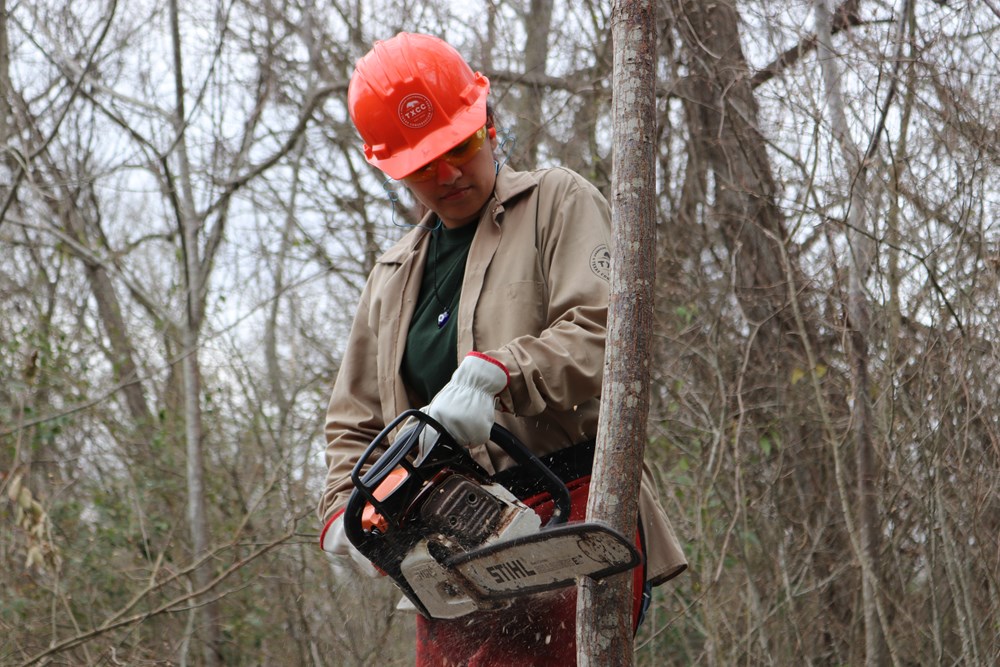
A clear chainsaw work area is more than a patch of bare ground beside the wood. You need reliable footing, control over who can approach, a plan for changing conditions, and a way to stop the job when any of those pieces no longer works.
Use this guide before an appropriate ground-level task that matches your practical training. It does not provide a felling plan or teach you to manage unstable, suspended, or storm-loaded wood.
Begin with the whole space
Stand back and identify the work, nearby paths, buildings, fences, parked vehicles, overhead branches, and possible utility involvement. Consider where other people normally move before deciding that a quiet yard is empty.
A side gate may open directly into the area, while a delivery driver may approach from the driveway without seeing you. Your setup needs to account for those real routes rather than an imaginary circle around the saw.
If the job involves a road, public path, shared access, power lines, or an area you cannot control, get appropriate qualified help. A homemade sign does not give you the authority or competence to manage public traffic or electrical hazards.

Write down the reason the location is suitable before you prepare the machine. If your explanation depends on nobody arriving, nothing shifting, and the weather staying exactly the same, you need a better plan.
Examine the ground you would stand on
Look for slippery surfaces, loose stones, hidden holes, uneven steps, and branches that can roll underfoot. Clear ordinary loose debris only when you can do so safely without disturbing loaded or unstable material.
Do not assume a thick carpet of leaves provides a level surface. It may hide roots, small limbs, or a change in ground level that becomes obvious only when your weight is on it.
Consider the difference between a tidy driveway and the slope immediately beside it. A log close to good footing does not necessarily allow you to work from that footing without leaning or reaching.
If a suitable working position is unavailable, change the plan through qualified assistance rather than inventing a platform, balancing on a pile, or using a ladder. Access is part of whether the job is appropriate at all.
Keep wood stability separate from ground tidiness
A clean floor does not establish that the piece you intend to cut is stable. Its support, weight, possible rolling movement, and relationship to other material need a competent assessment.
Do not tidy around a tangled pile by cutting away whatever protrudes first. A small piece can support another piece, and removing it can alter a much larger arrangement.

Swipe sideways to inspect the diagram, or focus it and use the arrow keys.
For example, branches lying across a low trunk may conceal whether the trunk is supported at both ends or resting on a single contact point. A photograph or a clean approach path cannot answer that question for you.
If you cannot explain the likely movement under the conditions your training covers, stop and call a qualified professional. Keep the work area closed while that uncertainty remains.
Establish who can approach and how
CDC's chainsaw guidance gives minimum separation distances for bystanders that depend on the task, including a different distance for felling and for cutting fallen material. Use the relevant manufacturer guidance, training, and site controls rather than treating one number as a guarantee for every scene.
Keep children, pets, and uninvolved adults away from the work area. A family member supervising a dog should be outside the hazard area, with a separate secure place for the animal if it cannot stay away reliably.
Tell anyone who needs to contact you that they must wait for the saw to be stopped and acknowledged communication before approaching. A wave from the edge of your vision should not become an invitation to walk toward a moving chain.
If you cannot prevent unexpected entry, postpone the task. Working at a busy household entrance while hoping everyone remembers your warning is a fragile arrangement.
Put communication into plain words
Agree how work stops before hearing protection and engine noise make ordinary conversation difficult. Keep the system simple enough that a person observing from a safe distance knows what to do if someone enters the area.
Do not rely on a shouted instruction that assumes you can hear words over equipment noise. Your practical training and the actual communication equipment should determine how you coordinate safely.
Give the person waiting outside the work area the property address and emergency access details. Knowing where the house is does not always mean knowing how an ambulance can reach the back of a large property.
A useful written note includes the address, nearest accessible entrance, phone availability, and the person to contact. Store it where that person can use it without crossing into the work zone.
Give fuel its own location
If you use a gas saw, plan the approved refueling area and the separate starting location according to the manual. North Carolina's Department of Labor guidance specifies separation from ignition sources and the fueling area; it also prohibits drop starting.
Do not let the fuel container become an item you carry around beside every cut. Put it in its appropriate location, away from heat and ignition sources, with the container closed as instructed.
A nearby vehicle, smoking area, outdoor heater, or other power equipment can change whether a proposed fuel location is suitable. Look at the whole scene rather than simply measuring from the log.
Wait for the saw to cool as required before refueling and follow the exact instructions. Time spent cooling and reorganizing is part of the task, not an interruption to rush through.
Keep tools and removed material out of your way
Set aside a location for the stopped saw's servicing equipment, protective cover, and other supplies. Avoid scattering tools on the ground where you may step or where someone could need to approach after shutdown.
Plan how cut material will be moved after the saw is safely stopped and isolated as appropriate. Do not combine running-saw handling with casual housekeeping or have a helper reach into the active work area.
If debris begins to obstruct footing or visibility, stop and restore the setup safely. A work area that was suitable ten minutes ago can become cluttered during a short job.
Use the pause to reassess the wood too. Removing one piece may reveal a different support relationship or a concealed object that changes the suitability of the remaining work.
Watch weather and visibility together
Choose conditions that allow you to see the complete task and maintain stable footing. Poor light, heavy rain, wind, and temperature stress can make an otherwise manageable location unsuitable.
A bright work light does not resolve every visibility problem. Strong shadows behind the wood, glare on wet surfaces, and a dark background can still conceal objects near the bar nose.
Do not stretch a late-afternoon job into darkness because only a few pieces remain. A planned stopping time can keep a short task from turning into an improvised night operation.
If wind starts moving damaged branches overhead, leave the affected area and arrange a competent reassessment. Your original plan does not remain valid simply because the saw is already out.
Define the conditions that end the session
Decide in advance that unexpected entry, uncertain wood movement, equipment problems, fatigue, or loss of suitable footing will stop the work. A written stop list makes that decision less vulnerable to impatience.
If you notice yourself leaning, reaching, or hurrying to finish, pause and compare your actual position with the plan. Do not wait for a slip or surprise movement to provide proof that conditions have changed.
Keep shutdown, cooling, covering, and storage time in the schedule. Planning only for cutting can leave you rushing the very steps that make the equipment safe to put away.
A good work area remains understandable from the first inspection to the final cleanup. When you can no longer explain who is clear, what is stable, and where you can stand safely within your training, the useful next action is to stop and revise the job.