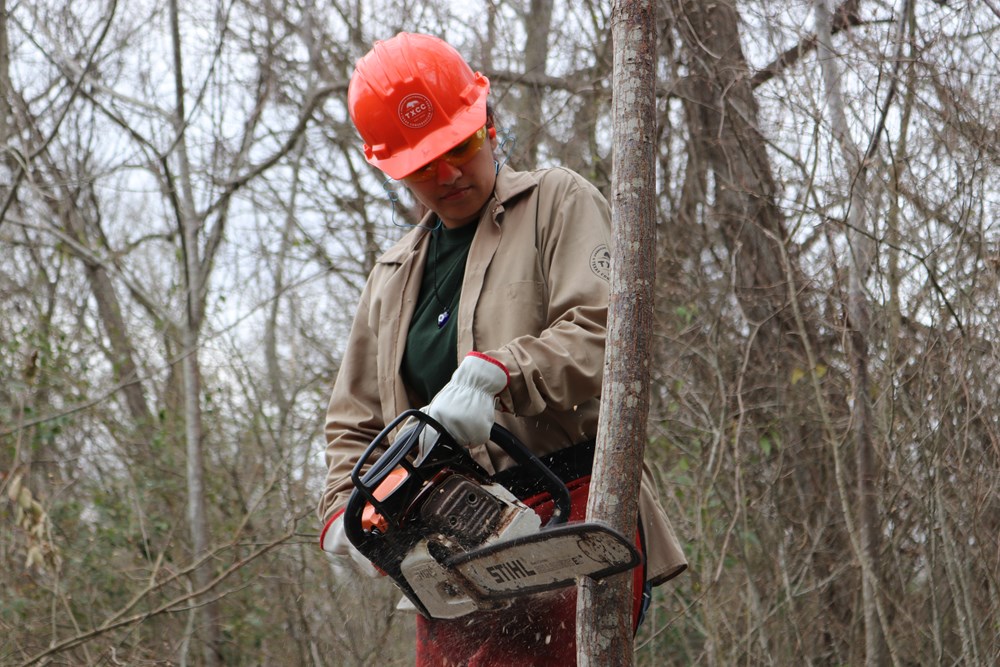
Kickback is a reason to know where the entire guide bar is, including the part you cannot see behind a log. It is not a trick that you can learn to catch by watching a slow-motion video.
If you are new to chainsaws, use this explanation to recognize the hazard and prepare questions for practical training. Do not use it as instruction for plunge cutting, tree felling, or working around storm-loaded branches.
Picture the upper part of the bar nose
The guide bar is the long metal support around which the chain travels. Its rounded far end is the nose, and the upper portion of that rounded end deserves particular attention.
STIHL explains that contact or pinching involving the moving chain near this upper quadrant can produce a rotational reaction that throws the bar upward and back. The movement can be fast and uncontrolled, with severe or fatal consequences.
The important relationship is between the moving chain, the point of contact, and the direction of the reaction. A small contact area does not mean a small hazard, and the object need not be the piece of wood you intended to cut.

Imagine a low branch hidden behind the end of a log. You may be looking closely at the near side while the bar nose approaches a different object on the far side, outside the part of the scene receiving your attention.
Visibility is part of your decision
Before any cutting task under instruction, identify where the nose would be throughout the work. If you cannot see or account for the objects near it, that uncertainty is part of the job assessment.
Do not assume open space on your side of a log means open space behind it. Branch stubs, a second log, a fence, and miscellaneous debris can change the scene beyond your immediate line of sight.
A pile of loose branches is especially poor material for guessing. Several pieces may overlap, conceal one another, or move when another part shifts.
Stopping to reassess does not mean reaching around the wood with a running saw or repositioning unstable pieces by hand. Shut down and follow your training and the manual's isolation and movement precautions before approaching an uncertain setup.
A chain brake is a protective feature with limits
STIHL describes its Quickstop system as reducing injury risk in certain kickback situations. The manufacturer also warns that no chain brake eliminates every kickback injury risk.
That distinction matters because stopping chain rotation and preventing the saw from moving are different outcomes. A brake should never be treated as permission to intentionally contact the hazard zone.

Swipe sideways to inspect the diagram, or focus it and use the arrow keys.
Read the model's description of its braking system rather than assuming every saw has identical controls or activation behavior. A feature described for one model may not exist on the machine you borrowed.
If a safety feature fails its prescribed check, take the saw out of use and arrange qualified service. Do not disable the brake, defeat a lockout, or keep working because the remaining cuts look easy.
Reduced kickback does not mean no kickback
Manufacturers can specify reduced-kickback bars and low-kickback chains for particular combinations. Those terms describe risk-reduction characteristics, not a safe contact zone you can deliberately use.
Check the approved powerhead, bar, and chain combination in your manual and with the dealer. Similar overall length or a chain that turns around the bar is not enough to establish compatibility.
A replacement package can look attractive because it promises faster cutting or a more aggressive chain style. That change deserves more scrutiny, not less, when your original equipment was chosen for a homeowner saw.
If the packaging language or color coding is unfamiliar, ask the manufacturer or dealer to identify it. Do not infer that a professional product is a better beginner choice simply because it costs more.
Condition changes the problem
STIHL's FAQ lists several factors that influence kickback, including chain speed, contact conditions, and chain condition. This is one reason a tidy drawing cannot predict what a particular real-world contact will do.
Use the manual's maintenance requirements and approved service procedures. A chain with damage, uncertain sharpening, or unexplained behavior should prompt a stopped-machine inspection or qualified service rather than an experiment in the yard.
Avoid a mental bargain in which fresh sharpening cancels poor visibility or protective equipment cancels unsuitable work. Those are separate considerations, and a weakness in one remains a reason to reconsider the task.
For example, replacing a worn chain does not make a brush pile orderly. It fixes a component issue only if the replacement and installation are correct; the tangle still needs its own competent assessment.
Keep your planning at ground level
If a job would require a ladder, climbing, overreaching, or holding a saw in an unfamiliar position, choose qualified professional help. Trying to gain a few inches of reach can remove the stable working position your training depends on.
Do not use a smaller saw as a workaround for overhead work. The reduced size of a tool does not remove a moving-chain hazard or make an unsupported position suitable.
Consider a branch caught above a garden gate. From below it may look like a single convenient cut, but reaching it and predicting its movement are separate problems that a photo cannot solve.
An arborist or trained tree crew can assess access, surrounding hazards, and the sequence of work. Your useful contribution is keeping people away and explaining the problem from a safe location.
Do not practice the hazard to understand it
You should not intentionally touch the bar nose to wood, test a brake by creating kickback, or stage an operating demonstration for a photograph. The consequence of a failed experiment can be immediate.
For learning, use a stopped and correctly isolated machine with an instructor and a diagram. You can identify the bar nose, discuss hidden contact, and ask about approved features without recreating the event.
Likewise, do not copy advanced cuts from a video because the presenter looks relaxed. The camera may omit the assessment, competence, supporting equipment, and failed conditions that determine whether the method is appropriate.
Ask a training provider what practical instruction is suitable for your saw and intended ground-level tasks. A course should help you decide when to decline work as well as how to handle equipment within its scope.
Treat surprising movement as a stop signal
If the saw reacts unexpectedly, shut down when you can do so safely and follow the manual and your training. Do not immediately repeat the same approach to find out whether it happens again.
Write a factual description for the dealer or instructor: what task you were doing, which components were fitted, and what you observed. Avoid turning a guess such as “probably just dull” into a diagnosis.
Keep anyone else from borrowing the machine until an equipment concern is resolved. A note attached to the stored saw is more dependable than assuming everyone heard your explanation at the end of the day.
If someone is injured, contact emergency services and follow your first-aid training and dispatcher instructions. Equipment inspection can wait until people are safe and the scene has been secured.
Make the hazard visible in your own preparation
On your pre-job note, write a plain question: “Where is the bar nose, and what could it contact?” That is more useful than a vague instruction to be careful because it directs your attention to a specific physical relationship.
Discuss that question with your instructor using the actual kind of work you plan to do. A supported, accessible piece of wood and a storm-tangled tree require very different assessments, even when the same saw appears in both scenes.
Review the correct manual whenever components or tasks change. Familiarity with yesterday's setup should not become a reason to overlook today's hidden branch, different bar, or unfamiliar machine.
The goal is to reduce the chance of encountering the hazard and recognize when the work exceeds your competence. Understanding kickback should make your stop decisions clearer, not make you more willing to see what the bar nose can get away with.