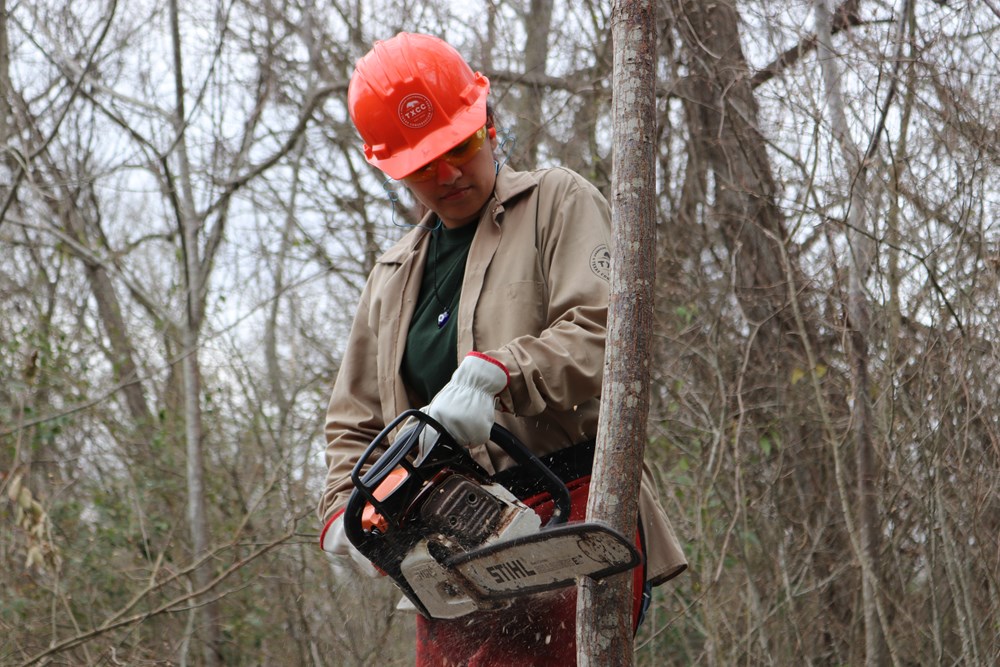
A useful chainsaw PPE check is a repeatable sequence you complete before the machine starts. It should reveal missing, damaged, incompatible, or poorly fitted equipment while you still have time to stop and correct the problem.
Build the check from the exact saw instructions, each protective product's instructions, and appropriate practical training. A complete collection of gear does not make an unsuitable tree or cutting task suitable for homeowner work.
Begin with the task and the person
Confirm that the job is within your competence and can be done under the conditions your training covers. Climbing, ladders, overhead work, utility involvement, and storm-loaded wood require appropriate qualified assessment rather than more confidence in protective clothing.
Consider your own condition before dressing for the task. Fatigue, distraction, impairment, illness, or a movement limitation can make postponing the work the right decision even when the saw and equipment are serviceable.
STIHL's gas-saw safety manual describes safe use in terms of the operator, machine, and use of the saw. Its preparation and protective-clothing sections belong to that wider decision about whether the person and equipment are ready for the task.

Write your stop conditions at the top of the checklist. That keeps the decision about whether to work ahead of the satisfying routine of fastening straps and checking boxes.
Lay out the complete equipment set
Use a clean, well-lit space to identify the head, eye, face, hearing, hand, leg, and foot protection required for your task and saw. Keep the machine stopped and safely isolated while you dress and adjust equipment.
A consistent layout makes omissions easier to see. If a necessary item is missing from its usual position, resolve that absence rather than mentally promising to find it once you reach the work area.
Keep product identities and instructions available for unfamiliar or borrowed items. A helmet shell, pair of earmuffs, and visor do not automatically form an approved system because they can be attached together.
Avoid building the set from whatever is nearest the shed door. Each item needs the right function, condition, fit, and compatibility, which can take a little preparation before a short job.
Inspect head protection and its components
Follow the helmet maker's inspection and replacement guidance for the shell, suspension, adjustment system, and any mounted accessories. Cracks, damaged parts, an impact event, or an unreadable service history may require professional advice or replacement.
Do not invent a universal retirement date for every helmet. Use the actual manufacturer's instructions and the product's history, including storage and exposure conditions where those matter.

Swipe sideways to inspect the diagram, or focus it and use the arrow keys.
Adjust the helmet as instructed while wearing the other head equipment. It should remain in its intended position without improvised padding, drilling, or modified mounts.
If the system will not fit correctly, stop the preparation and resolve it. A helmet repeatedly slipping forward can affect vision and become a distraction as well as a protection problem.
Check eye and face protection separately
Confirm what the saw and protective-equipment instructions require for eyes and face. A mesh screen should not automatically be treated as a substitute for suitable safety glasses or goggles where both are specified.
Inspect lenses, frames, straps, screens, and hinges for damage or interference. Poor visibility through a scratched or contaminated surface deserves correction before you approach the work.
Try the complete arrangement with your prescription glasses if you use them. A protector that fits comfortably without glasses may sit differently once the actual everyday equipment is included.
Do not work around fogging or poor visibility by lifting protection during exposure. Find an appropriate compatible solution while the machine is safely stopped.
Fit hearing protection with the helmet and glasses
Inspect and fit the exact earmuffs or earplugs according to their instructions. Consider whether glasses, helmet attachments, hair, or other equipment prevent the intended fit.
Keep the noise assessment and protection requirements for your actual saw in mind. A quieter-sounding battery machine should not lead you to ignore its stated hearing-protection instructions.
Agree how another person can contact you from a safe location before work starts. Do not rely on hearing a shouted sentence through noise and protection, or remove the protection during operation simply to improve conversation.
If your fit is uncertain or use is frequent, obtain appropriate hearing-conservation advice and fit testing. A large package rating cannot confirm the reduction achieved on your head.
Check gloves and clothing for control and entanglement
Use the gloves and clothing specified for the task, with the fit and material required by the relevant instructions. Inspect for damage, contamination, and anything that interferes with intended handling.
Secure loose straps, clothing ends, jewelry, and hair so they cannot create an entanglement concern. Avoid turning a comfortable loose layer into a hazard by leaving it uncontrolled near operating equipment.
Check movement without holding a running saw. You should be able to make ordinary movements appropriate to the task without a cuff catching, a glove slipping, or clothing restricting your reach into an awkward position.
Do not assume a garment's heavy appearance proves cut resistance. Ordinary workwear and purpose-designed chainsaw protective apparel make different claims and should be identified accordingly.
Inspect leg protection and its fit over footwear
Read the exact garment's label, including coverage, measurement method, power-source limitations, cleaning, and retirement rules. Check its condition and secure it according to the manufacturer.
Make sure the lower coverage and boot relationship follow the garment instructions without creating a trip hazard. Your usual jeans inseam may not be the measurement used to sell the chaps.
If a protective area was contacted or damaged, use the manufacturer's required response rather than patching it and assuming the original performance remains. Keep retired equipment clearly separated from usable items.
Remember that protective fibers can have different limitations with electric and gas machines. Resolve an unclear saw-and-garment combination with the manufacturer or qualified dealer before using it.
Check boots and the ground as a pair
Inspect the required footwear for condition, fastening, traction, and the protection specified for your task. Fit it with the leg protection rather than evaluating the boots alone.
Then assess the actual ground: loose rolling wood, wet surfaces, holes, slopes, and clutter can defeat a good footwear choice. Protective boots do not turn an unstable pile into a reliable standing place.
If the job requires reaching from unsuitable footing, change the plan or arrange qualified help. The answer is not to tighten a boot lace and accept a position outside your training.
Repeat the ground check as material accumulates during work. PPE remains one part of a changing environment, so a suitable setup at the start does not excuse ignoring later clutter.
Keep replacement consumables and spare components identified by the exact protective product they serve. A cushion, strap, or suspension that appears to fit another item should not be treated as an approved substitute merely because it makes the equipment feel usable again.
If a required part is unavailable, record that as a failed check and postpone use until the proper solution is established. The checklist should expose this kind of gap instead of concealing it beneath a general note that all the gear is present.
End the check with a clear go-or-stop decision
A useful checklist records a failed item as a reason to postpone, repair, replace, or ask for help. It should not become a ceremony in which every box is ticked because the saw is already outside.
Keep a separate list of service needs and equipment questions. That lets you distinguish a completed check from an unresolved concern that someone intends to address later.
Before starting, confirm the complete fit, suitable task, clear work area, communication plan, and relevant machine checks. Revisit them after a break, equipment change, or significant change in conditions.
The repeatable part is the order of your attention, not a promise that every session ends with cutting. A check that leads you to put the saw away has worked when the equipment, person, or job is not ready.