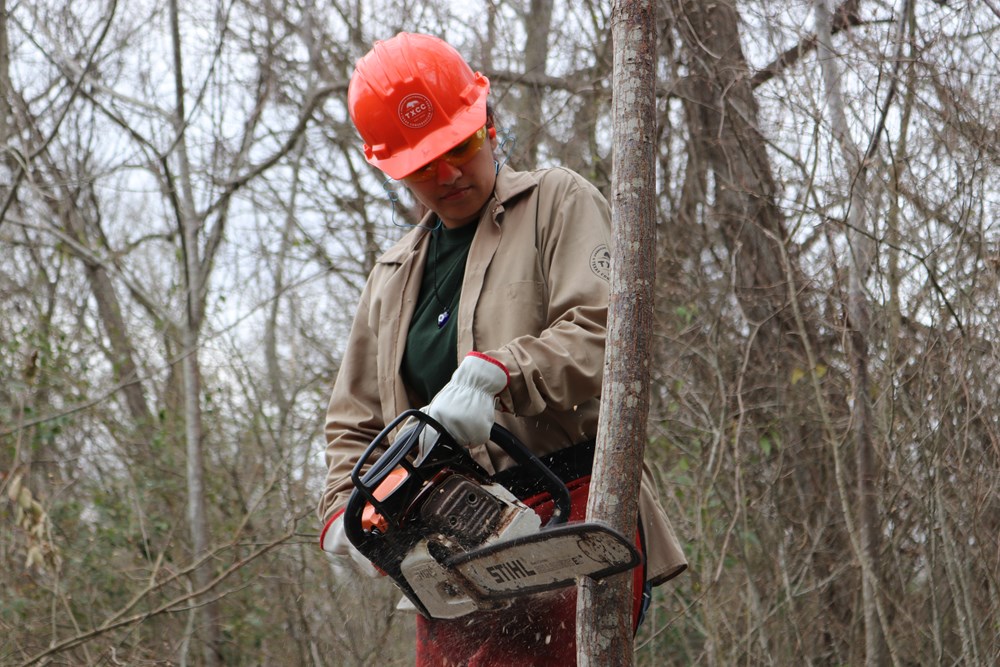
The best battery chainsaw for an occasional yard task depends on a suitable job, your training, and an exact kit you can support. A larger voltage number or longer bar does not establish that a saw is safer, faster, or appropriate for a damaged tree.
This documentation-based shortlist compares the DEWALT DCCS621P1 twelve-inch kit and EGO CS1611 sixteen-inch kit. We have not measured cutting speed, runtime, balance, battery endurance, noise, or performance against a gas saw.
Start by deciding whether a chainsaw belongs in the plan
Identify the actual ground-level task and whether your practical training covers the wood and conditions. A simple branch description can conceal unstable support, tension, utility involvement, or access that needs a qualified professional.
Choose professional help for work beyond your competence, including climbing, ladders, overhead tasks, and storm-loaded wood. Buying a cordless machine does not make those hazards disappear.
For some small tasks, a suitable hand tool or a service appointment may be a better answer. The purpose of a shortlist is to help you choose only after the task itself makes sense.

Keep required protective equipment, bar-and-chain oil, maintenance, and secure storage in the budget. A battery kit can include energy equipment without including everything necessary for safe preparation and use.
DEWALT DCCS621P1: the exact twelve-inch kit

DEWALT's official page identifies DCCS621P1 as a 20V MAX twelve-inch brushless chainsaw kit. Its listed contents include the DCCS621 saw, DCB205 battery, chain-tensioning tool, and bar sheath; the linked DCB205 is a 5Ah pack.
The inspected Amazon listing additionally states that a charger is included, while the official page's Includes list does not name it. The exact charger model remains unverified here, so confirm the current retailer package and compatible charging equipment before ordering.
Consider this kit when the exact manual, suitable task, and your handling assessment support the twelve-inch configuration and the documented battery platform fits your equipment plan. An existing compatible platform can matter, but verify actual battery and charger approval rather than assuming every same-brand pack is permitted.
Do not transfer the older DCCS620's features to this DCCS621 kit. In particular, the supplied tensioning tool should keep you from casually repeating a tool-free adjustment claim from another model's review.
This kit is less convenient if the unresolved charger identification prevents you from establishing a complete compatible setup. Ask the seller and manufacturer for that detail instead of treating the word kit as proof of a specific charger.
EGO CS1611: the exact 2.5Ah sixteen-inch configuration

Swipe sideways to inspect the diagram, or focus it and use the arrow keys.
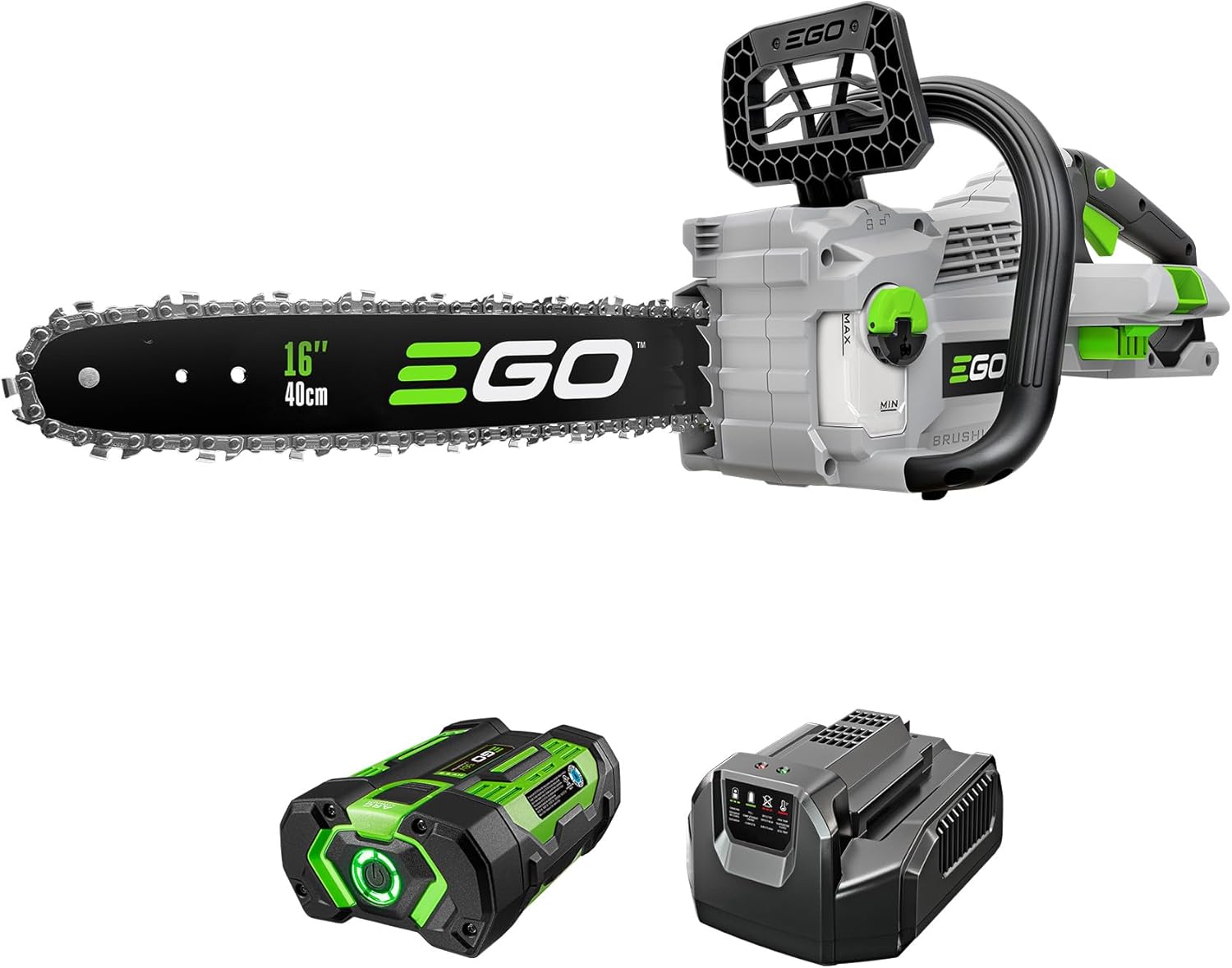
EGO's official product page identifies CS1611 as the sixteen-inch saw with a 56V 2.5Ah battery and standard charger. This is a different package from the CS1610 bare tool or CS1613 kit with a different battery capacity.
The manufacturer describes separate tool-free tensioning controls and automatic chain oiling. Those features still require the correct manual procedure and specified oil; automatic oiling does not mean a reservoir that fills or checks itself.
The official FAQ says bar-and-chain oil is not included. Add the appropriate product and read the filling and lubrication-check instructions before expecting a delivered box to be ready for work.
Consider CS1611 when the sixteen-inch approved configuration suits your actual appropriate task, the complete setup fits your handling needs, and you want this exact documented battery-and-charger package. We do not infer a runtime advantage from its voltage or compare its amp-hour number directly with the DEWALT pack.
This is a poor choice if you are selecting a longer bar to reach an overhead branch or handle a tree beyond your training. A different tool size is not a workaround for unsuitable access or unstable wood.
Compare complete kits rather than battery numbers
| Exact kit | Documented configuration | Limit to resolve |
|---|---|---|
| DEWALT DCCS621P1 | 12-inch saw; DCB205 5Ah pack; tensioning tool and sheath | Amazon says charger included; exact charger model unverified |
| EGO CS1611 | 16-inch saw;56V 2.5Ah pack and standard charger | Bar-and-chain oil not included; no tested runtime comparison |
Voltage labels and amp-hour ratings describe parts of electrical systems, but neither alone provides a cross-brand cutting-performance comparison. The motor, battery platform, chain, bar, conditions, and task all affect the experience.
Do not compare 5Ah on one voltage platform with 2.5Ah on another and declare that the first lasts twice as long. We have no matched runtime test to support that conclusion.
Similarly, advertised equivalent-engine or cut-count claims depend on the maker's stated conditions. Treat them as manufacturer claims rather than results measured by this site, and avoid combining different test scenarios into a ranking.
The more useful comparison is whether each exact kit supports the task and routine you can explain. Include charging, approved replacement parts, service access, and storage conditions in that decision.
Assess handling with the actual battery and protection
If possible, evaluate the stopped, safely isolated equipment through an appropriate retailer or dealer. The fitted battery, bar, and your required gloves and clothing contribute to how the complete assembly feels.
Do not judge handling only from a bare-tool photograph or an unspecified weight. A weight can exclude the battery or cutting attachment, making two apparently precise numbers incomparable.
If you cannot maintain an appropriate position without overreaching or fatigue, the proposed tool-and-task combination needs reconsideration. A battery saw's quieter starting behavior should not encourage casual one-handed handling.
Arrange practical instruction for the actual kind of ground-level work you intend. A written product comparison cannot watch your grip, assess the wood, or correct an unsafe position.
Plan maintenance and charging before the first cut
Read the exact saw manual for approved cutting attachments, tension, lubrication, isolation, and checks. Keep the separate battery and charger instructions with it rather than assuming the saw booklet covers every storage and temperature detail.
Use only approved batteries and charging equipment. A pack that physically attaches is not enough evidence of compatibility, and an adapter introduces another approval question rather than eliminating one.
Follow the specific charging location and temperature requirements and inspect equipment for damage. Do not use a cracked, swollen, leaking, or abnormally heating pack as part of an ordinary runtime experiment.
Keep batteries protected from conductive loose items during storage and transport, as their instructions require. A tool bag filled with metal fasteners is not automatically an appropriate place for an unprotected spare pack.
Know when neither shortlisted kit fits
Choose neither if the job needs professional tree work, the complete equipment does not suit your handling, or you cannot establish the approved battery-and-charger combination. A sale price does not resolve those conditions.
Choose neither as a replacement for necessary maintenance on equipment you already own without first identifying the actual problem. Sometimes a correctly serviced existing saw or a smaller appropriate hand tool serves the task better.
If you expect extended work that depends on unverified runtime, do not promise yourself that one kit battery will finish it. Plan from manufacturer documentation and suitable practical experience without turning an advertised cut count into a guarantee.
For occasional use, a clear storage and service plan matters as much as convenient starting. Equipment left unused for months still needs inspection and the specified preparation before it returns to work.
If you already own a battery platform, write down the actual approved pack and charger models before valuing that advantage. Shared branding is not the same as documented compatibility, and a spare pack with a different capacity can change the complete handling arrangement you intended to assess.
Keep the kit selection and the task assessment as separate notes. The convenience of an existing charger should not become the deciding argument for a saw whose approved configuration or handling does not suit the work.
Verify the selected package at checkout and delivery
Compare the full model number, battery identity, charger information, supplied cover, and current seller terms. The Amazon links are affiliate purchase links, and the site may earn from qualifying purchases.
For DEWALT, keep the charger-model question open until you obtain an exact answer. For EGO, confirm CS1611 and its 2.5Ah configuration rather than a grouped listing's bare tool or another battery kit.
Inspect the actual delivery and read its instructions before assembly or use. If the package differs from the verified offer, resolve the discrepancy instead of borrowing another model's manual to make the contents seem complete.
A useful battery-saw purchase connects an appropriate task with an identified, supportable system. The final choice should be one whose limitations you understand before the trigger is touched.