Answer: If you need reliable tire inflation and air suspension in demanding work environments, these work truck air compressors deliver fast inflations, durable construction, and convenient monitoring. They’re best for fleet maintenance pros, off-road technicians, and mobile service teams who require portable power and clear pressure readouts. This guide highlights five top options and explains who they’re best for, with practical buying tips and a quick comparison table for easy decision-making.
| Product | Best For | Key Benefit |
|---|---|---|
| VEVOR 12V Heavy Duty Air Compressor | Fleet drivers, off-roaders | Large 6L tank for steady pressure |
| GSPSCN 12V Heavy Duty | Professional mechanics | Double cylinders for rapid inflation |
| VIAIR 88P | Off-road enthusiasts | Compact yet capable with 120 PSI |
| UUP Tire Inflator | High-speed inflations | Double cylinders, fast 70L/min |
| RETRUE Onboard Air | Truck airbag suspension users | In‑cab control for airbags |
VEVOR 12V Heavy Duty Air Compressor

The VEVOR model combines a 6L tank with a 150 PSI maximum and 6.35 CFM airflow. It maintains pressure without pulsation, allowing faster tire inflation for trucks, cars, SUVs, and RVs. Digital pressure readout enables real-time monitoring, reducing guesswork during inflations.
Best for: Commercial fleets or off-road work crews needing steady pressure and visible readouts. The built‑in tank helps maintain pressure during longer inflation tasks.
Why selected: A balanced package of storage capacity and high airflow makes it versatile for multiple vehicle types and recreational gear.
Caution: Higher power draw requires a robust 12V supply; ensure wiring and circuit protection are adequate to avoid voltage drop during peak inflations.
GSPSCN 12V Heavy Duty Tire Inflator

The GSPSCN unit uses a dual‑cylinder direct drive design for rapid inflation, delivering up to 150 PSI and about 70 L/min. With long cords and hoses, it supports most standard vehicles and additional gear, from trucks to RVs and bikes.
Best for: Techs who need fast inflations across a wide range of vehicles with longer reach cables and hoses.
Why selected: The two-cylinder arrangement provides noticeably faster inflation than single‑cylinder models, which is advantageous on fleet runs.
Caution: The system can be louder and may require more frequent cooling on heavy, prolonged use.
VIAIR 88P Portable Compressor Kit

The VIAIR 88P offers 120 PSI and is designed for on‑the‑go performance. It includes a long hose and gauge, plus a compact case for storage. It’s suitable for cars, trucks, SUVs, and bikes, making it a versatile option for road trips and remote work sites.
Best for: Off-roaders and service crews needing a portable, all‑in‑one solution with an integrated gauge.
Why selected: Ultra-compact, easy to stash in a vehicle, and ready for inflating tires and lightweight inflatables on the go.
Caution: Might be less powerful for very large tires or ultra‑high PSI tasks compared to bulkier compressors.
UUP Tire Inflator Air Compressor

The UUP model features dual cylinders and a maximum 150 PSI with 70 L/min airflow. It inflates a typical 200/70/R18 tire from 0 to 40 PSI in about three minutes, making it a fast alternative for trucks and SUVs.
Best for: High‑speed inflations where time matters, such as commercial fleets and on‑site service vehicles.
Why selected: Efficiency is boosted by dual cylinders and a simple user experience, reducing operator effort during frequent inflations.
Caution: Noise and heat management are considerations during extended use; provide adequate ventilation and cooling when running for long periods.
RETRUE Onboard Air Compressor System
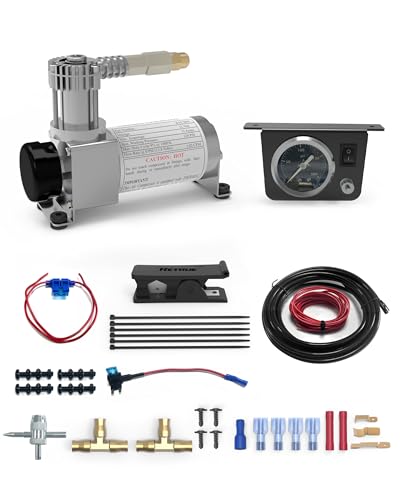
The RETRUE onboard system is designed for truck airbag suspension inflation, with fast inflation up to 100 PSI. It supports in‑cab control for quick and safe pressure adjustments and is ideal for maintaining ride height on varying loads.
Best for: Truck owners using airbag suspensions who want direct, in‑cab control and timely inflation responses.
Why selected: In‑cab operation reduces wheel incidents and over‑inflation risk, offering a safer, streamlined workflow for suspension adjustments.
Caution: This is a specialized system; ensure compatibility with your vehicle’s suspension setup and confirm wiring and fittings before installation.
Buying Guide
Key purchase considerations help match a compressor to your work truck needs. Consider vehicle type, application scope, and installation ease to pick the best option.
- Power and compatibility: Check your vehicle’s electrical system (12V DC) and whether the compressor’s draw fits your wiring and fusing. Higher CFM helps with faster inflations but may require heavier wiring.
- Tank vs. tankless design: A built-in tank sustains pressure for continuous inflation. Tankless units are lighter and more portable but may require more active running time to reach target pressure.
- Portability vs. onboard: Portable units are ideal for fleets without permanent mounting. Onboard systems are best for dedicated vehicles with fixed suspension or frequent tire work.
- Reach and accessories: Long hoses and multiple nozzles increase versatility for cars, trucks, RVs, bikes, and sports equipment. Ensure included adapters cover your common needs.
- Noise and durability: Look for lower noise levels in enclosed workspaces and robust housings for job-site durability. Heavy‑duty builds tend to last longer in harsh environments.
- Pressure range and stability: A higher max PSI helps with larger tires, but stability and pulsation control improve inflation accuracy and tire life.
Frequently Asked Questions
- What is a good PSI range for truck tires on the road?
- Is a built-in storage tank worth it?
- Do I need dual cylinders?
- Can I use these with air suspension systems?
- What maintenance is required for these compressors?
- Are portable inflators suitable for farm or construction use?
Most light trucks run 30–35 PSI for everyday driving; off‑road or heavy loads may require higher pressures per manufacturer guidance. A compressor with up to 150 PSI provides flexibility for multiple tire sizes.
Yes, a built-in tank maintains pressure during inflation and reduces compressor cycling, which can shorten motor life and create heat buildup.
Dual cylinders inflate faster and are beneficial for fleets performing frequent inflations. They can be louder and more complex than single‑cylinder models.
Some models are designed for airbag suspensions with in‑cab control. Verify compatibility with your system and any installation requirements before purchase.
Regular inspection of hoses and fittings, checking for leaks, and ensuring the unit remains free of debris helps maintain performance. Follow the manufacturer’s maintenance recommendations.
Yes, for smaller tires and field tasks. For heavy equipment tires or continuous, high‑duty inflation, a higher‑duty, professional system is typically preferred.