Choosing the right torque wrench for mountain bikes (MTB) helps protect components and ensure safe, reliable rides. This guide highlights five top options ideal for MTB enthusiasts, delivering accurate torque, durable build, and clear adjustment feedback. Each product suits different rider needs—beginner wrenchers, service-focused riders, and professional DIYers. The included buyer table compares ranges, accuracy, and best-use scenarios to simplify decisions.
| Product | Torque Range | Best For | Notable Benefit |
|---|---|---|---|
| YIYEIE Master Bike Torque Wrench Set | 10-230 lbf.in (1-26.0 Nm) | All-around MTB owners needing a complete kit | Micro-adjustment and calibration certificate |
| LEXIVON 15-Piece Torque Wrench Kit | 2-26 Nm (17.7-230.1 in-lb) | Detailed precision and frequent bit swaps | 72-tooth ratchet, dual-direction |
| INGJER Torque Wrench (1/4″) | 20-240 in.lb (2.25-27.1 Nm) | Professionals and DIYers needing solid Cr-V build | Audible click plus haptic feedback |
| Matework 50Pcs Inch Pound Kit | 10-220 in.lb (1.0-24.7 Nm) | MTB maintenance with extensive bit selection | Comprehensive set with case and certificates |
| Park Tool TW-6.2 Ratcheting Wrench | 10-60 Nm | Frequent torque setting changes on MTB components | Ratcheting 3/8″ drive and dial adjust |
These selections balance range, accuracy, and ease of use. Each entry includes a detailed feature set and practical notes to help you pick the best tool for your MTB maintenance routine.
YIYEIE Master Bike Torque Wrench Set

The YIYEIE kit provides a 1/4″ drive torque wrench with a broad 10-230 lbf.in (1-26.0 Nm) range and a 0.1 Nm micro-adjustment. It includes a comprehensive set of bit sockets (HEX, Torx, 6-point, Pozi, Phillips, Slotted, and Robertson) plus adapters and a 4-inch extension. It delivers a precise click-stop system and includes a calibration certificate with a traceable serial number. This setup is best for riders who want a complete, transport-ready tool kit for MTB components and frequent bolt work. A potential limitation is the subtle click at lower torque values, so careful listening or a tactile confirmation is recommended.
LEXIVON Bike Torque Wrench Kit

The LEXIVON 15-Piece kit covers 2-26 Nm (17.7-230.1 in-lb) with micro-adjustments to 0.2 Nm and a 72-tooth gear drive for smooth, precise tightening. It includes a wide range of hex and Torx bit sockets, a 3-inch extension, and a 1/4″ adapter. This tool is ideal for riders who need accurate, bidirectional torque readings and quick socket changes. It ships pre-calibrated with a calibration certificate, supporting consistent performance. Limitation: some users may find the pre-set range slightly narrow if frequently working near the extremes of MTB hardware.
INGJER UPGRADE 1/4 Torque Wrench
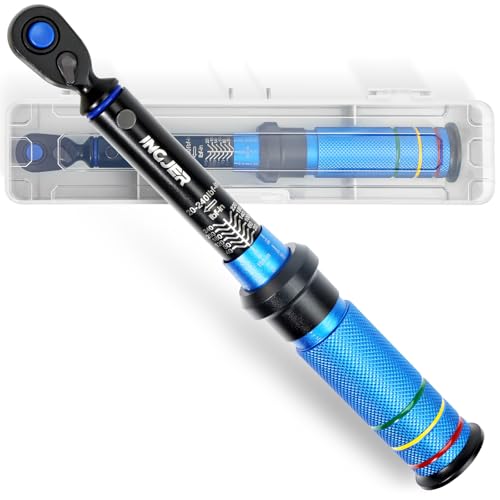
The INGJER model offers a 20-240 in.lb (2.25-27.1 Nm) range with dual-direction operation and durable Cr-V construction. It uses audible click and haptic feedback for torque confirmation, helping when wearing gloves or in less-than-ideal lighting. This wrench is well-suited for experienced riders who want reliable signaling and robust build for regular MTB maintenance. A caution: ensure proper calibration checks since the data notes standard ±3% accuracy, which may vary with heavy use or temperature changes.
Matework 50Pcs Inch Pound Kit
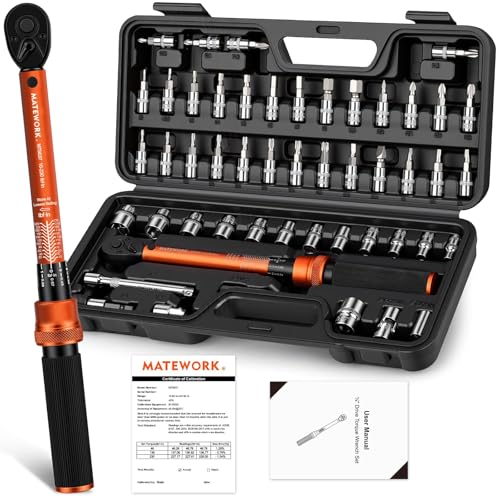
The Matework 50PCS set includes a 1/4″ drive torque wrench, extensive bit sockets (Hex, Torx, Philips, Slotted, Pozi, Robertson, 6-Point) plus multiple adapters and a 4″ extension. It has a dual-range scale of 10-220 IN.LB (1-24.7 Nm) with micro-adjustment and a calibration certificate. It is best for riders who want heavy bit variety and a protective case for transport. A limitation is that the click could be subtler at very low torque values, requiring attentiveness to audible cues.
Park Tool TW-6.2 Ratcheting Torque Wrench
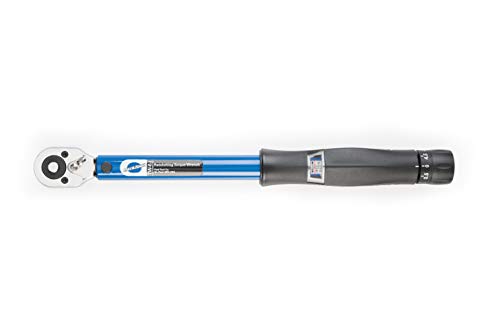
The Park Tool TW-6.2 offers a 10-60 Nm range with a dial-adjust, pre-set torque system and a 3/8″ drive. The ratcheting mechanism supports fast, repeated torqueing across MTB parts, and it ships with a direct, easy-to-read scale. It’s best for riders who routinely work on multiple MTB components and require quick changes. Limitation: this model may be heavier and bulkier than ultra-compact travel options, making it less ideal for tight trail-side adjustments.
Park Tool TW-5.2 2–14 Nm Torque Wrench
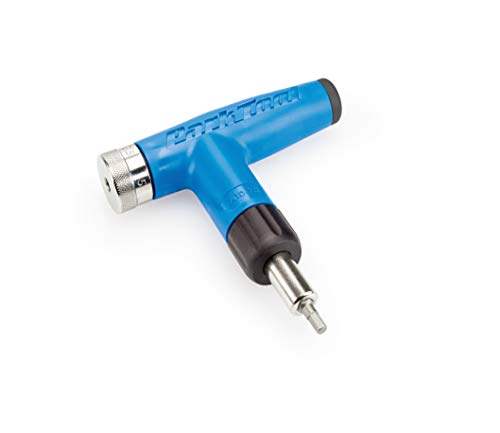
The TW-5.2 provides a smaller 2–14 Nm range with a 3/8″ drive and a quick-release mechanism for secure socket changes. This model is ideal for light MTB components and frequent, small-torque adjustments. It is best for riders who do precise work on hubs, seat clamps, and other components that require lower torque settings. A potential caveat is the narrower torque window compared with higher-range models, which may require a separate tool for larger fasteners.
Buying Guide: Key Considerations For MTB Torque Wrenches
- Torque Range: Match the tool to your typical MTB maintenance tasks. Higher-range wrenches cover crank bolts and stems, while lower ranges handle derailleur and brake components.
- Measurement Units: Some wrenches read in Nm, others in in-lb or lbf-in. Choose a unit system you consistently use to avoid errors.
- Drive Size and Bit Compatibility: Most MTB work uses 1/4″ drives with broad bit sets. Ensure the included bits cover your common fasteners (Hex, Torx, Phillips, Slotted, Pozi, Robertson).
- Click vs Digital: Click-stop wrenches provide simple feedback. Some offer digital readouts or haptic cues; prefer what you find most reliable in varied conditions.
- Calibration and Certification: Calibrated tools with traceable certificates help ensure ongoing accuracy; consider regular re-calibration as part of maintenance routines.
- Portability and Case: A protective case helps keep bits organized and tools portable for trail-side use or travel to a shop.
- Durability: Look for Cr-V or alloy steel constructions for long life; consider corrosion resistance if you ride in wet or humid environments.
FAQ
- Q: Do I need a torque wrench for MTB maintenance?
- A: Yes. It helps prevent over-tightening and component damage, and ensures consistent torque across critical fasteners.
- Q: What torque ranges are common for MTB components?
- A: Typical ranges vary by component; lower ranges (2-14 Nm) cover many small bolts, while higher ranges (10-60 Nm) suit crank bolts and stems.
- Q: How often should I calibrate a torque wrench?
- A: Follow the manufacturer’s guidance, but many riders calibrate annually or after heavy use or accidental drops.
- Q: Should I choose a kit with many bits or a focused set?
- A: A broad bit set offers versatility for MTB maintenance; a focused set is simpler for routine tasks.
- Q: Is a digital torque wrench better than a click-type?
- A: Digital wrenches provide precise numeric readouts, but click-type wrenches are simple, reliable, and easy to use in any lighting.