The right sliding miter saw blade can dramatically improve finish quality on both softwood and hardwood. This guide highlights top blades designed for sliding compound and radial arm saws, focusing on negative hook angles, thin kerf designs, and premium carbide blends to maximize control, speed, and edge retention. Each blade below is evaluated for crosscut performance, durability, and ease of use in common American workshop setups.
| Product | Brand | Size | Teeth | Key Benefit |
|---|---|---|---|---|
| Freud LU91R012 | Freud | 12″ | 72 | Premium TiCo carbide, negative hook angle, thin kerf |
| Oshlun SBW-120072N | OSHLUN | 12″ | 72 | Thin kerf, negative hook, finishing-grade carbide |
| Echo Corner 10″ | Echo Corner | 10″ | 80 | Negative hook for controlled finish cuts |
| Freud LU91R010 | Freud | 10″ | 60 | ATB grind, negative hook, crosscut efficiency |
| CMT 253.060.10 ITK | CMT ORANGE TOOLS | 10″ | 60 | Glass-smooth finish, ATB + ITK grind |
Freud Thin Kerf Sliding Compound Blade LU91R012
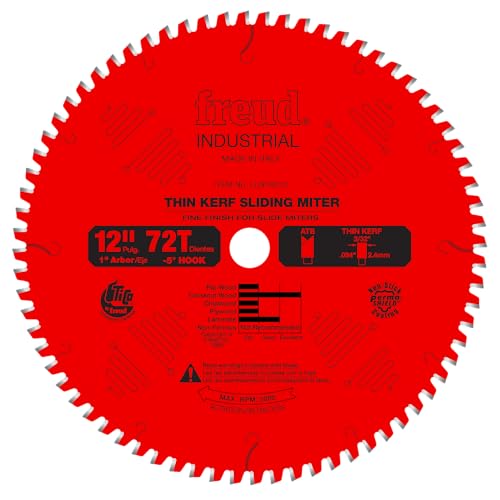
The Freud LU91R012 is a 12-inch blade featuring a 72-toothATB grind and a premium TiCo carbide blend. The blade uses a 5-degree negative hook angle to reduce climbing and provide smoother piece feeding during crosscuts. Its thin kerf design minimizes material waste and reduces horsepower requirements, making it suitable for labor-saving cuts on dense hardwoods as well as softwoods. The high-density carbide blend ensures edge retention under repeated crosscuts, delivering consistent finishes across multiple workpieces.
Oshlun SBW-120072N 12-Inch Blade

The Oshlun SBW-120072N is a 12-inch, 72-tooth blade designed for sliding miter and radial arm saws. Its thin kerf reduces material waste and lowers power demands, while a negative hook angle provides better control when finishing crosscuts. Precision-ground carbide tips enhance edge durability and provide a refined finish on fine workpieces. This blade is well-suited for cabinetry, trim, and fine carpentry where clean faces are essential.
Echo Corner 10-Inch Fine Finish Blade

The Echo Corner blade is optimized for fine finish sliding compound and radial arm saw cuts. It features an 80-tooth configuration and a negative hook angle, which reduces surface chipping and improves crosscut stability. Its counter-rotation tooth arrangement helps prevent tear-out, yielding glass-smooth faces on hardwoods, plywood, and laminates. This blade emphasizes precise, controlled cuts ideal for cabinetry and molding projects.
Freud LU91R010: 10-Inch Thin Kerf Blade

The Freud LU91R010 offers a 10-inch thin kerf blade with a 60-tooth ATB arrangement and a -5° negative hook angle. The TiCo HI-Density carbide blend emphasizes crosscut performance and durability, while the reduced hook angle helps minimize climbing and enhances control during finishing cuts. A .090 kerf and .071 plate thickness provide a balance of waste reduction and rigidity for stable or small workpieces.
CMT 253.060.10 ITK Industrial Finish Blade

The CMT 253.060.10 ITK blade is designed for fine finish crosscuts on sliding compound miter saws. It features a 10-inch diameter, 60 teeth, and a combination of a 1FTG+2ATB grind with a 5/8-inch bore. The ITK grind and ATB geometry provide a glass-smooth finish on softwoods, hardwoods, plywood, and laminates. This blade is optimized for precise trim work where a near-perfect crosscut face is required.
Buying Guide: Key Purchase Considerations
- Blade size and arbor compatibility: Most sliding miter saws use 10″ or 12″ blades with a 5/8″ arbor; verify your tool’s compatibility before buying.
- Tooth geometry and grind: ATB (Alternate Top Bead) teeth pair with clean crosscuts, while ITK blends emphasize finish quality on various materials. Negative hook angles improve control and reduce blade climb.
- Kerf width: Thin kerf blades require less power and material waste but can be less forgiving on very dense stock. Choose based on your saw’s horsepower and material type.
- Carbide quality: TiCo or C-4 carbide blends offer better edge retention and longer life under repeated crosscuts, especially with hardwoods.
- Finish quality vs. speed: High-tooth blades deliver smoother faces but may cut slower; balance your project needs with blade design.
- Material versatility: Some blades excel on softwoods and laminates, others perform best on hardwoods or plywood—check product notes for recommended materials.
- Noise, vibration, and chatter: A well-balanced blade with a precise grind reduces vibration and improves cut consistency, particularly on a sliding saw where feed stability matters.
When selecting a blade for sliding miter saw work, consider your typical projects—cabinetry, trim, molding, and built-ins—and choose a blade that balances finish quality with cutting speed. The blades listed above offer a range of kerf widths, tooth counts, and grind geometries designed to optimize crosscut performance in common American shop settings.