Choosing the right saw blade for plastic reduces chipping, heat buildup, and rough edges. This guide highlights blades designed to cut plastic cleanly while staying durable for repeated use. The selections below cover various common plastics, from PVC trim to acrylic sheets, and include options for consumer and contractor settings. Each blade emphasizes smooth cuts, low heat generation, and long life.
| Product | Key Benefit | Arbor |
|---|---|---|
| FOXBC 10-Inch 80-Tooth TCG | Low-vibration, precise aluminum and plastic cuts | 5/8″ |
| CRAFTSMAN 7-1/4″ 140T | Fine finish cuts on plastic and plywood blends | Additional data not shown |
| FOXBC 10″ 200-Tooth Contractor | Very fine cuts for plastic paneling and vinyl siding | 5/8″ |
| IVY Classic 35050 Swift Cut 7-1/4″ | Light gauge plastic/cut edges with controlled output | 5/8″ |
| Freud LU94M010 | Plastic-specific blade with heat-dissipating design | 5/8″ |
FOXBC 10-Inch 80-Tooth TCG for Aluminum, Non-Ferrous Metal & Plastic

Overview: This 10-inch miter or table saw blade features 80 teeth and a kerf of 0.094″, designed to cut aluminum, non-ferrous metals, and plastic. It uses a 5/8″ arbor and laser-cut stabilizer vents to trap noise and reduce vibration for improved accuracy and durability. The blade is made from high-density tungsten carbide for toughness and wear resistance, offering long life with consistent performance on plastics and select metals. Ideal for trimming plastic components or cutting plastic-involved metal assemblies in workshops and fabrication settings.
Key considerations:
– Teeth count and kerf balance speed and edge quality; 80 teeth suits finish cuts on plastics with minimal chipping.
– Arbor compatibility ensures easy integration with common saws.
– Tungsten carbide construction improves life when cutting plastics with additives or fillers.
CRAFTSMAN 7-1/4 Inch 140 Tooth Fine Finish Blade

Overview: This 7-1/4 inch blade is tailored for fine finish cuts on plywood, OSB, and plastic. It uses a fully hardened plate to maintain true cuts, precision-ground teeth for accuracy, and heavy-gauge high-carbon steel for extended life. While commonly used for wood-based sheets, its finish-oriented design can yield smoother edges on certain plastic laminates and composite panels when set up correctly, making it a versatile option for workshop tasks that involve plastic components.
Key considerations:
– Fine-tooth design helps reduce splintering on plastics when used with appropriate feed rate.
– Hardened plates maintain alignment for repeated passes.
– Not specialized for all plastics; test on a small sample first.
FOXBC 10 Inch 200-Tooth Contractor Blade for Plastic

Overview: A 10-inch blade built with 200 teeth and a 5/8″ arbor, featuring a 0.1″ kerf. This blade is optimized for fast and smooth cutting of plywood, OSB, plastic panels, and vinyl siding. The high tooth count reduces tear-out and produces clean miters and cross-cuts on plastic materials, making it suitable for high-precision finish work in cabinetry or trim installations that involve plastic components.
Key considerations:
– Very fine kerf supports reduced waste and cleaner edges.
– Multiple bushings (1/2″ and 3/8″) provide some compatibility flexibility when mounting adapters are needed.
– Great for panels and siding where plastic components are common.
IVY Classic 35050 Swift Cut 7-1/4″ 128T Blade

Overview: The IVY Classic Swift Cut blade is designed for cutting light-gauge aluminum, plastic, and vinyl siding up to 1/8″ thick. It uses a high-carbon alloy-steel blade with precision-ground teeth and no set for smooth, accurate cuts. The blade has a 5/8″ diamond knockout arbor and is a practical choice for routes that require consistent results across thin plastics and related materials.
Key considerations:
– Direction arrows must be followed to ensure proper rotation.
– Suitable for light plastics and vinyl siding; test on tougher plastics before committing to larger projects.
– Durable construction supports repeated use in light fabrication tasks.
IVY Classic 35056 Swift Cut 10″ 200T Blade

Overview: This 10-inch blade with 200 teeth is designed for aluminum, plastic, and vinyl siding cutting. It uses a 5/8″ arbor and remains a robust choice for those needing higher tooth density for cleaner plastic edges. The blade emphasizes a high-carbon alloy steel construction for reliable performance and longer life in plastic-cutting scenarios.
Key considerations:
– Higher tooth count supports smoother finish in plastics with minimal chipping.
– Ensure correct rotation and alignment with the arrows.
– Best used on thinner plastic materials and composite panels similar to vinyl siding.
Freud LU94M010: 10″ Plastic Blade
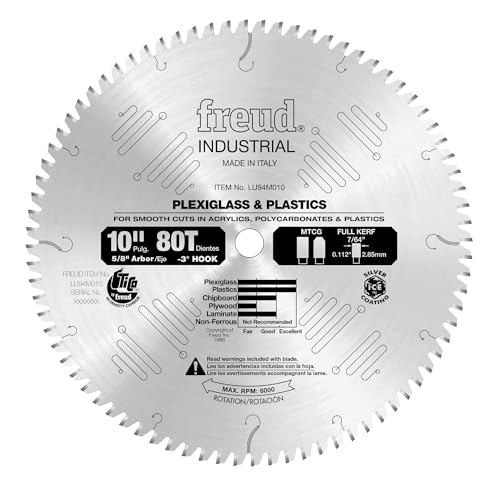
Overview: Freud’s LU94M010 is a 10″ plastic blade with a 5/8″ arbor and a TiCo HI-Density carbide blend. Its Modified Triple Chip Grind (MTCG) tooth design helps keep material cool and reduces melting when cutting plastics. With 80 teeth and a kerf of .110″, this blade aims to deliver controlled cuts, reduced heat, and consistent edge quality on a range of plastic workpieces.
Key considerations:
– TiCo carbide provides hardness and wear resistance for plastics.
– MTCG grind helps manage heat buildup, minimizing melt risk.
– Suitable for a variety of plastic types, including softer plastics and composites.
Buying Guide: Key Purchase Considerations When Selecting Plastic-Cutting Blades
- Material compatibility: Look for blades explicitly labeled for plastic, vinyl, PVC, or non-ferrous metals if you plan to cut mixed materials.
- Tooth design and count: Fine-tooth blades (80-200T) reduce chipping and produce smoother edges on plastics, especially when cutting thin sheets or veneer-faced panels.
- Kerf and finish: A thinner kerf saves material and reduces drag, but ensure your saw can handle the blade width. A refined grind (e.g., MTCG or precision-ground teeth) helps maintain cool temperatures and edge quality.
- Blade rigidity and stability: Stable blades with stabilizer features or laser-cut vents can minimize vibration, improving accuracy on plastic cuts.
- Arbor compatibility: Confirm the blade’s arbor size matches your saw (commonly 5/8″), and consider adapters if needed for compatibility with different models.
- Life and wear: Carbide-tipped blades last longer on plastics, especially when cutting abrasive plastics or recycled composites. Expect longer life with proper feed rate and stabilization.
- Cut quality vs. speed: Higher tooth counts yield finer finishes but can slow down the cut. For packaging, trim work, or cabinetry with plastic components, a balance between speed and finish is ideal.
- Safety and setup: Ensure proper blade direction, guard alignment, and a clean, stabilized cutting environment. Use clamps for thin or flexible plastics to prevent binding.
- Maintenance: Keep blades clean and free of pitch or plastic residue. Lightly deburr edges if required after cuts to prevent splinters or sharp edges.
Overall, selecting a blade with a fine tooth count, carbide construction, and a design geared toward heat management will provide the best results for most plastic cutting tasks. For mixed-material projects, consider owning a couple of blades with different tooth counts to optimize for speed vs. finish on each part.