Radial arm miter saws offer flexibility for crosscuts, bevels, and compound cuts with a dedicated space for larger or longer workpieces. This article identifies five top options that are well-suited for American woodworkers and contractors seeking reliability, accuracy, and ease of use. Each model is evaluated for who it’s best for, with clear pros, drawbacks, and practical buying considerations.
| Product | Best For | Key Benefit |
|---|---|---|
| SKIL 10″ Dual Bevel Sliding Compound Miter Saw MS6305-00 | Budget-conscious DIYers and hobbyists | Powerful motor and dual bevel with precise LED shadow line |
| DEWALT DWS780 12-Inch Double Bevel Sliding Compound Miter Saw | Pro DIYers and small shop setups requiring accuracy | XPS shadow light and robust dust management |
| Metabo HPT C10FCG2 10-Inch Single Bevel Compound Miter Saw | Lightweight, portable projects | Compact design with solid accuracy and ease of use |
| DOVAMAN 12-Inch Dual-Bevel Miter Saw | Ambidextrous operators and versatile cutting | Laser guide and wide cutting capacity |
| BOSCH CM10GD Compact Miter Saw | Compact shop spaces needing precision | Axial-Glide system for accurate, wide cuts |
SKIL 10″ Dual Bevel Sliding Compound Miter Saw MS6305-00

Best for budget-minded DIY projects, this SKIL model uses a powerful 15-amp motor delivering up to 4,800 RPM for fast, clean cuts. The dual bevel provides four positive stop angles at 48° left, 45° left, 0°, 45° right, enabling quick bevel adjustments during framing or molding work. The LED shadow line improves cut accuracy without relying on lasers that may drift over time. This saw is well-suited for hobbyists or small-shop users who need solid performance without premium pricing.
Who it’s best for: hobbyists and entry-level carpenters who want reliable power and straightforward bevel capabilities without breaking the bank. Why selected: strong RPM, reliable dual bevel, and a helpful LED alignment aid for simple accuracy. Caution: users should verify that the long sliding rail supports their typical material length, as extended cuts may require more space than smaller benches provide.
DEWALT DWS780 12-Inch Double Bevel Sliding Compound Miter Saw

Designed for demanding projects, this DEWALT model features a 12-inch double bevel with a robust 3,800 RPM motor. The integrated XPS shadow light system provides precise cutline visibility for accurate crosscuts, while the dust bag helps manage cleanup. It’s well-suited for builders, remodelers, and shop environments where consistent accuracy and visibility matter. Best for: professionals who need dependable accuracy in a heavier duty setup. Caution: larger footprint and weight may require a stable, dedicated workspace and proper setup room.
Metabo HPT 10-Inch Single Bevel Compound Miter Saw

Best for light-to-medium tasks where portability matters, this 10-inch Metabo HPT model offers a 15-amp motor delivering up to 5,000 RPM for precise cuts. It features an improved miter scale and controls for more accurate adjustments, a large table to support cuts, and a vise clamping system for stability. Choose this if you need a compact, easy-to-move option with solid precision and straightforward operation. Caution: it’s a lighter unit, so it may not handle heavy-duty, large-dimension stock as well as larger 12-inch models.
DOVAMAN Updated 10-Inch Sliding Miter Saw

Best for versatile cutting tasks with ambidextrous operation, this DOVAMAN model supports a 0–45° bevel and miter range, 5,000/3,200 RPM dual speeds, and a laser guide to improve cut accuracy. The extended 13-inch sliding rail and side tables enable wider cuts, making it suitable for larger moldings and trim projects. It’s a good pick for workshops that require ambidextrous use and a broad cutting range. Caution: always verify that the laser alignment stays true with repeated use, as some users report drift without regular calibration.
DEWALT DWS779 12-Inch Double Bevel Sliding Miter Saw

Best for pro-level remodeling tasks, this DEWALT 12-inch model combines a 15-amp motor with a robust 3,800 RPM performance. The tall sliding fences support crown molding up to 7-1/2 inches nested, and the system helps minimize debris with an efficient dust collection approach. Choose this if you need deep crosscut capacity, stable fence support, and reliable durability for repeated use. Caution: larger footprint requires a well-organized workspace and proper dust management strategy.
BOSCH CM10GD Compact Miter Saw
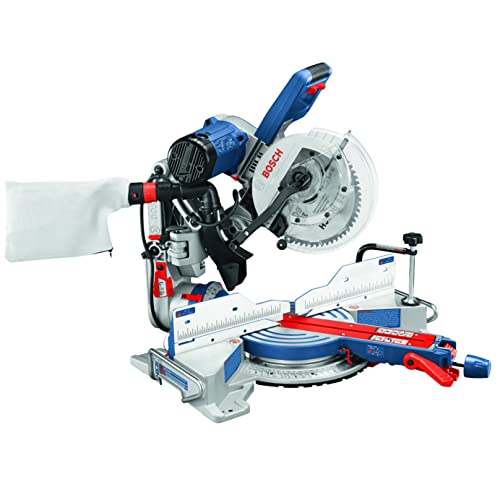
Best for tight spaces needing precise cuts, this Bosch Axial-Glide miter saw offers wide cross-cut capability with improved accuracy. Upfront metal bevel controls and square lock fences simplify quick adjustments, while a dust collection chute helps with cleanup. It’s ideal for small shops that still require reliable performance and precise alignment. Caution: the Glide system, while precise, can have a learning curve for first-time users accustomed to traditional rails.
Buying Guide: Key Purchase Considerations
- Cutting capacity: Consider your typical stock size, including crown molding and base trim. 12-inch blades often maximize crosscut capacity, but 10-inch models can be lighter and more portable.
- Bevel and miter ranges: Look for at least a dual bevel with positive stops and clear alignment guides. Wide bevel ranges enable more complex cuts without repositioning stock.
- Accuracy features: Shadow lines, laser guides, and saw line indicators help maintain precision. Ensure these features are visible and easy to calibrate.
- Dust management: A good dust collection system or bag reduces cleanup time and preserves visibility during cuts.
- Portability vs. stability: Heavier models offer stable performance on large jobs; lighter models are easier to transport between sites.
- Workspace fit: Check footprint, fence height, and sliding rail length to ensure it fits your workspace and supports your typical materials.
FAQ
- What should I consider when choosing a dual-bevel versus single-bevel saw?
– Dual-bevel saws eliminate flipping the workpiece for bevel cuts, saving time on complex jobs, but can be heavier and more expensive. - Is a 12-inch miter saw necessary for my projects?
– If you frequently cut wide boards, base and crown molding, or larger stock, a 12-inch model offers greater cutting capacity; for smaller trim work, a 10-inch unit may suffice. - What is the benefit of an XPS or laser guide?
– It improves cutline visibility and alignment, helping with precise crosscuts, particularly in bright shop environments where dust can obscure lines. - How important is a dust collection system?
– Very important for health, visibility, and cleanup. Choose models with built-in or compatible dust collection options for best results. - Can ambidextrous operation be advantageous?
– Yes, ambidextrous designs accommodate left- and right-handed operators, improving comfort and safety on long jobs. - What maintenance should I expect?
– Regular calibration of fences, miter scales, and laser guides; blade changes based on usage; and cleaning of rails to maintain glide smoothness.