Find the best quiet 80 gallon air compressor for industrial, workshop, or garage use. This guide highlights models designed to minimize noise while delivering reliable, steady air flow. A quieter compressor helps reduce fatigue and keeps work environments comfortable, especially in shared spaces. The top picks below are suitable for automotive tasks, painting, and heavy pneumatic tooling. They’re grouped by how well they balance noise level, capacity, and power for different buyers.
Summary table of selected products
| Product | Best For | Noise Level (approx.) | ||
|---|---|---|---|---|
| NorthStar Quiet Armor 80 Gal | Quiet environments, general shop work | 68 dB | 80 gal | 7.5 HP |
| VEVOR 80 Gallon Silent/Low-Noise (86 dB) | Industrial manufacturing, continuous use | 86 dB | 80 gal | 6.5 HP |
| EMAX E350 Whisper Quiet 80 Gal | Low-noise workplaces, painting | Whisper quiet (low) | 80 gal | 7.5 HP |
| POLAR AIR 7.5HP 80 Gal Silent/Quiet | Automotive and heavy-duty shop | Low noise (described as energy-efficient high output) | 80 gal | 7.5 HP |
| ATLAS AF7 80 Gal Vertical 5HP | Made in USA quality, steady performance | Standard industrial noise | 80 gal | 5 HP |
NorthStar Quiet Armor 7.5 HP, 80-Gal.

The NorthStar model emphasizes ultra-quiet operation for industrial tasks. It delivers 26 CFM at 90 PSI with a maximum of 175 PSI. The design targets environments where minimizing sound is essential, while still providing robust air delivery for common shop tools. Best for small to mid-sized shops or automotive bays where conversation-level noise is preferred. Limitations include a typical trade-off between quiet operation and peak CFM in demanding, continuous-use scenarios.
Who this is best for
- Workshops prioritizing low noise to maintain a comfortable environment.
- Automotive and light manufacturing tasks requiring reliable air flow without disruptive noise.
VEVOR 80 Gallon Silent 86dB, 6.5 HP

VEVOR’s 80-gallon, oil-free model emphasizes a balance of power and lower noise. It offers up to 15.5 SCFM @ 90 PSI and a max pressure around 145 PSI, with a stated noise level around 86 dB. This makes it suitable for high-demand tasks in larger shops where mobility and continuous air supply matter. A potential limitation is the oil-free design, which may alter maintenance needs compared to traditional oil-lubed units.
Who this is best for
- Factories or large garages needing long runtimes and steady air supply.
- Users seeking a quieter alternative to louder, traditional industrial compressors.
EMAX E350 Whisper Quiet 80 Gal
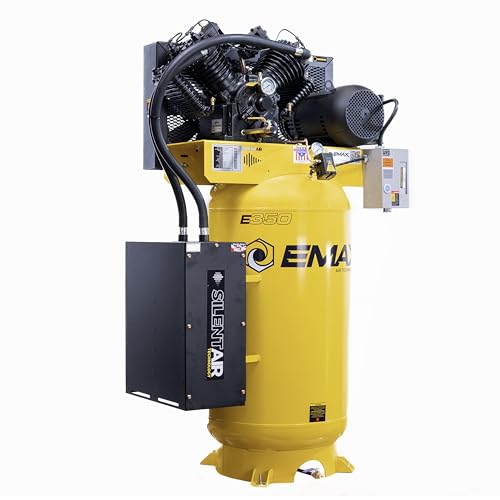
The EMAX E350 pairs a 7.5 HP two-stage design with a focus on low noise. It provides a robust 31 CFM at 90 PSI and a whisper-quiet system to reduce workplace disturbance. Its pressure lubrication helps extend pump life and supports reliable performance in demanding applications. A caveat is that the unit is geared toward industrial settings and may require appropriate mounting and space planning in smaller shops.
Who this is best for
- Industrial users needing strong air output with quieter operation.
- Facilities prioritizing worker comfort during long shifts.
POLAR AIR Industrial Silent 7.5HP 80 Gal

POLAR AIR emphasizes energy efficiency and a strong duty cycle for heavy workloads, delivering 31 CFM at 175 PSI with only 7.5 HP. This model is billed as assembled in the USA with a 70,000-hour pressure lubrication pump, aiming for reliability in tough environments. The higher PSI and CFM make it suitable for automotive bays and manufacturing lines, but the unit’s sheer output may come with larger footprint and power needs.
ATLAS AF7 80 Gal Vertical 5HP

The Atlas AF7 combines a vertical 80-gallon tank with a 5 HP motor and a two-stage pump setup, intended for durable performance in U.S.-made quality. It offers a steady air supply suitable for tools requiring consistent airflow with a manageable noise profile. This model is best for buyers prioritizing domestic manufacturing and a known component source, while ensuring adequate space for a vertical tank footprint.
Buying Guide
What to consider when choosing a quiet 80 gallon compressor
- Noise level vs. power: If quiet operation is paramount, compare dB ratings and the trade-off with CFM at your target PSI.
- Tank size and duty cycle: An 80-gallon tank supports longer runtimes between cycles, reducing pump cycling and noise spikes.
- Power requirements: 3-phase units can offer smoother operation and higher output; ensure your facility wiring matches the unit’s needs.
- Oil-free vs. lubricated pumps: Oil-free models reduce maintenance but may deliver different longevity guarantees; consider environment and maintenance capability.
- Two-stage vs. single-stage pumps: Two-stage designs generally push higher pressures with better efficiency for heavy tooling.
- Size and placement: A larger tank and heavier unit require adequate floor space and stable mounting to minimize vibration noise.
What kind of buyer should pick a quiet 80 gallon compressor?
- Small to mid-sized shops needing a balance of noise control and reliable air supply.
- Facilities with open layouts where quieter equipment improves overall comfort and productivity.
- Users with heavy tool workloads in automotive, painting, and light manufacturing who still want low disruption.
How to compare models quickly
- Compare decibel ratings and note the stated acoustic performance in real-use environments.
- Check 90 PSI CFM ratings to ensure enough air for your most demanding tool(s).
- Match electrical requirements with facility capacity to avoid overloading circuits.
Common concerns and caveats
- Oil-free designs may require different maintenance protocols; verify replacement part availability.
- Three-phase models require appropriate power infrastructure or inverters for single-phase setups.
- Large, heavy units demand secure mounting and safe handling during installation.
FAQ
- Q: Do quiet 80 gallon compressors deliver enough air for heavy tools? A: Yes, many models provide 25–31 CFM at 90–175 PSI, suitable for mid-to-heavy tooling when paired with an 80-gallon tank.
- Q: Is oil-free better for quiet operation? A: Oil-free pumps can reduce odor and maintenance complexity, but some users prefer oil-lubed pumps for longevity in demanding environments.
- Q: How important is the motor phase for performance? A: Three-phase units often offer smoother operation and higher sustained output, but require proper electrical infrastructure.
- Q: Can I place a large compressor in a small shop? A: Yes, but consider foot print, mounting, and noise isolation features to minimize disruption.
- Q: What is the best way to reduce noise further? A: Use vibration isolation mats, enclosure panels designed for compressors, and strategic placement away from work zones.
- Q: Should I choose a unit with a larger tank for quieter operation? A: A larger tank reduces pump cycling, which can lower average noise levels during operation.