For woodworkers seeking precise, repeatable miters and straight cuts, a high-quality table saw fence is essential. This guide highlights five top-performing precision fences and miter gauges that fit common slot sizes, offer micro-adjustments, and maintain alignment through demanding jobs. Each product below is evaluated for accuracy, ease of setup, and compatibility with standard table saw configurations.
Overview of selected products:
| Product | Brand | Key Benefit | Slot Compatibility | Typical Use |
|---|---|---|---|---|
| VEVOR Precision Miter Gauge | VEVOR | 15 stop angles and detachable disc for slot flexibility | 3/4″ x 3/8″ T-shaped or U-shaped | General-purpose precision cutting |
| Fulton Precision Miter Gauge with Aluminum Miter Fence | Fulton | Aluminum fence with 45° ends and multiple stops | Standard table saw slots | High-support miters and repeatable angles |
| Kreg KMS7102 Table Saw Precision Miter Gauge System | Kreg | Miter gauge with factory calibration and vernier adjustments | Standard table saw slots | Precise angle reproducibility |
| GOINGMAKE Table Saw Miter Gauge | GOINGMAKE | Micro-adjustable flip stop with extendable fence | 3/8 x 3/4″ T-slot | Fine crosscuts and bevel work |
| ALLmeter Digital Table Saw Gauge | ALLmeter | Digital readout for exact alignment | Fits 3/4″ groove width | Dial indicator-based alignment |
VEVOR Precision Miter Gauge

The VEVOR miter gauge is designed for most table saw slots measuring 3/4 x 3/8 inches and includes a detachable disc to suit both T-slot and U-slot configurations. It features a solid aluminum head with 15 positive stop holes, including a 90-degree primary stop and seven angles on each side at 15°, 22.5°, 30°, 35°, 45°, 60°, and 67.5°. This expands options for common woodworking angles, aiding in precise angle cuts. The gauge ships partially assembled to reduce setup time, allowing quick access to accurate measurements.
Fulton Precision Miter Gauge with Aluminum Miter Fence

The Fulton miter gauge pairs an aluminum miter fence with 45-degree ends for enhanced stock support. Its 0.200″ thick aluminum head is machined with 13 positive stop holes, including a 90-degree reference and angles at 22.5°, 30°, 45°, 60°, 67.5°, and 90° on both sides. A 17″ steel miter bar fits standard slots (3/4″ x 3/8″ with a 1/8″ T-slot) along the bottom, ensuring durability and stability during repeated cuts. This setup supports precise repeatable measurements for demanding tasks.
Kreg KMS7102 Table Saw Precision Miter Gauge System
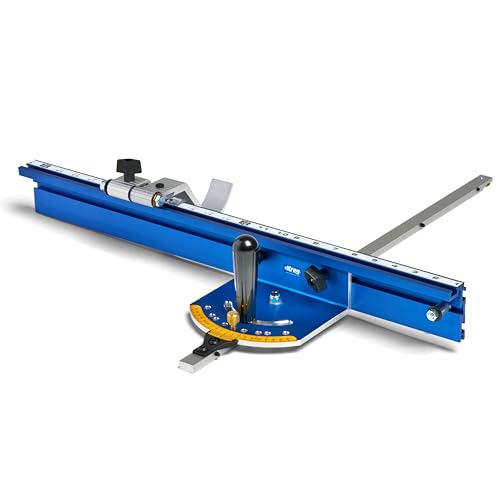
Kreg’s KMS7102 combines a precision miter gauge with a robust fence system, enabling accurate and repeatable angled cuts. The gauge includes a brass pin for quick angle changes, and a vernier-scale capability for adjustments down to 0.1 degrees. It’s designed to align with standard table saw slots for reliable performance across a variety of projects. This system emphasizes precise measurement and stable operation, making it suitable for furniture-grade joinery and cabinetry work.
GOINGMAKE Table Saw Miter Gauge

GOINGMAKE offers a miter gauge with a micro-adjustable flip stop and extendable fence, designed for precise crosscuts and miter cuts. The flip stop provides 0.001 inch (0.0254 mm) accuracy, and the product includes a magnifying glass for easy reading of scales. It supports 11 positive angle stops from 0 to 60 degrees, plus negative angles for broader versatility. An integrated zero-calibration feature enables rapid setup, reducing downtime between cuts and helping maintain consistent results across sessions.
ALLmeter Digital Table Saw Gauge
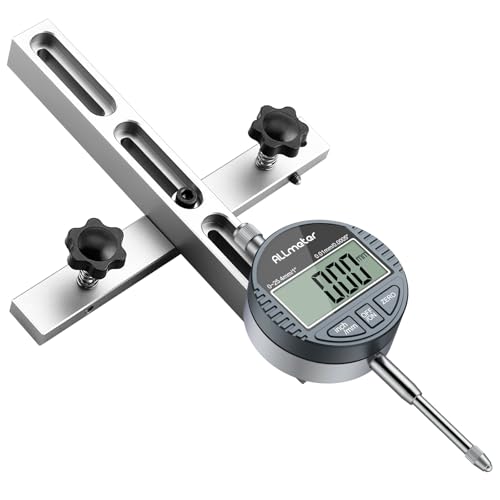
ALLmeter’s digital gauge provides a high-precision readout for fence alignment. The dial indicator offers 0.01 mm (0.0005 inch) accuracy, enabling exact alignment of the saw blade and fence. The CNC-machined aluminum bar includes three chutes for rigidity, and the device features six adjustment holes for the dial rod. It is designed to fit table saw grooves 3/4″ (19 mm) wide or larger, with screw adjustments for wider slots. This gauge is ideal where digital readouts enhance repeatability and calibration confidence.
Buying Guide: Key Considerations for Precision Fence Systems
- Slot compatibility: Confirm your table saw’s slot dimensions (usually 3/4″ x 3/8″ or similar) and whether the fence system offers a detachable disc or adaptable mounting for both T-slots and U-slots.
- Measurement accuracy: Choose devices with fixed positive stops, vernier scales, or digital readouts for consistent angle and length settings. Micro-adjustment features improve repeatability on fine cuts.
- Fence rigidity: A stiff, well-supported fence minimizes drift during cuts. Aluminum fences with reinforced bars and tight clamps tend to yield better results for long or wide workpieces.
- Ease of setup: Partial assembly, quick-zero calibration, and intuitive scales reduce setup time and potential user error, boosting overall productivity.
- Angle range and stops: Look for products offering common woodworking angles (0°, 15°, 22.5°, 30°, 45°, 60°, 67.5°, 90°) plus additional stops to cover less common cuts relevant to your projects.
- Compatibility with accessories: Some systems pair with flip stops, extendable fences, or additional miter gauges, enabling more versatile configurations for crosscuts and bevels.
- Durability and materials: Corrosion-resistant aluminum or steel components and solid die-cast parts generally withstand workshop use better than lighter plastic alternatives.
When selecting a precision fence system, weigh the importance of digital readouts versus mechanical stops, and consider how often you perform repetitive cuts. For cabinetry and fine furniture, a system with repeatable stops and a robust fence can dramatically improve accuracy and efficiency. For quick crosscuts on site, a gauge with fast zeroing and simple setup may be more practical. Always verify compatibility with your specific table saw model before purchasing.