Answer: For reliable vehicle air suspension and tire inflation, choose an on-board air compressor kit that matches your load, space, and control needs. This guide covers five top options—ranging from wireless and app-controlled systems to heavy-duty, tank-equipped kits—so you can pick the right fit for daily commuting, heavy towing, or off-road adventures. The best picks are categorized by installation style, control method, and pressure capability to help you decide who benefits most from each kit.
| Product | Best For | Key Benefit |
|---|---|---|
| maXpeedingrods On Board Air Compressor System Universal Air Spring Kit | Truck owners needing even load leveling | Single-path system with up to 100 psi |
| Air Lift WirelessOne 2nd Gen + EZ Mount | Riders who want wireless control | Mobile app and presets for easy adjustments |
| CNRAQR 150 PSI Onboard System | Heavy-duty trucks and trailers | High-pressure capability with durable aluminum tank |
| VIAIR 88P Portable Kit | Portable, no-permanent install needs | Compact, versatile for many vehicles |
| RETRUE Onboard Air Compressor System | In-cab control with fast inflation | Real-time pressure control from the seat |
maXpeedingrods On Board Air Compressor System
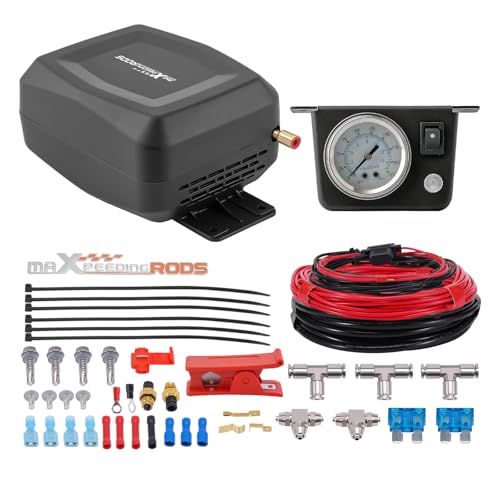
The maXpeedingrods kit is designed for trucks and vans that regularly carry heavy loads or tow trailers needing extra ground clearance. It uses a single-path system that evenly distributes air pressure to air springs, reducing ride harshness on rough roads. The on-board compressor supports up to 100 psi, enabling quick inflation of air springs in a minute or two. It does not require an external air tank, offering convenient in-cab pressurization with the gauge button to fill both bags at once. Best for: drivers who want straightforward, single-point air leveling without extra tanks. Caution: keep within the recommended 5-70 psi working range to avoid over-inflation.
Air Lift WirelessOne 2nd Gen + EZ Mount

This kit emphasizes wireless control. A compact, battery-powered handheld controller with an LCD helps you adjust air pressure without climbing into the cab. It includes a mobile app with Bluetooth-enabled manifold support and programmable presets. Best for: users who value remote adjustments and easy installation, especially in setups where running extra wiring is a concern. Limitation: wireless compatibility and app features may vary with vehicle electronics and mobile OS updates.
CNRAQR 150 PSI Onboard System

The CNRAQR kit targets heavy-duty use with a high maximum working pressure of 150 psi and brief bursts up to 250 psi. It includes a 1.6-gallon aluminum air tank, which provides durability and longevity under demanding conditions. Best for: trucks and trailers that require fast, high-pressure inflations and robust air storage. Caution: ensure proper wiring and ventilation when mounting near heat sources to maximize component life.
VIAIR 88P Portable Kit

The VIAIR 88P is a portable 12V air compressor capable of inflating up to 33-inch tires at 120 psi. It includes a 16-foot hose, multiple inflations tips, a built-in pressure gauge, and a carrying bag. Best for: compact, do-anywhere inflation tasks for cars, trucks, and light off-road gear. Limitation: being a portable unit, it may require more manual setup for long-term, constant-use applications.
RETRUE Onboard Air Compressor System
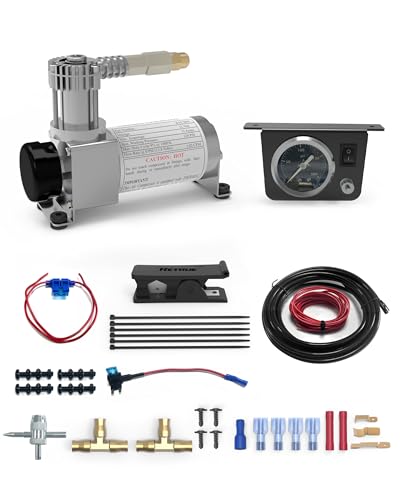
The RETRUE kit emphasizes fast, in-cab control for airbag suspension systems. It inflates to reach 100 psi, delivering quick inflation times and real-time pressure control from the driver’s seat. Best for: drivers who want quick, safe inflation with minimal pumping and fuss. Caution: verify compatibility with your specific airbag model and vehicle electrical system to ensure correct operation.
Buying Guide
- Control method: Decide between in-cab control (manual button or digital gauge) and wireless/app-controlled systems. Wireless setups offer convenience but rely on electronics and app compatibility.
- Pressure needs: If you regularly lift or level heavy loads, aim for kits with higher working pressure (100–150 psi) and robust tanks. For basic leveling, lower psi options can suffice.
- Tank size and durability: Aluminum tanks are lightweight and durable for mobile use. Larger tanks store more air, reducing cycle frequency, but require more space.
- Installation footprint: Some kits mount compactly with minimal wiring, while others use external tanks and hoses. Choose based on vehicle space and mounting feasibility.
- Portability vs. permanence: Portable units are easy to transfer between vehicles but may lack long-term stability, whereas onboard systems offer consistent performance but require permanent installation.
- Compatibility: Confirm your vehicle’s make, model, and the suspension or tires you intend to adjust. Some kits are designed specifically for certain airbag configurations or truck models.
Frequently Asked Questions
- What is the typical working pressure for these systems? Most kits target 100 psi as a common working range, with some offering higher max pressures for heavy-duty applications.
- Do these systems require an air tank? Some kits operate without a separate air tank, while others include a tank to store compressed air for quicker inflation.
- Can I install an onboard air compressor myself? Yes, many kits are designed for do-it-yourself installation with included components, but professional installation is recommended for complex suspensions.
- Will a wireless controller drain my battery? Wireless controllers use battery power and may draw minimal current; most systems are designed to operate with the vehicle’s electrical system to avoid battery drain when off.
- What maintenance is required? Regular inspections of hoses, fittings, and gauges are advised. Clean any debris from the compressor area and ensure connections remain tight.
- Which kit is best for off-road use? Kits with portable options or high-pressure onboard systems are suitable for off-road rigs that need dependable inflation on trails.