Choosing the right MIG welding wire for sheet metal improves bead visibility, penetration, and overall weld quality. This article highlights five well-regarded options, spanning common mild steel wires and versatile alloys. Each choice balances ease of use, spatter control, and deoxidizers to help both DIY enthusiasts and professional welders work efficiently on metal gauge ranges typical for sheet metal projects.
| Product | Diameter | Weight | Material | Notes |
|---|---|---|---|---|
| YESWELDER Flux Core Gasless MIG Wire E71T-GS | .030 in | 2 lb spool | Mild Steel (Flux Core) | Self-shields; good for outdoor use |
| PGN Solid MIG Welding Wire ER70S-6 | .035 in | 10 lb spool | Mild Steel | Low splatter; high deoxidizers |
| YESWELDER ER70S-6 MIG Wire | .023 in | 10 lb spool | Mild Steel | Great for sheet metal with 100% CO2 or AR/CO2 mix |
| ARCCAPTAIN ER70S-6 Mig Wire | .030 in | 10 lb spool | Mild Steel | Low splatter; smooth feeding |
| PGN Bearings ER70S-6 | .023 in | 10 lb spool | Mild Steel | Low splatter; good for all-position welds |
YESWELDER Flux Core Gasless MIG Wire E71T-GS .030

This E71T-GS flux-cored wire is designed for self-shielded welding, offering strong arc stability and high feedability. Its deoxidizing core helps produce cleaner welds through light rust or mill scale, which is beneficial when working with household and automotive sheet metal. It performs well in outdoor or draft-prone environments since shielding gas is not required, and it supports all-position welding including flat, vertical, and corner joints. Spatter is typically lower than average for flux-core wires, and slag forms readily for easy removal.
PGN Solid MIG ER70S-6 .035 Inch
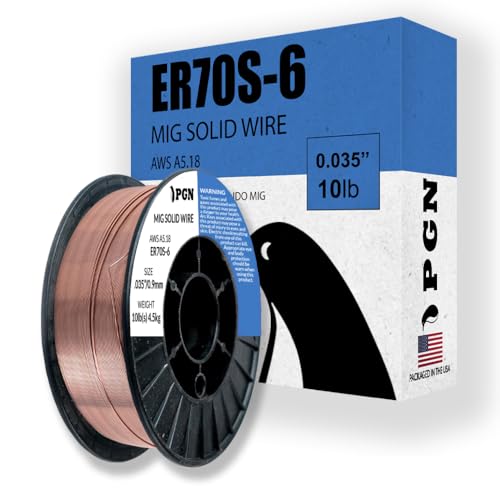
ER70S-6 is a widely used mild steel MIG wire with robust deoxidizers (silicon and manganese) to minimize porosity and improve bead appearance. The .035 inch diameter suits thicker sheet metals and projects requiring higher deposition rates. The wire demonstrates low spatter and smooth bead formation across single or multiple passes, making it a dependable all-position option for automotive body panels and general fabrication. It plays well with standard shielding gas mixtures, including 100% CO2 or mixed argon/CO2 configurations.
YESWELDER ER70S-6 MIG Wire .023 Inch

This .023 inch ER70S-6 wire serves well for sheet metal applications that require finer deposition and precise control. When paired with appropriate shielding gas (such as 80% Ar / 20% CO2 or 100% CO2), it supports smoother bead formation and easier cleanup. It’s a common choice for thinner gauge metal and intricate joints where heat input must be carefully managed to prevent burn-through.
ARCCAPTAIN ER70S-6 .030 Inch

ARCCAPTAIN’s .030 inch ER70S-6 MIG wire is designed for stable feeding and smooth penetration on mild steel. The 10 lb weight makes it a good option for ongoing projects, and the wire is specified to minimize slag and spatter while achieving consistent bead quality. It’s suitable for general purpose welding, including automotive panels and sheet metal fabrications, when used with compatible shielding gas.
PGN Solid MIG ER70S-6 .023 Inch

This .023 inch ER70S-6 wire provides precise control for sheet metal tasks requiring light heat input and clear bead definition. Its low-spatter profile supports cleaner welds across T-joints, butt welds, and lap welds. The high deoxidizer content helps mitigate porosity in less-than-perfectly clean base metals and is compatible with common shielding gas mixes used in hobby and professional settings.
Buying Guide: Key Purchase Considerations for Sheet Metal MIG Wires
- Material compatibility: For most sheet metal projects, mild steel wires such as ER70S-6 are standard. Consider aluminum alloys only if your project involves aluminum sheets.
- Diameter selection: Thinner gauges (0.023–0.030 in) offer finer control and reduced heat input, ideal for thin sheet metal. Thicker diameters (0.035 in) deposit more material but require higher heat and compatible equipment.
- Shielding method: Flux-core wires like E71T-GS are convenient for outdoor or drafty conditions since they are self-shielding. Solid wires require shielding gas (CO2 or CO2/Argon blends); ensure your welder supports your chosen gas.
- Deoxidizers and slag: Wires with deoxidizers reduce porosity in mildly oxidized base metals. Flux-core wires create slag that must be removed, which can aid bead shape but adds a cleaning step.
- Bead appearance and spatter: Low-spatter formulations improve bead quality and cleanup time, especially for precision sheet metal work.
- Welding position versatility: Look for wires tested for all-position welding if your projects involve ceilings, walls, or complex joints.
- Spool weight and feeding: Higher spool weights reduce frequent changes on long runs. Check your machine’s drive roll and tension settings for smooth feeding with each diameter.
- Compatibility with shielding gas: If using solid wires, confirm your equipment supports the gas mixture that yields the best bead profile for your project.
- Project scale: For automotive panels or repeated fabrication, consider 10 lb spools for extended runs; for small repairs, 2–2.5 lb flux-core spools can be sufficient.