Discover top hand rip saws that deliver clean, accurate cuts across or with the grain. This guide highlights five reliable options, detailing blade tooth configuration, construction, and sharpening attributes to help you choose the right tool for your woodworking or DIY projects.
Summary Table of Selected Products
| Product | Brand | Length | Teeth Per Inch (TPI) |
|---|---|---|---|
| Spear & Jackson Saw Skew Back 24 Inch | Spear & Jackson | 24 inch | 7 ppi |
| Lynx Garlick Thomas Flinn British 20” Rip Saw | Taytools | 20 inch | 4.5 TPI |
| IRWIN Hand Saw, Coarse Cut, 15-Inch | IRWIN | 15 inch | Coarse cut (tooth design specified as Tri-Ground) |
| Spear & Jackson Saw Skew Back 22 inch | Spear & Jackson | 22 inch | 10 ppi |
| Lynx Garlick Taytools Thomas Flinn British 24” Rip Saw | Taytools | 24 inch | 4.5 TPI |
Spear & Jackson Skew Back 24 Inch 7 PPI

The 24-inch Spear & Jackson skew back hand saw offers universal teeth designed for both crosscutting and ripping along or across the grain. The blade features precision cross-ground teeth and a design that allows teeth to be resharpened, helping maintain performance over time. This saw suits general carpentry tasks and fine woodworking where straight cuts and edge alignment matter.
Key features: universal teeth, cross-ground precision, resharpenable teeth, suitable for multiple grain directions. The skew back design aids control near the blade edge, reducing drift on longer cuts.
Lynx Garlick Thomas Flinn 20” Rip Saw
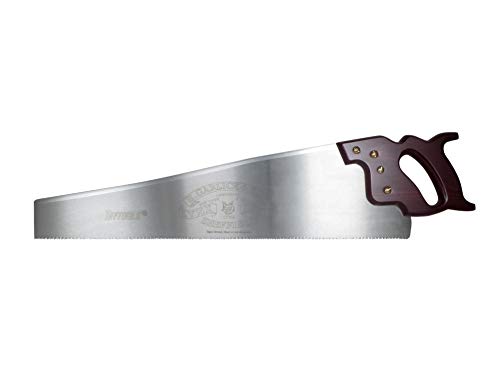
Made by Thomas Flinn of Sheffield, this 20-inch rip saw uses a tapered ground blade crafted from Sheffield alloy spring steel. The blade’s taper ground design thins toward the back, significantly reducing binding and promoting smoother ripping action. It balances edge durability with sharpenability, which is particularly useful for longer ripping tasks or stock preparation.
Key features: Sheffield steel, taper-ground blade, light binding, comfortable stained beech handle, designed for rip cutting.
IRWIN Hand Saw Coarse Cut 15-Inch

IRWIN’s 15-inch hand saw uses M2 tooth technology and Tri-Ground teeth to deliver fast, efficient cuts. A tapered-pitch nose improves clearance and stability, while deep gullets help remove chips quickly. This combination suits carpentry tasks requiring steady, straight cuts with predictable performance across varying wood densities.
Key features: M2 tooth technology, Tri-Ground teeth, tapered-pitch nose, deep gullets for chip removal, stable cutting.
Spear & Jackson Skew Back 22 Inch 10 PPI
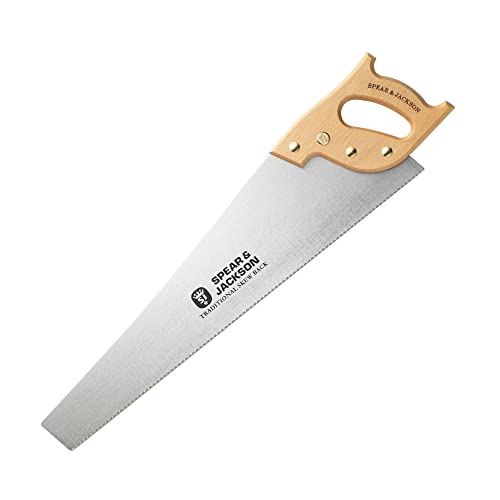
This 22-inch version from Spear & Jackson features a skew back blade with 10 ppi, designed for versatility across different cutting directions. The universal teeth and precision ground edges ensure reliable performance for both rip and crosscut applications, with teeth that are resharpenable to maintain efficiency over time.
Key features: 22 inch length, 10 ppi, universal teeth, resharpenable teeth, skew back geometry for control.
Lynx Garlick Taytools 24” Rip Saw
This 24-inch rip saw from Taytools uses a tapered ground blade for reduced binding and easier sharpening, crafted by Thomas Flinn of Sheffield. The combination of a durable blade and a stained beech handle provides a classic balance of control and comfort for extended ripping sessions.
Key features: tapered-ground blade, 4.5 TPI, Sheffield spring steel, traditional beech handle, optimized for rip cutting.
Buying Guide
What to look for in a hand rip saw
- Tooth configuration: Rip saws typically use larger teeth (lower TPI) for faster cutting along the grain, while higher TPI is better for finer work or crosscuts. Consider a blade with 4.5–10 TPI for general rip work.
- Blade reach and thickness: Longer blades allow for longer straight cuts; a taper-ground blade reduces binding and helps through tough stock. Blade thickness should balance rigidity and ease of sharpening.
- Blade material and heat treatment: Spring steel or high-quality alloys improve edge durability and ease of sharpening. Blades from reputable makers often retain performance longer.
- Handle design: Comfort and control matter for prolonged use. Look for a handle material and shape that suits your grip and project length.
- Sharpeningability: Some blades are designed to be resharpened, which can extend tool life and reduce replacement costs.
End-user considerations
- Experience level: For beginners, a 20–24 inch blade with moderate teeth count offers forgiving cuts and easier alignment.
- Stock density: Denser woods require sturdier blades and steady hands; consider higher-quality blades for hardwoods.
- Maintenance: Tools with readily available replacement parts and sharpening guidance help keep performance consistent.
Comparison at a glance
- Longer blades (24″) like Spear & Jackson and Taytools options excel in straight, long rip cuts and stock preparation.
- Smaller blades (15–20″) provide more maneuverability for detail work or tight spaces but may require more passes for larger stock.
- Lower TPI blades offer faster cuts in soft woods; higher TPI blades deliver cleaner edges in tougher stock but cut more slowly.
Choosing the right hand rip saw depends on your typical projects, wood types, and how you balance speed against precision. The options listed above provide a range suitable for general carpentry, hobbyist projects, and more demanding woodworking tasks.