Yes, handheld hammer drills provide reliable drilling and light demolition for common materials like wood, masonry, and concrete. This article highlights five top options across corded and cordless styles, explaining who each is best for and why. It’s ideal for DIY homeowners, hobbyists, and professional contractors choosing a versatile tool for varied tasks. The following selections balance power, control, and value, with clear notes on when to choose one over another.
Product Comparison at a Glance
| Product | Power Type | Key Benefit | Best For |
|---|---|---|---|
| GALAX PRO 4.5Amp 0-3000RPM | Corded | Dual-mode hammer/drill with 12 speeds | Home improvement projects with steady power |
| Hammerhead HAHD075 | Corded | Strong 7.5A motor and quick bit changes | Heavy-duty drilling (non-reinforced concrete) |
| DEWALT 20V MAX XR DCD806B | Cordless | High power in a compact 20V system with anti-rotation | Overhead or remote drilling, cordless work |
| DEKOPRO 6A Hammer Drill | Corded | 12 speeds, 2-in-1 modes, 360° handle | Versatile tasks in wood, metal, concrete |
| DCA 20V Cordless Hammer Drill | Cordless | High torque, 2 speeds, 18+1+1 clutch | Lightweight, precise fastening and drilling |
GALAX PRO 4.5Amp 0-3000RPM Corded Hammer Drill

Key features include a 4.5-amp copper motor delivering up to 3000 RPM, a dual-function selector for hammer and drill modes, and a 1/2-inch keyed metal chuck. This model is best for homeowners and hobbyists who need reliable performance on wood, masonry, steel, and concrete. Caution: not ideal for heavy-duty reinforced concrete. The 12-speed options help tailor impact intensity to material type.
Hammerhead 7.5-Amp 1/2 Inch Hammer Drill

Designed for demanding tasks, this tool offers a powerful 7.5-amp motor and a keyless 1/2-inch metal chuck for quick bit changes. The dual-function switch lets users move between drilling and hammer modes. It is best for projects that require more torque and faster drilling, but note that it cannot be used in reinforced concrete walls, which limits certain professional applications.
DESHUO 1″ SDS-Plus Lightweight Rotary Hammer
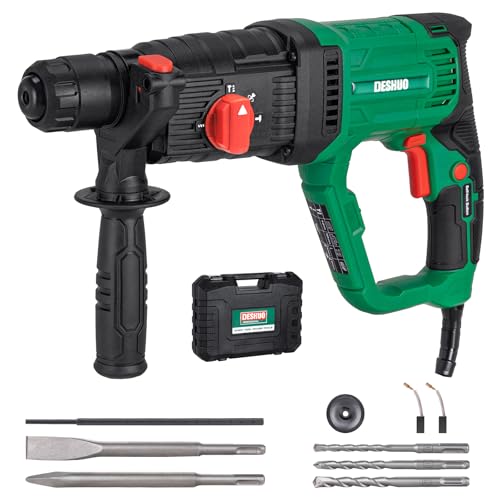
This SDS-Plus rotary hammer is tailored for concrete and masonry, weighing 7.19 pounds with tool-less bit changes. It delivers 0-1100 RPM and 0-5300 BPM with 3 Joules of impact energy. Best for DIYers focusing on lighter concrete work and tile removal, not for heavy demolition or SDS Max bits. Ensure SDS-Plus bits are used for compatibility.
DEKOPRO 6-Amp 1/2-Inch Hammer Drill

This 6-amp corded model provides up to 3,000 RPM and 48,000 BPM with 2-in-1 hammer and drill modes, plus 360° rotating handle for overhead work. Best for versatile home projects requiring steady power and ergonomic control. Limitation: power and speed are fixed to corded use, which may restrict portability.
DCA 20V Cordless Hammer Drill Set

Equipped with a pure copper motor, 354 in-lbs torque, and 2-speed settings (0-400 and 0-1500 RPM) plus a robust 18+1+1 torque clutch, this cordless set suits projects needing precision and mobility. The 1/2-inch keyless chuck allows quick bit changes. Choose this for lightweight, on-the-go drilling and fastening, but expect shorter runtime between charges on heavy jobs.
Buying Guide
What should you prioritize when choosing a handheld hammer drill?
- Power source: Corded models deliver constant power for ongoing work, while cordless models offer mobility but depend on battery life.
- Hammer vs drill mode: Look for a two-in-one function if you need concrete drilling and masonry work as well as wood or metal drilling.
- Chuck size: A 1/2-inch chuck supports larger bits and greater material variety; consider a keyless chuck for quicker bit changes.
- Speed and impact: More speeds and higher BPM/IMPACT ejection enable precise control across materials.
- Weight and ergonomics: Lightweight designs reduce fatigue for overhead or prolonged use; a 360° handle helps positioning.
- Durability and build: Metal chucks and cast gear components improve longevity in demanding tasks.
How do you pick between cordless and corded?
- Choose corded when you need uninterrupted power for continuous drilling or chiseling in a workshop setting.
- Choose cordless for overhead work, outdoor projects, or when access to outlets is limited.
Material-focused tips:
- For masonry and concrete, prefer higher BPM and impact energy, and use proper drill bits designed for concrete.
- For wood and metal, a variable speed setting helps avoid overdriving screws or overheating bits.
Frequently Asked Questions
- What is a hammer drill best used for?
Answer: Hammer drills provide rapid hammering action to break through masonry surfaces, making drilling into concrete and brick faster than standard drills. - Can I drill concrete with a regular drill?
Answer: A standard drill without hammer function can struggle with concrete; use a hammer drill or a rotary hammer with appropriate bits for best results. - What bit should I use for concrete?
Answer: Use carbide-tipped masonry bits or SDS-Plus bits (for SDS models) designed for concrete and masonry materials. - Is a 1/2-inch chuck necessary?
Answer: A 1/2-inch chuck supports larger bits and higher torque, which is beneficial for heavy-duty drilling and into tough materials. - Are cordless hammer drills less powerful than corded ones?
Answer: Some high-end cordless models offer comparable torque and speed, but corded drills generally provide steadier performance for extended tasks. - What safety practices are recommended?
Answer: Wear eye protection, secure materials, use appropriate bits, and start with lower speed to control feed and prevent bit deflection.