Whether you’re sharpening blades, shaping fixed blades, or grinding custom handles, a reliable belt grinder or belt sander is essential. This guide highlights five solid options that balance speed, control, and durability for knife makers in the American workshop. Each pick is evaluated for versatility, ease of use, and build quality to help you choose a tool that fits your workflow and budget.
| Product | Brand | Key Benefit |
|---|---|---|
| Mini Belt Sander | Blissthrill | High power, adjustable speeds, compact build for tight spaces |
| Belt Grinder Knife Jig | JCFANTS | Fixed angle precision for consistent blade geometry |
| Low Speed Bench Belt Grinder Combo | Bucktool | One-button belt changes, direct-drive performance |
| 3in1 Belt Sander / Disc Sander / Grinder | KFMK | All-in-one flexibility with adjustable belt and tracking |
| High Speed 6″ Bench Grinder & 1″x30″ Belt Sander | KFMK | High RPM for fast material removal and sharpening |
Blissthrill Mini Belt Sander For Knife Making

The Blissthrill mini belt sander is designed for knife making, woodworking, and metalwork in tight spaces. It features a robust 775 motor with adjustable speeds from 4000 to 9000 RPM, enabling precise control from fine polishing to aggressive grinding. A seven-speed range and forward/reverse rotation add versatility for different blade geometries and materials. Its stainless-steel construction and four shock-absorbing rubber pads minimize vibration, supporting a steady finish on delicate handles as well as hardened steels. Compatibility with a wide belt ecosystem includes sanding belts, discs, grinding wheels, and polishing wheels, making it a compact all-in-one solution for small shops.
Pros: compact footprint, adjustable speeds, low vibration. Cons: smaller work area, limited heavy stock removal compared to larger machines.
JCFANTS Belt Grinder Knife Jig
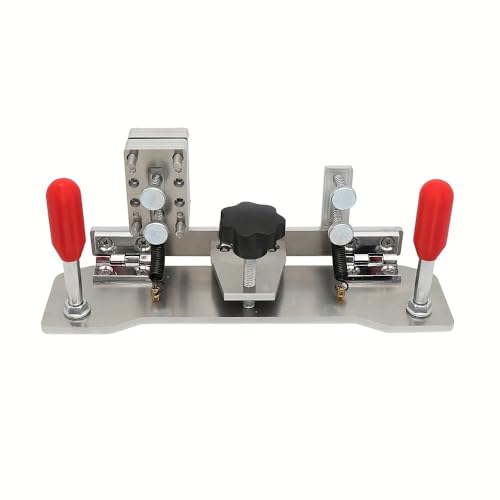
The JCFANTS knife jig provides a fixed-angle sharpening solution compatible with belt sanders. Built on a durable stainless steel base, it offers adjustable clamps and precision guides to maintain consistent blade angles during grinding. Two red-handled quick-release clamps securely hold knives, while a center adjustment knob enables precise angle control. This tool enhances repeatability for flat-grind and bevel work, making it a solid option for knife makers who prioritize accuracy in profile and edge geometry.
Pros: precise angle control, sturdy construction, easy quick-release clamps. Cons: requires a compatible belt sander platform to maximize utility.
Bucktool Low Speed Belt Grinder Combo

The Bucktool combo combines a 1×30 inch belt grinder with a 6 inch grinder, offering a versatile platform for knife making, sharpening, wood, and metalworking. It features a direct-drive motor delivering 1790 RPM and a one-button belt cover for quick belt changes. The design emphasizes ease of maintenance and efficiency, with a belt release system that speeds up belt swaps during long sessions. This setup supports quick shaping tasks and refined finishing when time is a factor in production runs.
Pros: intuitive belt changes, space-efficient, reliable direct-drive design. Cons: belt speed is on the modest side for very aggressive material removal.
KFMK 3in1 Belt Sander, Disc & Grinder

KFMK’s 3in1 belt sander combines a 2″x36″ belt, a 7″ disc, and an 8″ grinder in one unit. This versatility is ideal for knife makers who need to switch between bevel shaping, flat stock removal, and final finishing without moving between machines. A 3.1 Amp induction motor provides steady power, and the belt can be adjusted up to 90 degrees for varied bevels. Quick belt release and a user-friendly tracking system simplify setup and ongoing adjustments, making it a strong all-around choice for multi-surface grinding tasks.
Pros: broad toolset in one unit, adjustable belt tracking, solid motor. Cons: larger footprint than single-function grinders.
Sbestily Multifunctional Electric Knife Sharpener
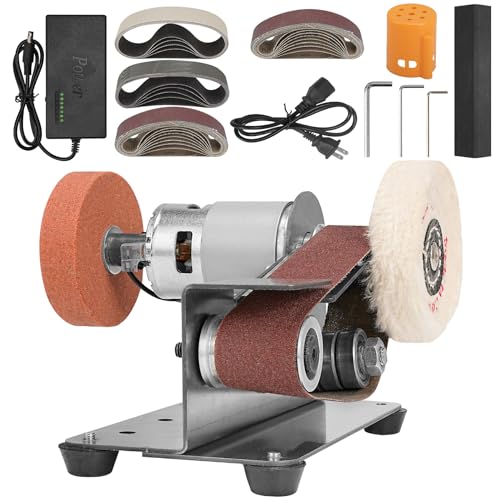
The Sbestily multifunctional sharpener offers a 15-degree slope on the sanding belt for efficient knife-edge sharpening. It supports knife making with a grinding wheel and polishing wheel on either side, enabling quick assembly of a compact benchtop grinder. Seven-speed adjustments via a slider on the power adapter provide a simple way to tailor speed for different steel types and blade thicknesses. This setup suits hobbyists and serious hobbyists who want a dedicated belt grinder with adjustable speed in a compact form factor.
Pros: preset 15-degree slope, dual-wheel add-ons, adjustable speeds. Cons: belt-based systems may require periodic wheel alignment for best results.
ONECHOI Belt Grinder Knife Jig

The ONECHOI knife jig is a precision-angle grinder accessory designed for belt sanders. With a -5° to 25° adjustable range, a stainless steel protractor plate, and a robust aluminum body, it emphasizes accuracy in blade alignment and bevel formation. The jig accommodates clamping across multiple heights thanks to 44 tapped mounting holes and six bolts for secure knife attachment. It’s built to reduce misalignment and improve repeatability in bevel and edge geometry across repeated passes.
Pros: wide angle range, strong clamping system, corrosion-resistant build. Cons: requires a compatible belt sander to realize full potential.
Buying Guide: Key Purchase Considerations
- Purpose and workflow: Identify whether you need a dedicated grinder for bevel shaping, a versatile all-in-one unit, or a compact setup for small shops. For fixed-angle accuracy, consider a knife jig or dedicated guides.
- Power and speed range: Look for motors with adjustable speeds and sufficient horsepower to handle steel without overheating. Slow speeds reduce heat buildup on high-hardness steels; high speeds remove material quickly for beveling.
- Belt size and compatibility: Choose belt sizes that fit your typical blade length and project scale. A unit offering multiple belt options expands your capabilities across different materials and finishes.
- Stability and vibration control: A solid base with vibration-damping feet improves finish quality and user comfort during long sessions.
- Maintenance and upgrades: Consider accessibility for belt changes, wheel replacements, and potential add-ons like polishing wheels or a tracking system. Easy belt release systems save time on repetitive tasks.
- Footprint and footprint management: For smaller shops, prioritize compact designs with space-efficient layouts without compromising performance.
<li;Accuracy tools: If precision is essential, integrate a jig or angle guide to maintain consistent bevels and blade geometry through repeated grinding passes.
When comparing options, weigh the balance between single-task efficiency and multi-function flexibility. For knife makers who frequently switch tasks—from bevel shaping to final finishing—a modular or 3-in-1 setup can streamline workflow. For those prioritizing precision, add-on jigs and alignment tools enable consistent blade geometry across sessions.