Choosing the right granite cutting blade can dramatically improve cutting speed, reduce heat buildup, and extend blade life. This guide focuses on high-quality diamond blades designed for angle grinders, specifically selected to handle granite, concrete, and other masonry materials. We’ll cover 5 top options, highlight their strengths, and help you decide which blade fits your material, cutting style, and climate conditions. The goal is safer, cleaner cuts with fewer passes and less downtime.
Summary of Selected Products
| Product | Brand | Key Benefit | Arbor | URL |
|---|---|---|---|---|
| Segmentation Diamond Blade, 4.5″ | EZARC | Aggressive cutting for granite and masonry | 7/8″-20mm-5/8 | View |
| Super Thin Diamond Blade, 4.5″ | EZARC | Clean, precise tile and stone cuts | 7/8″-20mm-5/8 | View |
| Segmented Diamond Blade, 4.5″ | Inwell | Fast cuts on granite and concrete | 7/8″-20mm | View |
| Super Thin Diamond Blade, 3″ | EZARC | Precision tile and stone work | 3/8″-13mm | View |
| Beveling Diamond Blade, 4.5″ | VOSIDUE | Beveling and shaping for granite and stone | 5/8″-11 | View |
Each blade has strengths in different scenarios: segmented blades excel in fast rough cuts across masonry, super-thin blades minimize chipping and deliver cleaner edges, and beveling blades help create finished profiles in granite work. The following sections break down each option with its notable features and typical use cases.
EZARC 4-1/2 Inch Segmented Diamond Blade

The EZARC Segmented Diamond Blade is designed for aggressive cutting of granite, concrete, sandstone, and limestone. Its segmented design offers robust performance under heavy-duty conditions, making it suitable for professional contractors and DIYers tackling large stone projects. With a 7/8″-20mm-5/8 arbor, this blade fits standard angle grinders used in masonry work.
Key benefits include faster cutting due to the diamond grit’s hardness and sharpness, plus improved debris removal thanks to the blade’s segment gaps. These gaps promote airflow to dissipate heat and help maintain cutting efficiency over longer sessions. The result is less downtime and a cleaner workspace, especially when cutting dense granite blocks or thick slabs.
EZARC 4-1/2 Inch Super Thin Diamond Blade
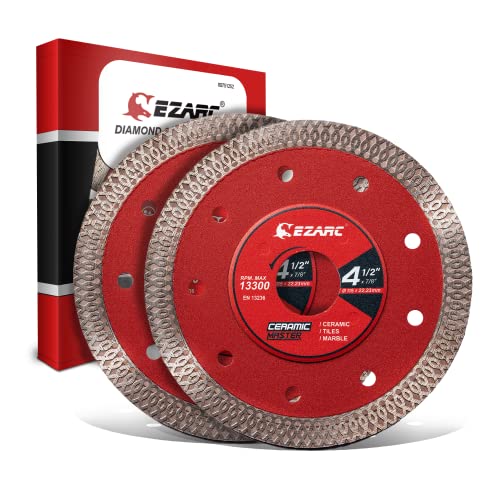
EZARC’s Super Thin Diamond Blade is engineered for precise cuts in tile and stone, including porcelain, ceramic, granite, and marble. The ultra-thin profile reduces cutting resistance, enabling cleaner edges with less chipping—beneficial for finished surfaces where appearance matters. It’s a favored choice for tile installers and DIYers who require accuracy in intricate layouts.
Designed for either dry or wet cutting, the blade performs optimally in wet conditions that can extend blade life. The included X-teeth turbo mesh rim enhances efficiency, and the core is engineered to minimize vibration, contributing to safer, more controllable cuts across delicate material surfaces.
INWELL 4-1/2 Inch Segmented Diamond Blade

The INWELL 4-1/2 Inch Segmented Diamond Saw Blade combines a tough steel body with 7mm high diamond segments for a balance of speed and durability. Its segmented design supports efficient heat dissipation and debris removal, helping maintain performance during extended cutting sessions on granite, concrete, and brick.
The blade is optimized for hot and demanding environments, providing steady performance with reduced vibration. A fully hardened construction helps resist wear, while the segmentation supports faster material removal in dense stone materials, making it well-suited for professional masonry work and large-scale renovations.
EZARC 3 Inch Super Thin Diamond Blade

The EZARC 3-inch Super Thin Diamond Blade targets precision in tight spaces where tile and stone edges require careful finishing. Its compact size is ideal for small-format renovation work, allowing plumbers, tilers, and DIY enthusiasts to make precise cuts without sacrificing edge quality.
Like its 4.5-inch counterpart, it employs X-teeth turbo mesh rims and a diamond-embedded cutting edge to minimize chipping and maximize edge clarity. It supports both dry and wet cutting, and wet operation can significantly increase blade life in challenging cut lines or dense porcelain and granite surfaces.
VOSIDUE Beveling Diamond Blade For Granite

The VOSIDUE 4.5″ beveling diamond blade focuses on beveling and shaping granite edges with speed and consistency. Its 2.5mm blade thickness and doubled-sided vacuum brazed construction support robust performance for shaping profiles, smoothing bevels, and finishing edges on granite countertops or stone features. The 5/8-11 thread makes it compatible with common grinders used in stone fabrication.
Beveling blades are particularly useful when preparing edges for polishing or integrating with other stone features. The design emphasizes durability, heat management, and consistent cutting action to deliver smooth, uniform bevels across varied granite surfaces.
Buying Guide: Granite Cutting Blade Considerations
Choosing the right blade depends on material, machine compatibility, and project goals. Here are key purchase considerations from multiple perspectives:
- Material and thickness: For granite and dense masonry, segmented blades excel in aggressive material removal, while super-thin blades emphasize precision and reduced chipping on finished surfaces. Consider your primary tasks—rough cuts vs. precise edging—and pick accordingly.
- Arbor compatibility: Ensure the blade arbor matches your grinder (common sizes include 7/8″-20mm-5/8 and 5/8-11). Mismatched arbors can cause vibration, wobble, and unsafe operation.
- Dry vs. wet cutting: Wet cutting extends blade life and reduces heat, but requires a water source. Dry cutting is more convenient but may wear blades faster and produce more dust unless mitigated with dust control.
- Durability and heat management: Segmented blades manage heat through gaps and airflow, while thicker cores and reinforced designs reduce vibration and warping. For long cutting sessions on granite, blades with robust cooling and debris removal are advantageous.
- Edge quality versus speed: If you need pristine edges for countertops or tile interfaces, opt for super-thin blades with chip-minimizing technology. For bulk removal in construction, segmented blades can save time.
- Beveling capabilities: For finished granite edges, beveling blades provide shaping and profiling without the need for secondary tools, though they may require careful handling to avoid overheating.
- Wet impact on durability: In many tiles and granite applications, wet cutting can significantly extend blade life by cooling the bond and grit during use, especially on dense materials.
- Brand and warranty: Reputable brands typically offer better consistency, replacements, and safety certifications. Evaluate blade warranty and intended use scenarios to avoid underperforming blades in the field.
- Safety and vibration: Look for blades with thicker cores or vibration-reducing designs to lessen fatigue and provide smoother operation, particularly for novices or longer projects.
In summary, for heavy-duty granite and masonry cutting, segmented blades provide speed and debris management, whereas thin blades deliver cleaner finishes on tiles and edge work. A beveling blade adds edge-profile capability, and a smaller 3-inch blade can help with precise, intricate cuts in tight spaces. When choosing, align blade type with your grinder’s compatibility, the material density, and the required finish quality to achieve best results.