Answering the need for fast, reliable chainsaw sharpening, these electric sharpeners are designed for both DIY enthusiasts and professionals. The right choice depends on how often you sharpen, your work environment, and the chains you use. The top picks below are evaluated for power, versatility, and ease of use to help you decide which model fits your needs.
| Product | Best For | Why It Stands Out |
|---|---|---|
| Sharp Pebble Electric Chainsaw Sharpener Kit | Home users and hobbyists | Complete kit with multiple grinding wheels and angle guide for consistent results |
| Oregon Professional Compact 120-Volt Bench Chain Grinder | Small shops and DIYers | Bench or wall mounted; universal sharpe ner for many chain types |
| VEVOR 140W Electric Chainsaw Sharpener | Mid-volume woodshops | Three grinding wheels; high RPM for tougher chains |
| KonKell 250W Electric Chainsaw Sharpener | Frequent users and professionals | High-speed with adjustable angle; durable construction |
| Kvlilioo 230W Electric Chainsaw Sharpener | DIY and contractors | Adjustable angle, comprehensive depth control for precise sharpening |
Sharp Pebble Electric Chainsaw Sharpener Kit

The Sharp Pebble kit includes a 120V chainsaw tool, an angle guide attachment, a wrench, and four sharpening wheel bits (5/32”, 3/16”, 7/32”, 7/32” – note potential duplication in sizes). This setup enables quick sharpening of dull chains with an even angle across teeth. It is best for occasional users or hobbyists who want a straightforward, all-in-one solution. A potential limitation is the wheel set variety; ensure your chain pitch matches the bit sizes provided.
Oregon Professional Compact 120-Volt Bench Chain Grinder

This bench or wall-mounted grinder is designed for semi-professional and home users who regularly sharpen chains. It easily mounts to a bench or wall with included bolts and sharpens up to .404” pitch chains. It is best for small workshops that want a stable, dedicated sharpening station. A caution: setup requires a fixed workspace, which may limit portability.
VEVOR 140W Electric Chainsaw Sharpener

The VEVOR sharpener offers a 140W motor and speeds up to 5700 RPM with three interchangeable grinding wheels (3.2 mm, 4.5 mm, 6.0 mm). It supports multiple chain pitches, making it versatile for households and professional use alike. It’s best for users who want a balance of power, wheel variety, and straightforward operation. A potential drawback is that larger chains may demand more frequent wheel changes, depending on usage.
KonKell Electric Chainsaw Sharpener
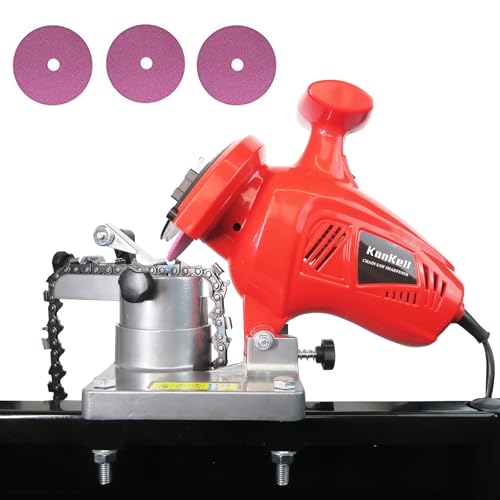
The KonKell sharpener runs at 250W with a high speed of 8400 RPM and features an adjustable angle for sharpening chains from 1/4″ to 3/8″ pitch. It is durable and suitable for frequent use, making it a strong choice for professionals or serious DIYers. A limitation is that its design favors users who can manage a heavier tool and a fixed sharpening setup.
Electric Chainsaw Sharpener, 230W Bench Grinder

This 230W bench grinder-type sharpener offers a wide 0-35° slant angle and a 145 mm wheel, with depth and angle adjustments for precise results. It suits contractors and DIYers who need reliable, quick sharpening across various chain types. The device is heavier, so consider storage and workspace requirements. It is best for users who want adjustable depth and angle control for customizable sharpening outcomes.
Buying Guide
- Power and RPM: Higher wattage and RPM typically translate to faster sharpening, especially for tougher chains. However, power should match the size of your chains and the number of chains you sharpen regularly.
- Wheel Variety and Pitch Compatibility: Look for models offering multiple wheel sizes or options compatible with your chain pitch (e.g., 1/4″, 3/8″, .325″, .404″). This ensures broader applicability across chains.
- Mounting and Workspace: Bench-mounted or wall-mounted units save space and provide stability. Portable handheld kits work well for field use but may risk inconsistent angles without practice.
- Angle and Depth Adjustment: Adjustable angles help match chain tooth geometry. Depth control ensures uniform sharpening across all teeth, reducing bite variability.
- Ease of Use: For beginners, a guided angle rail or an all-in-one kit reduces the learning curve. Professional users may prioritize speed and durability over simplicity.
- Maintenance and Parts: Consider availability of replacement wheels and bits. Durable construction and corrosion resistance extend tool life in outdoor settings.
Frequently Asked Questions
- Do I need a dedicated chainsaw sharpener or can I use a standard grinder? A dedicated chainsaw sharpener provides precise tooth angles and depth, reducing the risk of uneven sharpening compared to a general-purpose grinder.
- What chain pitches are compatible with most sharpeners? Common pitches include 1/4″, 3/8″, .325″, and .404″. Check the product’s listed compatibility before purchasing.
- Is bench mounting essential? Not essential, but bench mounting offers stability and repeatable angles, which improves consistency for frequent sharpening.
- How often should chains be sharpened? This depends on usage. Mark teeth that appear dull and sharpen when you notice decreased cutting efficiency or increased effort.
- Can I sharpen chains without removing them from the saw? Handheld handheld kits often allow sharpening on the bar with no removal, while bench units may require chain removal for certain setups.
- Are diamond bits better than steel grinding wheels? Titanium-coated or diamond bits provide longer wear and consistent edge formation, especially for hard-to-sharpen teeth.