Dual fuel generators offer flexibility by running on gasoline or propane, providing reliable backup power when the grid goes down. This guide highlights five top dual fuel models and compares their capabilities to help you choose the right size, reliability, and features for your needs. Each option balances portability, run time, and safety features like CO sensors and automatic shutoffs to protect your family and electronics.
Summary of chosen products
| Product | Brand | Fuel Types | Running/Peak Watts | Key Safety/Extras |
|---|---|---|---|---|
| Westinghouse 12500 Peak Watt Dual Fuel Home Backup Portable Generator | Westinghouse | Gas, Propane | 8500-12500 | Remote Electric Start, CO Sensor, Transfer Switch Ready |
| DuroMax XP13000HX 13,000-Watt Dual Fuel | DuroMax | Gas, Propane | 13000- | CO Alert, Heavy-Duty 500cc OHV |
| WEN 5,600-Watt Dual Fuel Portable Generator with Wheel Kit | WEN | Gas, Propane | 4500-5600 | CO Watchdog, Electric Start |
| WEN 4,750-Watt 120V/240V Dual Fuel Portable Generator | WEN | Gas, Propane | 3800-4750 | Wheel Kit, Electric Start |
| Westinghouse 4650 Peak Watt Dual Fuel Portable Generator | Westinghouse | Gas, Propane | 3600-4650 | RV Ready, CO Sensor |
Westinghouse 12500 Peak Watt Dual Fuel Generator

The Westinghouse 12500 Peak Watt Dual Fuel Home Backup Portable Generator delivers substantial power for whole-house load support. It offers up to 12,000 running watts on gasoline and 11,200 peak on propane, with a 6.6-gallon tank for extended runtimes. Features include remote electric start, a digital hour meter, and multiple outlets to support large loads. Its portable design plus transfer switch readiness makes it suitable for emergency home power and RV setups, with safety features including a carbon monoxide shutdown system.
The unit provides versatility with gas and propane compatibility, enabling longer shelf-stable fuel options. The transmission of power through multiple receptacles ensures compatibility with common household circuits and essential appliances. A robust 457cc engine underpins reliability during extended outages, while the CO shutdown adds a protective safety measure in occupied spaces.
DuroMax XP13000HX Dual Fuel Portable Generator

With 13,000 watts of output, the DuroMax XP13000HX is designed for whole-home resilience during storms or outages. It supports both gasoline and propane, letting you switch as fuel availability changes. The 500cc OHV engine and copper windings are built for longevity, and the unit emphasizes safety with CO alerts to protect occupants. It is well-suited for large loads, including air conditioning and multiple large appliances, and is intended for transfer-switch-ready setups and RV use.
Considering fuel availability and cost, propane can offer a longer shelf life, while gasoline provides readily available power. The XP13000HX emphasizes durability and powerful performance at the upper end of portable generators, making it a strong choice for users who need high output and flexible fuel options for extended outages.
WEN 5,600-Watt Dual Fuel Portable Generator (DF5600X)

The WEN DF5600X combines high output with dual fuel flexibility for demanding backup power. It runs on gasoline at 5600 surge watts and 4500 running watts, or propane with a similar capacity. The generator supports both 120V and 240V outputs, making it compatible with home transfer switches and various heavy-duty loads. An electric start simplifies operation, especially during stressful outage scenarios. CO watchdog technology adds a safety layer by automatically shutting off the unit if CO levels rise.
WEN’s focus on accessibility and portability is evident in the design, including a wheel kit and straightforward start mechanism. While delivering significant power, the unit remains relatively compact for a dual-fuel model, providing a balance between performance and maneuverability for outdoor work sites or home backup protections.
WEN 4,750-Watt Dual Fuel Portable Generator (DF475T)

The WEN DF475T offers a practical balance of power and portability. It supports gasoline with 4750 surge watts and 3800 running watts, and propane with 4350 surge watts and 3500 running watts. A key feature is the electric start, enabling quick ignition during emergencies. The unit benefits from a dual-fuel design, enabling flexible fuel choices depending on availability and cost. It is compact enough for RV use while delivering enough headroom for essential circuits in a home backup scenario.
Users should assess their typical load profile to determine if this model comfortably covers essential appliances, especially if expanded to a full home backup. The inclusion of the CO shutdown adds safety for occupied spaces, providing a safeguard in emergency power setups.
Westinghouse 4650 Peak Watt Dual Fuel Generator
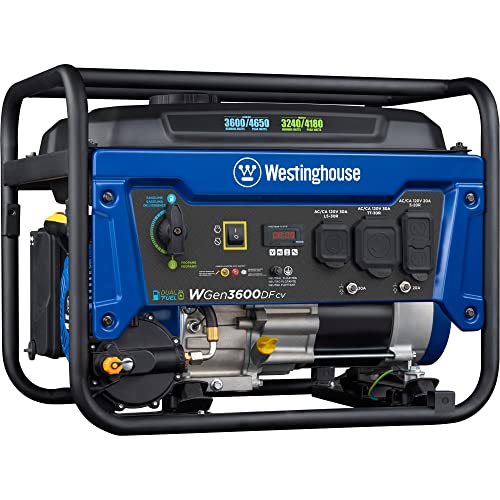
The Westinghouse 4650 Peak Watt Dual Fuel Portable Generator is RV-ready and provides versatile power with gas and propane capabilities. It includes a 4-gallon fuel tank with a fuel gauge for better runtime planning and multiple outlets (including RV-ready) to support recreational or home backup needs. The CO sensor helps monitor air quality and shutdowns the unit if dangerous conditions are detected. This model blends moderate peak output with portability, suitable for campers and small-to-medium home backup tasks.
As a compact option, it focuses on essential outlets and straightforward operation. The CO sensor contributes to occupant safety, while its RV compatibility broadens its use cases for recreational vehicles as well as emergency preparations.
Buying Guide: Key Purchase Considerations
When selecting a dual fuel generator, consider these factors to match your needs:
- Power output: Determine your critical load. For whole-home backup, aim higher (12,000+ running watts) or plan staged loads. For smaller setups or RVs, 4,000–6,000 running watts may suffice.
- Fuel flexibility: Dual fuel fuels expand fuel availability during outages and can extend run time with propane in some models. Consider local fuel costs and storage safety.
- Safety features: Look for CO sensors, automatic shutoffs, and properly rated outlets. A transfer switch-ready design simplifies connecting to home circuits.
- Portability and size: Heavier units deliver more power but require more space and effort to move. Wheel kits and handles add convenience for frequent repositioning.
- Run time and tank size: Larger tanks provide longer runtimes but add weight. Balance fuel capacity with space constraints for your setup.
- Engine durability: Copper windings, OHV design, and reputable brands influence longevity and maintenance frequency.
- Compliance: Consider EPA III and CARB certifications if you operate in regulated areas, particularly for quiet operation and emissions.
- Noise levels: Inverter-based dual fuel generators typically run quieter and are better suited for indoor or campground use; assess decibel ratings for your environment.
- Outlets and compatibility: Ensure outlets match your essential devices and that transfer switches or RV compatibility align with your planned usage.
Safety and maintenance plans should accompany any generator purchase. Regular oil checks, air filter replacements, and fuel-quality management help maximize performance and longevity. For emergency preparedness, pairing a generator with a professional-installed transfer switch can streamline power restoration while maintaining safety.