When you need precise bottom-edge finishes or clean downward cuts in wood, metal, or plastic, selecting the right jigsaw blade is essential. This guide reviews top downward-cutting and reverse-cut jigsaw blades from trusted brands, highlighting compatibility, blade life, and finish quality. Below you’ll find five standout options with practical details to help you choose the best blade for your project.
| Product | Best For | Key Benefit |
|---|---|---|
| MRCGTCE 50 Piece Contractor Jigsaw Blades Set | Wood, Metal, Plastic | Downcut (T144D) and versatile sets for everyday use |
| Diablo DJT308BFP5 Bi-Metal Jig Saw Blades | Ultra-fine top/bottom finishes | Dual-end teeth for smooth both-sides finishing |
| Diablo DJT101BRF5 Reverse Wood Cuts | Top finishes and reverse/flush cuts | Reverse-tooth design for splinter-free top cuts |
| Hariendny 14 PCS U-Shank Jig Saw Blades | Wood, Plastic, Metal, mixed materials | Broad tooth options with durable HCS |
| All-purpose wood, plastic, metal cutting | Comprehensive assortment with storage case |
These blades cover a wide range of materials and cut types, with several featuring downcut designs aimed at reducing chipping on the visible face and finishing the underside smoothly. As you compare blades, consider material hardness, blade width, tooth count, and shank compatibility (T-shank is common for many modern jigsaws). The following sections break down each product with a concise overview of its strengths and typical use cases.
MRCGTCE 50 Piece Contractor Jigsaw Blades Set
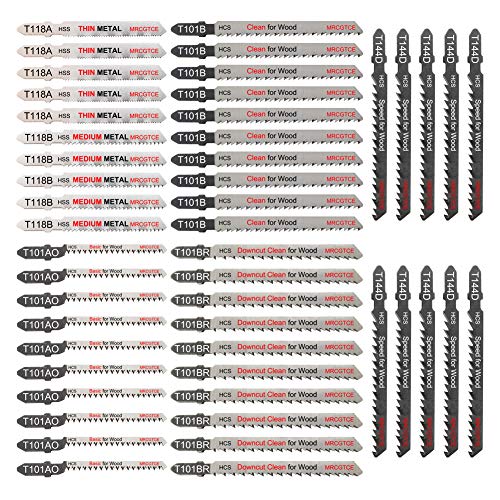
The MRCGTCE set provides a cost-effective solution with a wide blade assortment for common jobs. It includes 5 blades for thin metal cutting (T118A, 3″, 21 TPI) and 5 for medium metal cutting (T118B, 3″, 12 TPI), plus a majority of wood-cutting blades (T101AO, T101B, T101BR, and T144D). The blades are SK5 high-carbon steel for longevity and HSS-grade performance in metal cutting. A storage case helps keep blades organized for quick project access.
Key considerations: This is a high-value set that covers multiple materials. Expect good wear resistance, though individual blade life will vary with metal thickness and material hardness. The assortment is well-suited for hobbyists and professionals who switch between wood, plastic, and metal without swapping blades constantly.
Diablo Bi-Metal Jig Saw Blades DJT308BFP5 (4-5/8″, 12 TPI, 5-Pack)

Diablo’s DJT308BFP5 focuses on ultra-fine finishes on both top and bottom of wood. The blade’s design features teeth facing in opposite directions at each end, delivering cleaner, smoother finishes and better heat tolerance for longer blade life. It’s a bi-metal construction, providing excellent balance between hardness and flexibility for tough applications, especially when precision matters.
Key considerations: Ideal for fine woodworking where surface quality matters on both faces of the cut. The life extension relative to standard blades helps reduce blade changes on projects with a lot of trimming and finishing cuts. It excels in gentle curves and small radii when a clean face is required.
Diablo Bi-Metal Jig Saw Blades DJT101BRF5 (4″, 10 TPI, 5-Pack)

These blades are designed for reverse wood cuts with a focus on top-cut quality. The reverse-tooth geometry helps minimize splintering and produces a clean edge on the material’s top surface, which is particularly useful for cabinetry, plywood work, and decorative cuts. The blades are built for long life with a bi-metal construction that balances durability against the demands of aggressive wood cutting.
Key considerations: If top-surface finish is critical, these are a strong choice for refinishing or visible-edge projects. They perform well on softwood and plywood and are a practical option for general woodworking tasks requiring precision and control.
Hariendny 14 PCS U-Shank Jig Saw Blade Set

This set covers a range of materials with U-shank blades, including 6T, 8T, 10T, 14T, 18T, 24T, and 32T options. The blades are made from high-carbon steel (HCS), which provides ruggedness and wear resistance for everyday projects. The variety in tooth counts supports different cutting needs—from fast rough cuts to finer finishes in manual or powered operations.
Key considerations: Good versatility for builders who tackle mixed materials. The high-carbon steel construction supports durability, but you’ll want to monitor heat buildup when cutting thicker plastics or metals. This set is best for hobbyists and DIYers seeking broad compatibility with U-shank jigsaws.
EZUVITA 25-Piece Jigsaw Blades Set
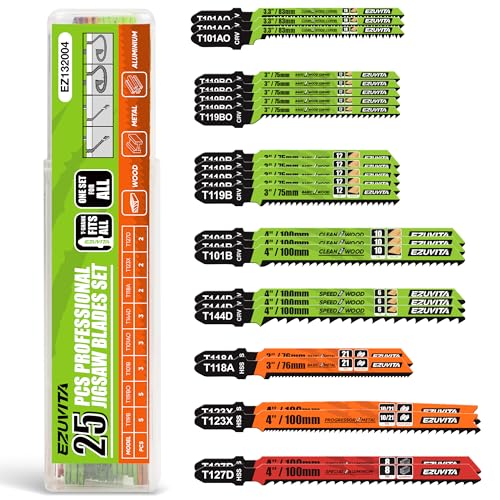
EZUVITA’s ensemble includes a wide mix of blade types for speed, smoothness, and versatility. With CR-V and HSS steel construction and a multifunctional selection, the 25-piece set is designed to handle wood, plastic, and metal cuts. The set also includes a storage case for organization, which is useful for portable workspaces or job sites with limited tool systems.
Key considerations: A strong all-around choice for homeowners and professionals who value a broad assortment in a single package. The included T-shaped and curved-cut blades cover a spectrum of cutting scenarios, from straight rips to intricate curves, with emphasis on reliable performance across materials.
Buying guide: When choosing downward-cut or reverse blades, consider your primary material (wood vs. metal), preferred cut quality on the exit face, and your jigsaw’s shank compatibility. For clean bottom finishes and reduced chipping, downcut and reverse-tooth blades are preferred. For dense hardwoods or metal, prioritize higher tooth counts and bi-metal construction for longer life. Always verify compatibility with your jigsaw model, especially shank type and blade length, to ensure safe, efficient operation.
Buying Guide: Key Considerations For Downward Cutting Jigsaw Blades
- Material compatibility: Wood, metal, and plastic blades serve different purposes. Downcut designs minimize tear-out on the bottom face and improve edge quality on the exit surface.
- Tooth geometry: Fine teeth (high TPI) yield smoother cuts; aggressive teeth cut faster but can cause more splintering if not paired with the right material.
- Blade construction: Bi-metal blades offer durability for metal cutting, while carbon steel blades can provide flexibility and affordability for wood.
- Shank compatibility: Ensure your jigsaw accepts the blade’s shank (T-shank is common for modern tools; U-shank adapters may be needed in some models).
- Blade length and thickness: Longer blades cut deeper; thicker blades resist bending in tougher materials but require more power to drive.
- Finish quality: For projects where the visible edge matters, downcut and reverse-tooth blades can reduce chipping and provide smoother finishes on the exit face.
- Cost vs. life: Sets with mixed blades provide value, but dedicated single-purpose blades may offer superior edge quality for critical work. Consider your typical project mix.
These options collectively cover common downward-cut applications and reverse-cut needs across wood, plastics, and metals. When selecting, balance the breadth of the blade set with the specific materials you encounter most often to optimize both performance and value for your shop or job site.