Finding the right digital multimeter for automotive work means balancing safety, accuracy, and ease of use. This guide highlights five dependable models that perform well on vehicle electrical systems—from cranking circuits to battery health checks. Each entry includes core features, ideal use cases, and what to look for when shopping. Use the buying guide at the end to compare options and ensure you pick a meter that fits your automotive diagnostic needs.
| Product | Brand |
|---|---|
| AstroAI Digital Multimeter and Analyzer TRMS 6000 Counts | AstroAI |
| KAIWEETS HT118E Digital Multimeter | KAIWEETS |
| Fluke 15B+ Digital Multimeter | Fluke |
| Innova 3320 Auto-Ranging Digital Multimeter | Innova |
| ANENG Digital Multimeter with Case | ANENG |
AstroAI TRMS 6000 Counts Multimeter For Automotive

The AstroAI TRMS meter provides True RMS readings for AC current and voltage, plus auto-ranging for easy measurements across automotive circuits. It covers voltage, current, resistance, diodes, continuity, capacitance, frequency, duty cycle, and even temperature. Features such as a backlit LCD, data hold, auto shut-off, and a kickstand simplify field diagnostics. This model is well-suited for quick automotive troubleshooting and home electrical work, offering professional-grade capabilities in a user-friendly package.
KAIWEETS HT118A Auto-Ranging Digital Multimeter
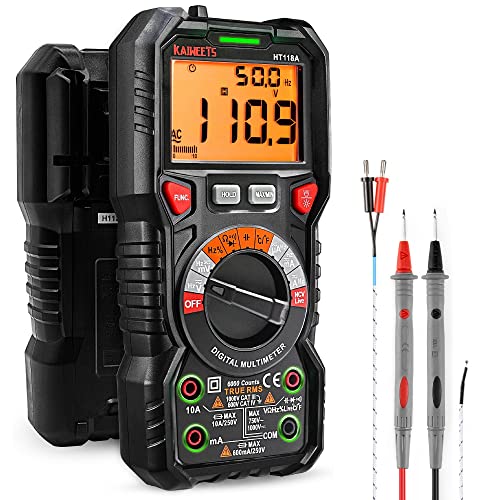
The HT118A offers wide automotive utility with dual 1000V DC and 750V AC voltage ranges, 10A current capability, and 60 MΩ resistance. It measures temperature, capacitance, frequency, duty cycle, diodes, continuity, and non-contact voltage (NCV) with audible/visual alerts. An included large 2.9″ backlit display, auto-ranging, and a sturdy kickstand make it a solid choice for troubleshooting vehicle wiring, fuses, batteries, and charging systems. Its portability and robust feature set suit both DIY enthusiasts and professional techs.
Fluke 15B+ Digital Multimeter

Fluke is a trusted name for electrical testing, and the 15B+ brings a CAT III 600V safety rating for automotive and residential work. It measures AC/DC voltage up to 1000V and current up to 10A, with capacity for resistance, continuity, diode, and capacitance tests. The 15B+ emphasizes reliability and safety, making it a preferred choice for automotive diagnostics where precise readings and durable construction matter in challenging environments.
AstroAI Digital Multimeter Tester (Blue)

This AstroAI model focuses on essential automotive measurements with a 2000-count display. It measures DC/AC voltage, DC current, resistance, continuity, and diodes. It’s a practical entry-level option for hobbyists and beginners who need a straightforward tool for basic car electrical checks, battery testing, and simple circuit troubleshooting. Notable is its compact design and clear readouts, suitable for on-the-go diagnostics or shop work when high-end features aren’t required.
Buying Guide: Key Purchase Considerations
When shopping for an automotive digital multimeter, focus on the following factors to ensure you get a meter that suits your needs and safety standards:
- Auto-ranging and display: Auto-ranging simplifies use, especially for beginners. A large, backlit display helps in dimly lit engine bays and garages.
- Reach and safety ratings: For automotive work, ensure the meter supports at least CAT III ratings and current/voltage ranges appropriate for vehicle electrical systems.
- True RMS vs. average responding: True RMS meters provide more accurate readings for non-sinusoidal automotive loads and fluctuating systems.
- Measurement capabilities: Voltage, current, resistance, diode and continuity tests are essential; consider additional features like capacitance, frequency, duty cycle, temperature, and NCV for broader troubleshooting.
- Durability and form factor: A rugged build, protective case, and a stable kickstand help in shop environments and under hood work.
- Data retention and memory: Some models offer data hold, Min/Max logging, and backlighting for all-day diagnostics.
- Accessories: Quality test leads, probe accessories, and a carrying case add value, especially for automotive use where probes must reach tight spaces.
- Brand and support: Reputable brands like Fluke, Innova, KAIWEETS, and AstroAI typically provide reliable customer support and manuals, important for complex diagnostics.
What To Compare Across Models
Core comparisons should consider accuracy, range coverage, and safety. If you frequently diagnose battery health, voltage stability, and alternator performance, prioritize models with robust DC measurements, AC compatibility, and optional temperature readings. For DIY enthusiasts working on electrical projects beyond vehicles, a meter with broader function sets (capacitance, frequency, duty cycle) offers more versatility. Finally, price-to-feature balance matters: higher-end models deliver reliability and protection, while entry-level meters keep costs down for basic checks.
Quick Usage Tips For Automotive Work
To maximize safety and accuracy: inspect leads for wear, ensure the meter is in the correct range or set to auto-range, connect common ground properly, and avoid measuring live circuits beyond rated voltages. When checking automotive batteries, measure both the open-circuit voltage and load voltage to assess cranking capacity. Use the NCV feature to identify live circuits before proximity work, and keep the meter and leads away from high heat and moving parts whenever possible.