The right circular saw blade makes melamine projects faster and neater by delivering clean, chip-free cuts with minimal sanding. This guide highlights top blades designed for melamine and plywood finishes, focusing on 7-1/4″ blades common to many table and circular saws. Each option is evaluated for edge quality, durability, and ease of use to help American homeowners and professionals choose the best blade for fine finish work on melamine surfaces.
style=”display:none;”>Product Summary Table
| Product | Brand | Teeth | Diameter | Kerf | Best For |
|---|---|---|---|---|---|
| Diablo Ultra Finish Carbide Saw Blade (D0760A) | Diablo | 60 | 7-1/4″ | .059″ | Ultra finish crosscuts and rip cuts on wood, plywood, melamine |
| FOXBC 7-1/4″ 60-Tooth Ultra Fine Finish | FOXBC | 60 | 7-1/4″ | 0.063″ | Fine finish cuts; crosscuts and melamine edges |
| Diablo Ultra Finish 7-1/4″ 60T (D0760X) | Diablo | 60 | 7-1/4″ | Not listed | Chip-free crosscuts; smooth edges on melamine |
| Freud LU79R007 7-1/4″ Thin Kerf | Freud | 60 | 7-1/4″ | Not listed | Splinter-free cuts on plywood and melamine |
| Freud LU79R006M20 160mm Blade | Freud | 48 | 160mm | 0.087″ | Plywood/melamine across larger machines |
Diablo Ultra Finish Carbide Saw Blade for Wood (D0760A)

Diablo’s Ultra Finish 7-1/4″ blade combines TiCo Hi-Density carbide with a Perma-SHIELD non-stick coating. The 60 ATB teeth and a thin kerf promote clean crosscuts and rip cuts on wood, plywood, and melamine. The blade’s heat resistance and reduced gumming help maintain cutting quality in melamine projects, reducing sanding time. Suitable for cabinetry and finish carpentry where edge quality matters.
FOXBC 7-1/4″ Ultra Fine Finish 60-Tooth Blade
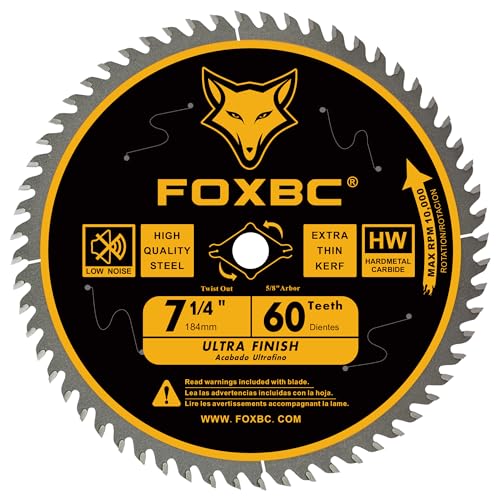
FOXBC offers a 7-1/4″ 60-tooth ATB blade designed for ultra-finish cuts. Its high-density tungsten carbide construction emphasizes toughness and wear resistance for long blade life. With a 0.063″ kerf and 5/8″ arbor, it delivers precise, splinter-free cuts suitable for melamine and other veneered surfaces, making it a reliable option for cabinetry and decorative plywood work.
Diablo Ultra Finish 7-1/4″ 60T (D0760X)

This Diablo model emphasizes precision cuts with a 60-tooth configuration designed for clean crosscuts in melamine, plywood, and hard woods. TiCo carbide provides robust edge retention, while a Perma-SHIELD coating reduces heat buildup and resin gumming. The blade targets minimal sanding for fine cabinetmaking and professional projects where edge smoothness is critical.
Freud LU79R007 7-1/4″ Thin Kerf

Freud’s LU79R007 features a thin kerf and Hi-ATB grind to deliver splinter-free cuts on melamine, plywood, and veneered surfaces. The 60-tooth design provides a balance between fast material removal and clean edges. The Hi-Density TiCo carbide enhances wear resistance for repeated uses on project boards, furniture panels, and cabinetry components.
Freud LU79R006M20 160mm Thin Kerf

Freud’s LU79R006M20 blade is a 160mm variant designed for plywood and melamine through larger saw configurations. Its 48-teeth count is paired with a TiCo Hi-Density carbide blend, offering smooth, chip-free cuts in veneered boards. The 0.087″ kerf and 20mm arbor compatibility expand its use in heavier-duty applications where wider panels are common.
Buying Guide: Key Purchase Considerations
- Material Compatibility: Melamine edges benefit from blades with ATB or Hi-ATB grind and TiCo carbide for clean cuts and edge integrity. Look for coatings (Perma-Shield) to reduce heat and gumming.
- Blade Kerf and Tooth Count: For melamine, a thin kerf (0.059″ – 0.063″) with 60 teeth commonly yields smooth, splinter-free edges. Higher tooth counts increase finish quality but may slow material removal.
- Arbor Size and Compatibility: Most 7-1/4″ blades use a 5/8″ or 7/8″ arbor. Confirm your saw’s arbor before purchasing. Some blades use metric arbors (e.g., 20mm).
- Coatings and Coasting: Perma-Shield or similar non-stick coatings protect blades from heat and corrosion, extending life in melamine use where resin can gum up blades.
- Brand and Availability: Reputable brands (Diablo, Freud, FOXBC) offer blades designed for crosscuts and melamine with consistent performance. Availability on major retailers affects ongoing project timelines.
- Thin Kerf vs Standard Kerf: Thin kerf blades reduce waste and are often preferred for precise edge work on melamine surfaces, though they may require higher-quality saws to prevent deflection.
- Maintenance: Regularly clean the blade, remove pitch, and inspect teeth for chipping. Re-coating is not common, but replacement blades should be considered when performance declines.
In practice, choosing a blade with a fine tooth count, ATB or Hi-ATB grind, TiCo carbide, and a Perma-Shield coating tends to deliver the best melamine results. For cabinetmaking and trim work, opting for blades with a thin kerf helps minimize tear-out at the edges, while higher-quality coatings extend blade life in resin-heavy materials.