Answering the buyer’s need: these circular saw blades are designed to deliver smooth, accurate cuts in laminate surfaces, reducing chipping and tear-out. The top picks here are best for finish carpenters, DIY remodelers, and cabinet makers who value clean edges and dependable performance. The listed products cover a range of common lamination tasks—from straight ripping to detailed bevel cuts—across 4-1/2″ to 7-1/4″ sizes. The summary table below highlights the key attributes to compare at a glance.
| Product | Diameter | Tooth Count | Arbor | |
|---|---|---|---|---|
| Diablo Track Circular Saw Blade | 6-1/2″ | 52 | 】 | Finish work on laminate with track saws |
| DEWALT 6 1/2″ 90T | 6-1/2″ | 90 | 1/2″ | Smooth, fast cuts on vinyl laminate and similar materials |
| COMOWARE 7 1/4″ 60T | 7-1/4″ | 60 | 5/8″ | General wood, laminate, plywood |
| GRAFF 4-1/2″ 120T | 4-1/2″ | 120 | 3/8″ | Fine finish cuts in laminate and related materials |
| Revvstark 6-1/2″ 24T/60T | 6-1/2″ | 24T & 60T | 5/8″ | Versatile for cut types in wood and laminate |
Diablo Track Circular Saw Blade For Laminate
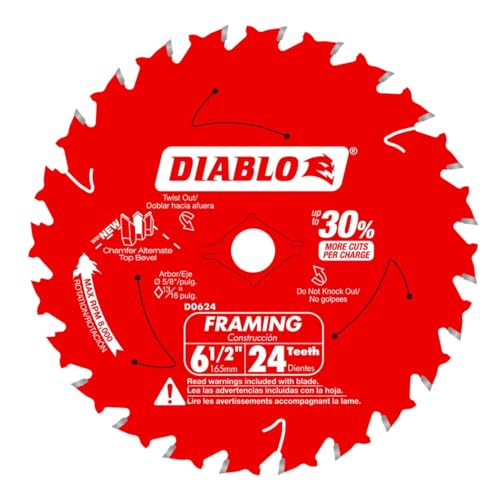
Features: Precision cuts delivering clean, straight, and beveled edges. Optimized for MDF, PVC, and laminate applications with a 1.8 mm laser-cut kerf for rigidity in track saw use. TiCo Hi-Density Carbide teeth provide longer life and consistent performance in ripping, cross-cutting, and plunge cuts.
Best for: Finish carpenters and installers who work with laminate in track saw setups, needing straight, precise cuts with minimal tear-out. Limitations: Best used with track saw systems; not ideal for high-volume, aggressive cutting without a track context.
DEWALT Circular Saw Blade, 6 1/2 Inch, 90 Tooth

Features: Tungsten carbide teeth stay sharper longer; anti-stick coating reduces friction and gum-up for smoother cuts; thin kerf enables faster, smoother cutting action.
Best for: General laminate work where a balance of speed and finish quality is needed, especially with vinyl-laminate layers. Limitations: Anti-stick coating helps, but finer teeth 90T may produce slower cuts on very thick laminates compared to high-ATB blades.
COMOWARE 7 1/4” 60T ATB Blade
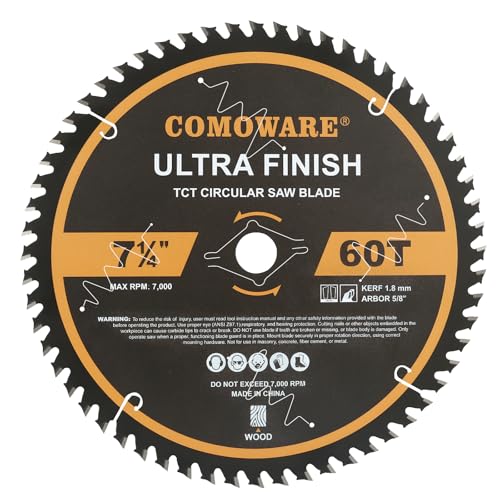
Features: Tungsten carbide teeth with ATB geometry for cleaner cuts in wood and laminate; 5/8″ arbor ensures stable fit on common saws; anti-vibration and Teflon anti-stick help maintain precision over long runs.
Best for: Longer cuts in laminate sections where edge quality matters. Limitations: 60T may not be ideal for extremely dense laminate or thick veneers as 90–100T blades might yield smoother finishes.
GRAFF 4-1/2 Inch Laminate Blade

Features: Suitable for wood, plywood, laminate, drywall, and plastic; smooth cutting with edges that avoid scoring; durable carbon steel construction for longevity.
Best for: Compact laminate tasks or tight spaces where a smaller blade size is advantageous. Limitations: 4-1/2″ blade may have limited depth of cut for thicker laminates.
Revvstark 6-1/2″ 24T & 60T

Features: 24T and 60T carbide-tipped options; high abrasion resistance; thin laser-cut kerf for fast, durable cuts; 5/8″ arbor for broad compatibility.
Best for: A versatile laminate job where both rough ripping and fine finishes are needed within one blade family. Limitations: 24T is more aggressive and may require more support to avoid tear-out on delicate laminates.
Buying Guide
- Blade size and arbor compatibility: Match the blade diameter and arbor size to your saw’s requirements. Laminate work often benefits from smaller blades for tight control or larger blades for faster, straight cuts.
- Tooth design and count: ATB (Alternating Top Bevel) teeth are common for clean finishes on laminate. Higher tooth counts yield smoother edges but slower cutting speed; lower counts cut faster but may require more finishing work.
- Kerf and rigidity: A thin kerf reduces material waste and effort but must be paired with a rigid blade to prevent deflection on straight cuts, especially when using a track saw.
- Coatings and debris resistance: Anti-stick coatings reduce gum-up in laminated layers that contain resins. Carbide teeth provide longer life on tough laminates and plastics.
- Material compatibility: Confirm the blade is rated for MDF, PVC, plywood, laminate, and similar non-metallic materials. For vinyl laminate, blades with fine teeth and clean kerf are beneficial.
- Track saw vs. handheld use: Some blades are optimized for track saw precision, offering smoother straight cuts. If using a track system, ensure kerf rigidity and track compatibility.
FAQ
- Do I need a special blade for laminate? Yes, blades with fine teeth, ATB geometry, and anti-chipping design reduce tear-out and provide cleaner edges on laminate surfaces.
- Is a higher tooth count always better for laminate? Higher tooth counts typically improve finish quality but can slow cutting; balance with your project speed needs.
- Can I use metal-cutting blades on laminate? No, use blades designed for non-metallic materials to avoid poor finishes or blade damage.
- Should I prefer carbide-tipped teeth for laminate? Carbide teeth offer longer life and consistent sharpness under resin-rich laminates common in cabinetry and furniture.
- Are 4-1/2″ blades useful for laminate? Smaller blades work well for tight spots or finish work in compact projects, but depth of cut can be a limitation on thicker laminates.
- What is the advantage of a 6-1/2″ blade with a track saw? Track-saw blades with proper rigidity help produce straight, accurate cuts with minimal chipping in laminate panels.