Yes—these circular saw blades are designed for fine cuts, delivering clean edges with minimal splintering. The best options suit different saws and project sizes, from compact 5-1/2 inch blades to standard 6-1/2 and 7-1/4 inch blades. This guide highlights five blades optimized for fine finishes, thin kerf design, and consistent performance across common woodworking tasks. The top picks are ideal for plywood, trim, cabinetry, and detailed crosscuts, with clear guidance on who benefits most from each option.
| Product | Blade Size | Tooth Count | Best For |
|---|---|---|---|
| Revvstark 6-1/2″ 24T & 60T | 6-1/2″ (165 mm) | 24T & 60T | Ripping and finishing cuts in wood |
| WORKPRO 6-1/2″ 60T | 6-1/2″ | 60T | Ultra-fine finish for plywood, trim |
| Echo Corner 7-1/4″ 60T | 7-1/4″ | 60T | Framing and crosscuts with smooth edges |
| FOXBC 6-1/2″ 60-Tooth | 6-1/2″ | 60T | General wood cutting with fine finish |
| Revvstark 5-1/2″ 24T & 48T | 5-1/2″ | 24T & 48T | Framing and finish cuts on wood |
Revvstark Circular Saw Blade 6-1/2″ 24T & 60T

Best for: Home woodworkers who need both a fast cut and a refined finish. The blade uses a durable alloy steel body with carbide teeth offering 24T for fast roughing and 60T for finer finishes. The thin kerf and heat-resistant teeth support cleaner cuts with less blade deflection, especially useful for crosscuts along the grain.
Why selected: Its dual-tooth design provides flexibility for different stages of a project, allowing quick material removal with a later fine-cut pass. The 5/8″ arbor is common on many saws, simplifying compatibility. Cautions: Ensure correct mounting to avoid overtightening and check for proper clearance with thicker materials.
WORKPRO 6-1/2″ Woodworking Circular Saw Blade

Best for: Cabinetry and trim work where a clean, finished edge is essential. This 60T carbide-tipped blade features laser-cut expansion slots to reduce vibration, delivering smooth cuts with minimal tear-out on plywood and laminates.
Why selected: The ultra-fine finish design enhances edge quality and reduces splintering, making it ideal for precision work. Cautions: The 60T configuration is best used with clean, sharp blades and properly aligned saw settings to maximize edge quality.
FOXBC 6-1/2″ Circular Saw Blade Ultra Fine Finish
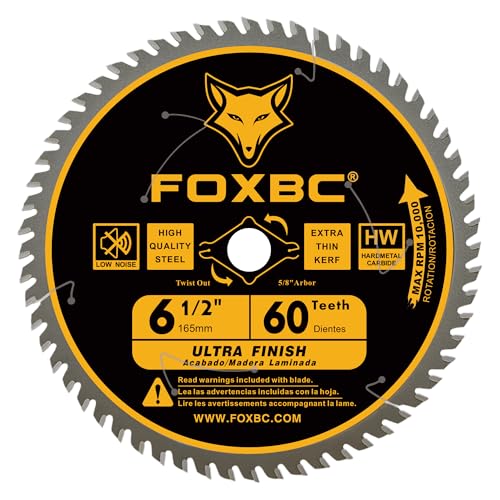
Best for: General wood cutting with a focus on a fine finish. This 60-Tooth blade emphasizes an ultra-thin kerf (0.059″) for fast, precise cuts with less effort and reduced waste, compatible with most corded and cordless saws.
Why selected: The combination of a thin kerf and 60 teeth supports tight tolerances and smoother crosscuts. Cautions: For thicker stock or heavy ripping, consider a blade with fewer teeth for faster removal and avoid overheating by maintaining steady feed pressure.
Luckyway 5-1/2″ 24T & 48T Combo Blade

Best for: Lightweight projects and framing where a balanced cut quality and speed are needed. The combo 24T and 48T teeth provide efficient ripping with a finish option, supported by a durable alloy steel body and C3 tungsten carbide tips.
Why selected: The two-tooth-count options give flexibility for varied tasks, from fast rough cuts to smoother finishes. Cautions: The 5-1/2″ size is best suited for smaller saws; ensure your tool can accommodate the arbor size and diameter.
Revvstark 5-1/2″ 24T & 48T for Wood

Best for: Small to medium wood projects requiring a balance of speed and finish quality. The 24T segment handles fast passes, while the 48T provides a cleaner edge for finish work, using durable tungsten carbide tips to resist wear.
Why selected: The 5-1/2″ size fits compact saws, while the mixed tooth counts expand versatility for different cut types. Cautions: Avoid heavy-duty ripping with the 24T setting on thick stock to prevent excessive heat buildup.
Buying Guide: Fine-Cut Circular Saw Blades
What to consider when choosing a fine-cut blade
- Blade size and arbor: Match your saw’s diameter and arbor to ensure proper fit and safe operation.
- Tooth count: Higher teeth (60T) deliver smoother, finer finishes; lower counts cut faster but with rougher edges.
- Kerf width: Thinner kerf reduces material waste and requires less force, aiding precision.
- Material and coating: Carbide-tipped teeth offer longer life and cleaner cuts in hardwoods and laminates.
- Vibration control: Expanded slots and blade plate stability contribute to smoother cuts and less chatter.
Best practices for achieving fine cuts
- Ensure blade is sharp and properly mounted with correct alignment to prevent deflection.
- Use appropriate cutting speed and steady feed pressure to minimize splintering.
- Rub-cutting or backer boards can further reduce tear-out on veneer surfaces.
Buying considerations by project type
- Cabinetry and trim: Prioritize 60T blades with fine finishes and minimal kerf.
- Framing and rough cuts: A 24T blade can speed up initial passes, then switch to a finer blade for finishing.
- Laminates and plywood: Look for blades with anti-splinter designs and thin kerf to reduce tear-out.
FAQ
- What blade is best for fine finishes? A 60T carbide-tipped blade is typically best for smooth edges on wood and plywood.
- Does kerf affect cut quality? Yes, a thinner kerf reduces material waste and improves cutting efficiency, aiding precision.
- Can I use a woodworking blade on hardwoods? Yes, carbide-tipped blades are suitable for hardwoods, but ensure the tooth geometry matches the task.
- How should I maintain blade life? Regular cleaning, proper storage, and avoiding overheating extend blade life.
- Is a higher tooth count always better? Higher tooth counts improve finish quality but may cut slower; choose based on the priority between speed and finish.
- Do blade sizes matter for different saws? Yes, use blades rated for your saw’s diameter and arbor to ensure safe operation.