Choosing the right diamond blade is essential for clean, efficient cuts in concrete, pavers, and masonry. This guide highlights five reliable options designed for dry or wet cutting on angle grinders and saws. We compare design, durability, and performance to help American DIYers and professionals select blades that balance speed, life, and dust control for paver projects.
| Product | Brand | Diameter | Arbor | Best For |
|---|---|---|---|---|
| MASTER DEPOT 7″ Segment Diamond Blade | MASTER DEPOT | 180 mm (7″) | 7/8″–5/8″ adjustable | Pavers, concrete, masonry |
| DEWALT DW4712 Block/Brick Blade | DEWALT | 7″ | 7″ | Dry/wet masonry, block, brick |
| CRALY 10″ General Purpose Blade | CRALY | 10″ | 7/8″ | Pavers, masonry, concrete |
| WHIRLWIND USA LSS 10″ Blade | WHIRLWIND USA | 10″ | 5/8″–7/8″ | Dry/wet cutting, general masonry |
| Trabo 7″ Masonry Turbo Rim Blade | Trabo | 7″ | 7/8″ with reducer | Cement, pavers, rebar cuts |
MASTER DEPOT 7 Inch Segmented Diamond Blade

The 7 inch segmented diamond blade from MASTER DEPOT uses a segmented design to improve airflow, dissipate heat, and remove dust. With a 180 mm diameter and a 10 mm segment height, it supports high-speed cutting up to 8700 rpm and is compatible with 7/8″–5/8″ arbors on handheld angle grinders. The ultra-thin 1.6 mm kerf reduces cutting resistance, enabling fast, precise cuts with lower vibration and noise, making it suitable for pavers and masonry work.
DEWALT DW4712 Block/Brick Diamond Blade

DEWALT’s 7-inch continuous rim blade is designed for dry or wet cutting of block and brick. Its high-performance masonry capacity supports smooth, consistent cuts with reliable heat management. While explicitly noted as a masonry blade, it is commonly used for general-purpose cutting tasks on concrete surfaces, including paver installations. The blade is manufactured in China and optimized for ease of use and durability in demanding conditions.
DEWALT DW4725 Masonry Blade
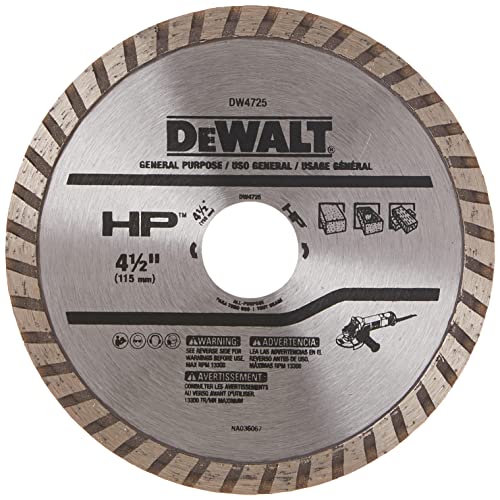
The DEWALT DW4725 blade features a high-performance diamond matrix that purportedly delivers up to 200 times the life of conventional abrasives and improved material removal. Its thinner kerf design enables faster cuts while minimizing dust. This makes it suitable for repeated passes over pavers, concrete, and other masonry materials, helping reduce downtime on job sites.
WHIRLWIND USA LSS 5-Inch Blade

The WHIRLWIND USA LSS 5-Inch blade uses a dense diamond construction and hot-press process to reduce vibration and noise during high-speed operation. It accommodates dry or wet cutting and provides a compact option for smaller paver projects where maneuverability is essential. It’s designed with durability and consistent performance in mind for concrete, stone, brick, and masonry tasks.
Trabo 7 Inch Masonry Turbo Rim Blade

The Trabo turbo blade features an interrupted cut design to deliver clean cuts at a competitive price. Its turbo rim is optimized for cement, pavers, concrete with rebar, and natural stone. The blade embeds quality diamonds for professional-grade cuts, with 7/8 inch arbor and a 5/8 inch reducer ring for compatibility with various tools. It’s suitable for tough masonry tasks needing robust performance without excessive heat buildup.
Buying Guide: Key Considerations For Paver And Masonry Blades
- Blade diameter and arbor: Ensure the blade diameter matches your tool and that the arbor size (7/8″, 5/8″, etc.) aligns with your grinder or saw. Some blades offer adapters for compatibility.
- Blade type and tooth design: Segmented blades promote faster chip removal and cooling, which is helpful for dense pavers. Continuous rims provide smoother cuts on bricks and blocks, while turbo designs excel at quick material removal in tough materials.
- Material compatibility: Choose blades rated for concrete, masonry, pavers, brick, terrazzo, or stone. Multi-material blades may perform well on a range of surfaces but may wear faster on exceptionally hard substrates.
- Dry vs. wet cutting: Dry blades are convenient for portability but may generate more heat and dust. Wet-cut capabilities reduce dust and temperature, extending blade life, but require a water source and seals on equipment.
- Durability and life: Higher-grade diamond matrices typically yield longer life, especially under heavy use. Consider blades with reinforced hot-press manufacturing for stability and reduced vibration at high RPM.
- Kerf thickness: Thinner kerfs cut faster and with less material removal, but can be more prone to damage if misaligned. Thicker kerfs are sturdier for through-cuts in tough materials.
- Safety and maintenance: Use proper PPE, verify tool speed ratings, and follow manufacturer guidelines for speed and feed. Regularly inspect blades for cracks or missing segments to prevent accidents.
- Cost vs. performance: Compare blade life and cut quality rather than just upfront price. A blade with longer life and cleaner cuts can reduce labor time on paver projects.
- Application range: If you work with mixed materials (concrete, brick, stone), select blades advertised for multi-material use, but calibrate expectations for each substrate to avoid subpar results.
Overall, the right blade for cutting pavers depends on material hardness, tool compatibility, and whether you prioritize speed, longevity, or dust control. The five blades featured here provide a range of options from segmented and turbo designs to continuous rim variants, helping you tackle driveway, patio, and walkway projects with confidence.