The right bandsaw blade can dramatically improve throughput, edge quality, and blade life when working with portable sawmills. This guide highlights five top options designed for 144″ and 158″ systems, with both DoubleHard high-alloy blades and durable option blends. Each blade balances longevity with sharpness, helping you maximize production while maintaining precise cuts on varied timber. Below you’ll find a quick summary and deeper product details to help you compare performance, compatibility, and value.
| Product | Length | Width | Rake | Material |
|---|---|---|---|---|
| Wood-Mizer 144″ Sawmill Blades (5-Pack) – DoubleHard 10° | 144″ | 1-1/4″ | 10° | High-alloy steel |
| Wood-Mizer 158″ Sawmill Blades (5-Pack) – DoubleHard 10° | 158″ | 1-1/4″ | 10° | High-alloy steel |
| 144″ Sawmill Blades 5-Pack – 10° All-Purpose (phabcf) | 144″ | 1-1/4″ | 10° | Alloy steel |
| Wood-Mizer 132″ Sawmill Blades (5-Pack) – DoubleHard 10° | 132″ | 1-1/4″ | 10° | High-alloy steel |
| 158″ Sawmill Blades – 10° All-Purpose (phabcf) | 158″ | 1-1/4″ | 10° | High-density alloy steel |
Wood-Mizer 144″ Sawmill Blades 5-Pack – DoubleHard 10°

Designed for portable sawmills, these 144″ blades come in a 5-pack to support continuous production with less downtime. The DoubleHard high-alloy steel offers improved wear resistance, aiming to deliver twice the blade life of standard carbon steel. They fit select Wood-Mizer, Harbor Freight, Norwood, Timbery, TMG Industrial, and Woodland Mills portable systems, making them a versatile choice for mixed equipment setups. The 10° rake provides a balanced cut for general-purpose sawing and hardwood processing.
Wood-Mizer 158″ Sawmill Blades 5-Pack – DoubleHard 10°
This 158″ blade set supports larger sawmill configurations and some resaw operations. The 5-pack includes DoubleHard 10° blades, engineered for extended sharp life and better wear resistance. They are compatible with select Wood-Mizer, Baker, Timberking, TMG Industrial, and Woodland Mills portable mills and band resaws. The blade geometry optimizes material removal while maintaining rigidity during long runs, reducing chatter and snag risks on variable grain.
144″ Sawmill Blades 5-Pack – 10° All-Purpose (phabcf)
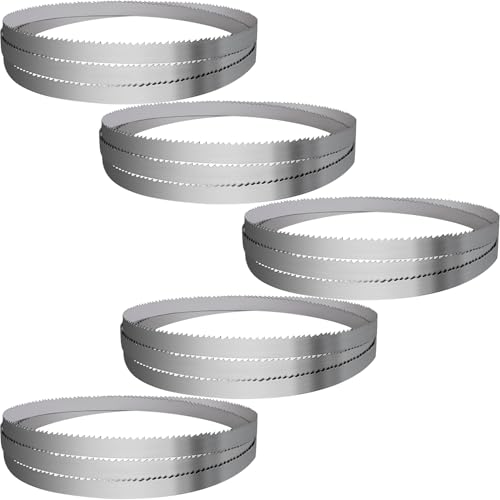
The 144″ blades in this set feature a 10° rake and 1-1/4″ width with a 0.042″ thickness, designed for compatibility with a range of 144″ sawmills including Wood-Mizer, Harbor Freight, Frontier, Timbery, and TMG Industrial Mills. High-density alloy steel and precision welding contribute to better wear resistance. The manufacturing process involves high-temperature treatment to enhance hardness and toughness, supporting tougher sawing tasks and longer blade life across hardwoods and softwoods alike.
Wood-Mizer 132″ Sawmill Blades 5-Pack – DoubleHard 10°
The 132″ blades are aimed at smaller portable mills or those that need shorter cut length without sacrificing blade strength. The DoubleHard 10° blades promise twice the sharp life versus standard carbon steel, with compatibility across Wood-Mizer, Baker, Hud-Son, and Timbery mills. They provide a solid all-around performance for general-purpose sawing and mixed species work, balancing cut quality with blade durability for frequent re-sawing and routine maintenance windows.
158″ Sawmill Blades 5-Pack – 10° All-Purpose (phabcf)
Featuring a longer 158″ length and the same 1-1/4″ width, these 10° blades are built for heavy-duty, all-purpose cutting. The high-density alloy steel and careful welding are designed to endure repeated stretching, traction, and coiling. The result is smoother operation and improved resistance to wear in demanding sawmill tasks, including hardwood processing and longer runs with consistent cut accuracy.
Wood-Mizer 144″ Sawmill Blades 5-Pack – DoubleHard 9° Hardwood
These 144″ blades are tailored for hardwood sawing with a 9° rake, offering robust performance on tougher wood species. The 5-pack format helps sustain productivity for crews running multiple shifts or keeping a steady inventory. The DoubleHard construction remains a core feature, delivering extended blade life and reliable cutting performance when faced with dense feedstock and heavy loads common in hardwood milling projects.
Buying Guide
When selecting bandsaw blades for sawmills, consider blade length, width, rake angle, and thickness to match your mill model and material. Longer blades (158″) are compatible with larger sawmills and can support deeper cuts, but require stable guides and tensioning. A 10° rake generally offers a good balance for all-purpose sawing, while a 9° to 10° variant may be preferable for hardwoods to balance aggressive cutting with control. Blade life is influenced by blade material and heat treatment; high-alloy or bi-metal construction typically yields longer service life under demanding loads.
Compatibility is critical. Confirm the blade length and tooth pitch with your mill maker or manual, and verify whether your equipment accepts the 1-1/4″ width and 0.042″ thickness. If you operate a mixed fleet, a set that includes blades with broad compatibility across brands can reduce the number of blade types you need to purchase. For frequent re-sharpening or long production runs, blades described as resharpenable or designed for extended wear resistance may offer the best long-term value.
Blade life and cutting quality also depend on material handling and maintenance. Proper tensioning, clean guides, and correct feed rates reduce tooth wear and chatter. Some blades advertise enhanced life through toughened or alloyed teeth; others emphasize easier resharpening with specialized grinding wheels. Consider your workflow: do you prioritize lower downtime, smoother cuts, or the ability to process harder species? Each option can address different production goals and maintenance capabilities.
Bottom-line considerations for choosing bandsaw blades for sawmills:
- Compatibility: Ensure the blade length, width, and thickness fit your mill and any resaws you operate.
- Tooth geometry: Rake angle and pitch affect cutting aggressiveness and smoothing; choose according to material type.
- Material and durability: High-alloy or bi-metal blades typically offer longer life on challenging stock.
- Maintenance: Resharpenable blades may reduce long-term costs but require appropriate equipment.
- Economics: Consider pack size and blade life when evaluating total cost per foot of cut.