Choosing the right air compressor pressure switch or relay switch ensures consistent pressure, protects the motor, and lengthens the life of your setup. This guide highlights five top options and explains who they’re best for. Whether you run a small shop, a garage setup, or a DIY project, these switches deliver dependable on/off control and easier wiring for 12V systems or standard 110V/120V configurations.
Buyer snapshot:
| Product | ||
|---|---|---|
| VIAIR 90111 | 12V portable systems needing built-in relay | On at 110 PSI, off at 145 PSI, built-in relay |
| MEANLIN MEASURE | Flexible 110–240V or 110–150V ranges with gauge option | 4-way replacement with gauge and relief valve |
| Ketofa LF10-4H-1-NPT | Versatile 4-port mounting for multiple outlets or gauges | Cut-in 95–125 PSI, 1/4″ NPT, four-port manifold |
| VIAIR 93940 | Heavy-duty 12V relay for higher draw | 40 Amp capacity, four spade posts |
| JahyShow | Universal replacement with strong durability | 90–125 PSI, 26A contacts, leak-proof design |
VIAIR 90111 Pressure Switch with Relay

The VIAIR 90111 integrates a pressure switch with a built-in relay, simplifying wiring for 12-volt systems. It activates at 110 PSI and detaches at 145 PSI, helping regulate cycling and protect the compressor motor. This option is best for portable air tools or vehicle air systems where a compact, single-unit control is preferred. A built-in relay extends load-carrying capacity, which can prolong component life in heavier-use scenarios.
Best for: users needing an all-in-one switch and relay for 12V systems with straightforward, predictable cycle behavior. Choose this if you want a compact, ready-to-wire unit without adding an external relay.
Caution: Ensure your load does not exceed the relay’s compatible current range for your particular compressor model.
MEANLIN MEASURE Pressure Switch with Gauge
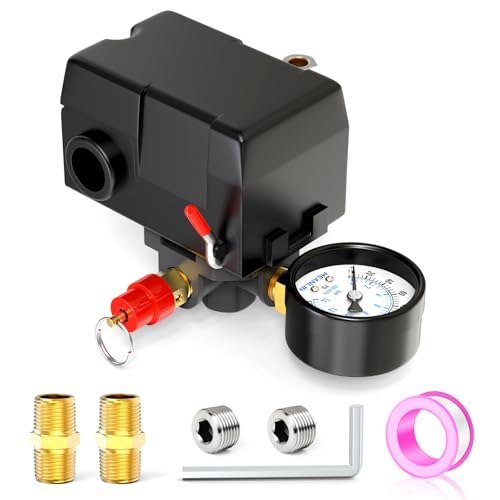
This pressure switch comes with a 0-200 PSI gauge and a safety relief valve, offering an easy-to-read pressure readout and additional protection. It supports 110–150V or 110–240V operation and uses a sturdy construction with a 1/4″ thread size. The red switch provides visible on/off control for automatic operation. This option is ideal for users who want a versatile control valve with integrated gauge and enhanced safety features.
Best for: workshops or home garages needing gauge-enabled monitoring and an automatic control switch for reliable pressure regulation. The design supports reliable operation in varied voltages.
Caution: verify the electrical rating matches your power source and ensure proper mounting to avoid unintended strain on connections.
Air Compressor Pressure Switch LF10-4H-4 Port
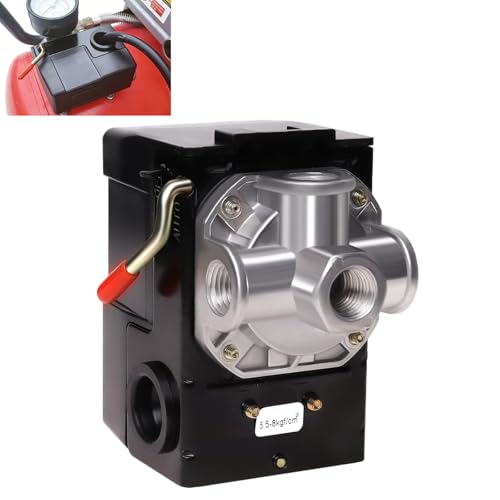
The LF10-4H-4 Port pressure switch is designed for flexibility with a four-port manifold that enables mounting in multiple directions and the optional addition of relief valves or gauges. It has a cut-off range of 95–125 PSI and a 1/4″ female NPT connection, making it broadly compatible with a variety of single- or two-stage compressors up to 125 PSI. This model supports modular setups where additional outlets are needed without sacrificing performance.
Best for: installations requiring multiple outlet ports or space for a relief valve and gauge. Choose this if you value flexible mounting and expansion capabilities.
Caution: ensure your system’s maximum operating pressure stays within the 125 PSI limit of this switch to avoid performance issues.
VIAIR 93940 40 Amp Relay

The VIAIR 93940 relay is built to handle higher electrical loads, with a 40-amp rating and four 1/4 inch spade post connectors. This option is suitable for compressors or systems that draw more current and require a robust relay. Its mounting tabs aid secure installation in a variety of layouts, reducing the risk of loose connections during operation.
Best for: high-draw 12V compressors or setups that require a stronger relay to manage larger starting or running currents. Choose this if a standard small-relay proves insufficient for your load.
Caution: ensure wiring gauge and fuse protection are appropriate for the 40A capacity to prevent overheating or wiring damage.
JahyShow Universal Air Compressor Pressure Switch

This JahyShow switch targets universal replacement with a 90–125 PSI range and a 26A maximum load, using 1/4″ NPT threading and robust sealing to prevent leaks. It emphasizes durability and consistent switching performance, suitable for both home garages and more demanding workshops. The leak-proof design and reinforced diaphragm are notable for long-term reliability in varied environments.
Best for: replacing aging switches or upgrading to a heavier-duty unit without changing port sizing. Choose this when you need strong electrical performance and a secure, leak-resistant design.
Caution: verify compatibility with your compressor’s port size and ensure the replacement model matches the target circuit’s electrical requirements.
Buying Guide
Key factors to consider when selecting an air compressor relay switch or pressure switch:
- PSI range and cut-in/cut-off: Match the switch’s operating window to your compressor’s performance and the tools you plan to power. Narrow ranges offer precise control; broader ranges accommodate variable workloads.
- Port size and threading: Most devices use 1/4″ NPT connections. Check compatibility with your hoses, valves, and fittings. Four-port options support multiple outlets or gauges; single-port designs keep things simple.
- Electrical rating: Ensure the relay’s amperage rating aligns with your system’s draw. Higher-load relays prevent nuisance tripping but require correct wiring and protection.
- Integrated gauge and relief valves: Gauges help monitor pressure directly on the switch. Relief valves add safety by preventing over-pressurization.
- Mounting and space: Four-port manifolds offer mounting flexibility, while compact units fit tight spaces. Consider the orientation and accessibility of adjustment screws and connections.
- Durability and materials: Look for robust housings, corrosion-resistant contacts, and sealed diaphragms to reduce leaks and maintenance needs.
- Voltage compatibility: For 110–120V systems, choose switches designed for that range; for 12V systems, prioritize integrated relays and simplified wiring.
- Replacement compatibility: If you’re replacing an existing switch, verify model numbers, port sizes, and electrical connections to avoid mismatches.
Frequently Asked Questions
- What is a pressure switch and why do I need a relay with it?
A pressure switch turns the compressor on and off at preset pressures. A relay improves electrical reliability by handling higher currents, reducing wear on the switch contacts and wiring.
- What PSI range should I look for in a home garage setup?
Common ranges are around 90–125 PSI or 110–150 PSI, depending on tools and compressor capacity. Choose a range that maintains adequate pressure for your largest pneumatic tool without frequent cycling.
- Are four-port pressure switches better than single-port ones?
Four-port switches offer mounting flexibility and additional outlets for gauges or valves. If you need multiple outputs, a four-port design is advantageous; otherwise, a single-port unit may suffice.
- How important is the unloader valve in a pressure switch?
An unloader valve helps release residual pressure when the compressor shuts off, reducing restart load and extending motor life.
- Can I use any 1/4″ NPT pressure switch on my compressor?
Most compressors accept 1/4″ NPT switches, but verify thread size, gauge needs, and electrical compatibility before purchasing.
- What safety features should I look for?
Relief valves, sealed diaphragms, and durable contact materials improve safety by preventing over-pressurization and electrical arcing.