Answering buyers seeking reliable inline air dryers for compressors, this article highlights five top options that deliver dry, oil-free air at common workshop pressures. These products are best for hobbyists, automotive hobbyists, or small to mid-size shops that need consistent air quality for spray guns, pneumatic tools, or plasma cutters. Each selection prioritizes filtration, easy maintenance, and clear water separation. Below you’ll find concise, comparison-friendly details to help you decide which line dryer fits your setup and workflow.
Summary table of chosen products:
| Product | Best For | Key Benefit | Max Pressure |
|---|---|---|---|
| LE LEMATEC Inline Air Dryer | General workshop use | 1-micron filtration; versatile 2-150 PSI range | 150 PSI |
| LNCHKA Double Filter + Regulator | Precise pressure control | Double filtration with adjustable regulator | 145 PSI |
| NANPU Desiccant Dryer | Dry, clean air for pneumatic tools | Zinc alloy body; color-change beads | 0-145 PSI |
| BLCH AF4000-04 Manual Drain | Budget-friendly, reliable drying | 5µm brass element; solid filtration | 145 PSI |
| AIRZOE AF4000-04 (1/2″ NPT) | Higher flow, mid-size setups | 5 micron brass element; 4000 L/min | 145 PSI |
LE LEMATEC Inline Air Dryer & Water Separator for Compressor, 1/4″ NPT
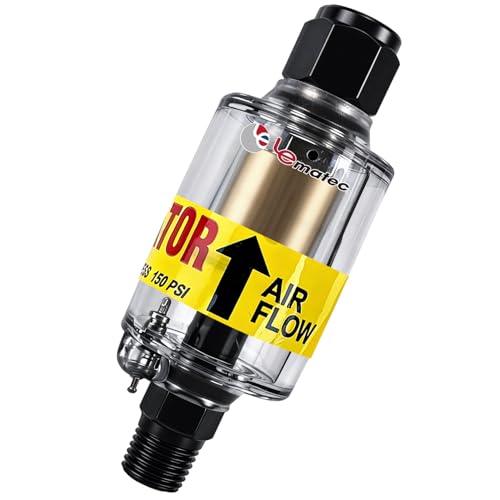
Best for: General workshops needing reliable moisture protection across various tools. Why selected: It offers a concise moisture protection stage with a 1-micron element, suitable for HVLP spray guns and other compressed-air tools, and operates across a wide pressure range (2-150 PSI). Caution: Ensure proper threading and sealant when installing to prevent leaks.
LNCHKA Air Filter Dryer 3/8 NPT Auto/ Semi-Auto Drain

Best for: Buyers who want stable outlet pressure with dual filtration. Why selected: Combines a transparent filter cup with a brass filter element and a regulator, aiding long-term service and clear maintenance indicators. Limitation: The 0-150 PSI range should be matched to your compressor’s capabilities to avoid over-pressurization.
NANPU Zinc Alloy Desiccant Dryer, 3/8″ NPT

Best for: Applications requiring very dry air prior to tooling. Why selected: Uses desiccant beads that change color to indicate replacement, with a zinc alloy body for added durability. Caution: Desiccant bead replacement timing depends on usage; monitor bead color to maintain dryness.
BLCH 1/2″ NPT Air Line Dryer AF4000-04

Best for: Smaller professional shops needing a reliable 5µm filtration option. Why selected: 1/2″ NPT fittings and a robust brass 5µm element deliver strong filtration with a longer service life. Caution: Check compatibility with existing plumbing and ensure correct mounting to avoid stress on fittings.
AIRZOE AF4000-04 1/2″ NPT Air Dryer

Best for: Mid-size setups requiring higher air flow. Why selected: 4000 L/Minutes flow with a 5 micron brass element, providing solid filtration and long service life. Caution: Confirm the line size matches 1/2″ NPT to prevent flow restriction.
Buying Guide
Use this quick guide to refine your choice when shopping for an inline air dryer.
- Filtration level: Choose 5µm brass elements for dry air and good water removal; consider 1µm elements for more sensitive tools.
- Pressure range: Ensure the dryer supports your system’s operating pressure (common ranges include 0-145 PSI and up to 150 PSI).
- Maintenance indicators: Models with color-changing beads or visual indicators simplify upkeep and reduce downtime.
- Material and build: Zinc or brass components offer durability; polycarbonate bowls provide visibility and heat resistance.
- Connection size: Match NPT size (1/4″, 3/8″, 1/2″) to your compressor and hoses for a tight, leak-free install.
- Drain type: Manual vs semi-auto drains affect maintenance frequency; choose based on how often you drain condensate in your workflow.
Frequently Asked Questions
- What is an air compressor line dryer used for?
Answer: It removes moisture and particulates from compressed air to protect tools and achieve better spray finishes and tool performance. - What does the micron rating indicate?
Answer: The micron rating refers to the size of particles the filter can remove; lower microns remove smaller contaminants. - Is a desiccant dryer better than a standard filter?
Answer: Desiccant dryers remove more moisture but are typically used for applications requiring extremely dry air; filters alone may suffice for general tools. - Can I install a line dryer with my existing regulator?
Answer: Yes, inline dryers are designed to integrate with regulators and other filtration stages; ensure proper thread size and seals. - How often should I replace the filtration element?
Answer: Replace as indicated by any visual indicators (e.g., color-changing beads) or at recommended maintenance intervals for your usage level. - What size line dryer do I need?
Answer: Choose based on your hose size (1/4″, 3/8″, 1/2″) and required airflow (L/min or CFM) for your tools.