Answering the common question: which air compressor is best for laser cutting and engraving machines? This guide compares eight reliable options, focusing on performance, suitability for different laser systems, and practical trade-offs. Ideal buyers include hobbyists upgrading a home shop, professionals running midsize laser workflows, and factory setups needing steady air supply and clean air handling. Below, you’ll find concise product snapshots, a buying guide, and a short FAQ to help you choose confidently.
| Product | Best For | Key Benefit |
|---|---|---|
| Cloudray 60W ACO-328 | Small CO2 laser engravers | Compact, heat-dissipation optimized |
| Cloudray 135W ACO-009D | Mid-range CO2 lasers | High flow, robust build |
| PYXGLAQ Air Assist (30L/min) | Desktop D1/D1 Pro laser engravers | Stable airflow, lens protection |
| Cloudray 160W ACO-009E | Powerful CO2 systems | Balanced air output |
| GWEIKE 3KW Screw Compressor | Industrial/large laser setups | High pressure, oil-free air |
| xTool Selected Air Compressor & Dryer | Metal cutting with clean air | HyperPure filtration |
| xTool Air-Compress Assist (M1/S1) | Advanced xTool machines | True 30L/min airflow |
| Reboot Plasma Cutter with Built-In Air Compressor | Integrated, compact setups | All-in-one unit |
Cloudray 60W Air Compressor ACO-328

Best for: Small CO2 laser engravers and hobbyist setups needing a compact, heat-dissipating air pump. It uses a 60W magnetic motor and 220V supply with 50Hz frequency. The case is made from aluminum alloy for lightweight heat management, and its straight-line reciprocating motion supports stable air production. Caution: check compatibility with your laser’s required air pressure range and ensure sufficient electrical supply.
Cloudray 135W ACO-009D Air Pump

Best for: Mid-range CO2 laser engraving systems needing higher air flow. Features include 135W power, 110V operation, 120L/min flow, and an aluminum alloy housing for effective heat dissipation. It is designed to provide robust air assist, while the durable construction supports longer operation. Limitation: higher power may require larger electrical circuits and cooling considerations in compact setups.
PYXGLAQ Air Assist for La-ser Cutter

Best for: D1 and D1 Pro laser engravers requiring steady 30L/min airflow. It helps remove smoke and debris for deeper, faster cuts and better lens protection. Selected for its emphasis on cleaner cuts and reduced downtime. Caution: ensure the nozzle and air path compatibility with your specific lasing module to prevent embrittlement or misalignment over time.
Cloudray 160W ACO-009E Air Pump

Best for: Higher-demand CO2 laser systems that require stronger air output. The 160W design emphasizes efficient cooling with a focus on heat dissipation through a ZL 102 aluminum alloy case. Choose this if your laser process benefits from stronger air pressure and consistent performance across longer runs. Caution: ensure your power supply and wiring can safely handle the 160W unit.
GWEIKE 3KW Screw Air Compressor

Best for: Industrial laser cutting with larger machines needing an oil-free, high-pressure air supply. It delivers 1.5MPa (217 PSI) output and is designed to work with M2/M3 laser series, providing faster and cleaner cutting. Caution: this is a high-capacity unit; verify space, noise, and maintenance requirements in a shop environment.
xTool Selected Air Compressor & Dryer

Best for: Metal cutting with clean, oil-free air and high filtration. It features a HyperPure three-stage filtration system removing oil, rust, and moisture, enabling precise cuts on stainless steel and other metals. Caution: compatibility with metal-cutting nozzles and expected service intervals should be reviewed for non-standard setups.
xTool Air-Compress Assist for S1/M1 Ultra

Best for: Advanced xTool machines needing true 30L/min terminal airflow and auto-adjusting air control. Benefits include reduced cutting edges with improved speed and efficiency. Caution: Auto mode requires compatibility with your machine’s control logic and may not suit all engraving tasks.
Reboot Plasma Cutter With Built-In Air Compressor
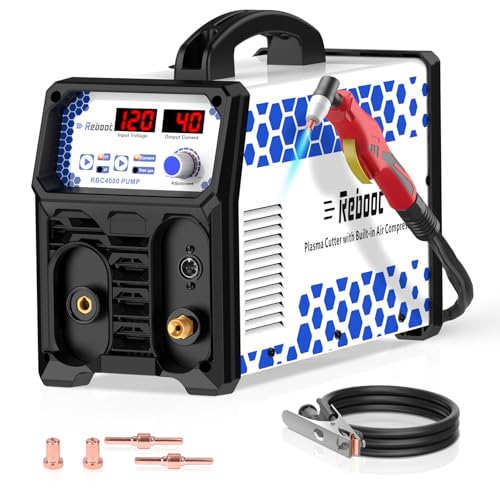
Best for: Integrated, compact plasma cutting setups needing an all-in-one air supply. This built-in air compressor reduces clutter and simplifies installation. Limitation: consider the trade-off between the compact design and potential serviceability or upgrade options compared to standalone units.
Buying Guide
- Air volume vs. laser needs: Determine your laser’s recommended air flow (L/min) and required pressure. Higher wattage lasers typically demand more robust air supply.
- Air quality: Oil-free and clean air reduce contamination risk for optical lenses and mirrors. Consider filtration (HyperPure or equivalent) when cutting metals or using high-power systems.
- Power and electrical compatibility: Match voltage (110V vs 220V) and frequency to your shop’s electrical setup. Ensure circuit capacity to handle startup surges.
- Build and heat management: Aluminum alloy housings and efficient heat dissipation extend component life in continuous operation.
- Integrated vs. standalone: Built-in compressors save space but may limit serviceability. Standalone units often offer easier upgrades and maintenance.
- Noise and footprint: Industrial units may be louder and larger; weigh workshop space and noise constraints when selecting a unit.
- Compatibility with laser hardware: Verify nozzle types, air paths, and connectors to ensure compatibility with your laser head and lens system.
Frequently Asked Questions
- What air pressure do laser cutters require?
– Most CO2 laser cutters benefit from a stable air pressure within a specified range per the manufacturer’s guidance; check your machine manual for exact values. - Why is oil-free air recommended?
– Oil-free air minimizes the risk of contaminating laser optics and reduces maintenance on lenses and mirrors. - Is an integrated air compressor better than a separate unit?
– Integrated units save space and simplify setup, but standalone compressors can offer easier upgrades and maintenance access. - What should I consider about filtration?
– Filtration reduces moisture, oil, and particulates, improving cut quality and tool longevity. Three-stage or high-efficiency filters are common. - Can I use a higher-capacity compressor for smaller machines?
– Yes, but ensure the system can regulate pressure to the laser’s required range to avoid hardware strain or overheating.