When shopping for a pressure switch for a 60 gallon air compressor, aim for models that reliably start and stop within a safe PSI range, offer multiple ports for expansion, and provide built-in safety features. This guide highlights five options that span common ranges from about 90 to 175 PSI. Each product is suited to different setups—industrial, DIY workshop, or garage systems—so you can pick based on your compressor’s cut-in and cut-out needs and expansion plans.
Buyer snapshot: the following table summarizes the five selected switches, their rated pressure range, port configuration, and best-use scenario.
| Product | Best For | Pressure Range | Ports |
|---|---|---|---|
| Square D Pumptrol Pressure Switch | General purpose, compact setups | 95–125 PSI | 1 port |
| MEANLIN MEASURE Air Compressor Switch | Auto control with gauge and safety valve | 110–150 PSI | 4 ports |
| Huivlei Heavy Duty Switch | Higher demand, 135–175 PSI setups | 135–175 PSI | 4 ports |
| Dreyoo Air Compressor Pressure Switch (90–120 PSI) | Lower-start systems, compact builds | 90–120 PSI | 4 ports |
| Dreyoo Air Compressor Pressure Switch (135–175 PSI) | Higher pressure, larger tanks | 135–175 PSI | 4 ports |
Square D Pumptrol Pressure switch for compressed air compressor 9013FHG12J52M1X 95-125 psi With Unloader & On/Off Lever (Paks)

The Square D Pumptrol is a compact, single-port pressure switch with a 95–125 PSI window and an unloader valve. It includes an ON/OFF lever for manual control, making it practical for simple 60 gallon setups that require quick start-stop actions. Best for smaller, straightforward air systems or as a replacement in existing units that use 1-port switches. A limitation is the narrow operating range, which may not suit higher-demand applications.
MEANLIN MEASURE Air Compressor Pressure Switch Control Valve 110-150 PSI
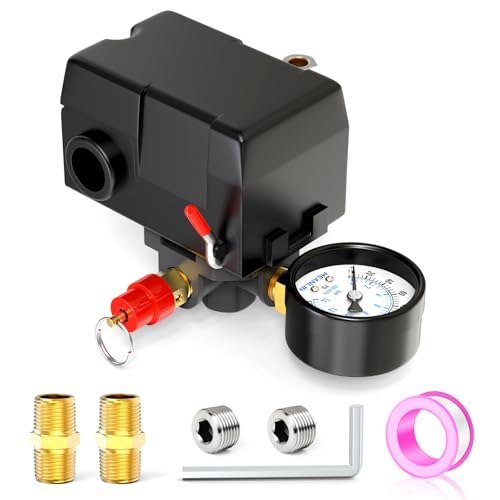
The MEANLIN MEASURE switch provides a wider 110–150 PSI range and a built-in 0–200 PSI gauge with a safety relief valve. It features a red ON/OFF switch knob for straightforward automatic control and a sturdy build suitable for mid-sized workshops. It’s a versatile choice when a larger starting range and quick visual pressure checks are beneficial, though it may require extra installation space due to its four-port design.
Huivlei Heavy Duty Pressure Switch for Air Compressor 135-175 psi

The Huivlei model is geared toward higher-demand setups with a 135–175 PSI range and a robust four-port manifold. It supports mounting flexibility and can accommodate additional elements like gauges or relief valves. Best for larger 60 gallon systems or shops that require higher cut-in pressures. A potential limitation is that the higher range may be unnecessary for lighter-duty tasks, increasing complexity without added benefit.
Dreyoo Air Compressor Pressure Switch, 90-120 PSI, 4 Port
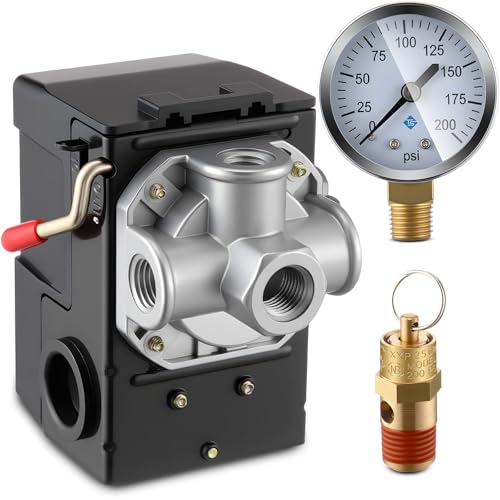
The Dreyoo 90–120 PSI switch features four ports and a 20 A rating, making it suitable for small to mid-size setups requiring stable auto-start and stop. It contains a 200 PSI brass safety valve and a 0–200 PSI gauge for monitoring. Choose this if you want a compact, reliable option that starts around 90 PSI and avoids over-pressurization. It may be limiting for higher-demand tools that need more headroom.
Dreyoo Air Compressor Pressure Switch,135-175 PSI, 4 Port
This Dreyoo model is built for higher-pressure applications with a 135–175 PSI range and four ports, facilitating expansion with gauges or relief valves. It includes a 0–200 PSI gauge for real-time pressure readouts and a brass safety valve for overload protection. Best for two-stage or more demanding single-stage compressors. A note: higher PSI ranges may not be necessary for all 60 gallon systems and could require more careful system matching.
Buying Guide
What range should you choose?
For most 60 gallon compressors used in DIY garages or light industrial settings, a switch in the 110–150 PSI or 135–175 PSI range covers typical cut-in/cut-out needs. If your system operates at lower pressures, a 90–120 PSI switch can be sufficient, while higher ranges suit tools with greater air requirements.
How many ports do you need?
Single-port switches are compact and easier to install, good for simple systems. Four-port switches allow adding gauges, relief valves, or multiple outlets, increasing flexibility for expansion or safety upgrades.
Why is safety valve and gauge important?
Built-in relief valves prevent over-pressurization, while a calibrated gauge helps monitor real-time pressure. For 60 gallon setups, these features reduce risk and help maintain consistent performance during heavy use.
What about ease of installation?
Look for a switch with compatible NPT connections (most are 1/4″ NPT). A model with an accessible ON/OFF lever or straightforward wiring can simplify maintenance and troubleshooting.
Which model should you avoid?
A switch with a narrow range that doesn’t match your compressor’s operating window can cause frequent cycling or insufficient start-up pressure. Ensure the selected switch aligns with your intended PSI window and mounting space.
FAQ
- What PSI range is typical for a 60 gallon compressor? Most setups use a range between 90 and 175 PSI, depending on the tools and accessories connected.
- Do I need four ports on a pressure switch? Not always. Four ports are beneficial if you plan to add gauges, safety valves, or multiple outlets, but many basic systems work well with a single-port switch.
- Is a higher PSI range better? Not inherently. Choose a range that matches your tools’ requirements and avoids unnecessary cycling or wear.
- Can I replace a pressure switch myself? Yes, with basic plumbing and electrical safety practices. Always disconnect power before replacing components and verify the wiring and fittings match your compressor.
- Should I choose a model with a gauge? A built-in gauge helps monitor pressure in real time, which is useful for maintenance and process control.
- What maintenance is needed for pressure switches? Periodically inspect for leaks, ensure the unloader is functioning, and confirm gauge accuracy to maintain consistent performance.