The best 6-inch circular saw blades for American DIYers and professionals deliver clean finishes, long life, and reliable performance across common wood-cutting tasks. This guide highlights five top choices and explains who each blade is best for, plus practical buying tips. Ideal buyers include cabinet makers, framing carpenters, and weekend DIYers who want crisp edges, reduced tear-out, and efficient cutting.
| Product | Brand | Arbor | Teeth | Best For |
|---|---|---|---|---|
| Oshlun SBW-060024 6-Inch 24 Tooth | OSHLUN | 1/2-Inch | 24 | General purpose and trimming |
| Diablo D0641X 6-1/2″ 40-Teeth Finish Trim | Diablo | 5/8-Inch | 40 | Finishing trim and plywood |
| Revvstark 6-1/2″ 24T & 60T | Revvstark | 5/8-Inch | 24 / 60 | Fast, versatile cuts |
| WORKPRO 6-1/2″ 60T | WORKPRO | 1/2-Inch | 60 | Plywood and trim finishes |
| DEWALT DWA1612CMB 6-1/2″ 18/24T | DEWALT | 1/2-Inch | 18 / 24 | General wood and framing |
Oshlun SBW-060024 6-Inch 24 Tooth ATB General Purpose

The Oshlun SBW-060024 is a general-purpose 6-inch blade with ATB geometry and a 1/2-inch arbor. Its thin kerf design minimizes the load on the saw and facilitates fast, easy cuts. Best for quick trims, cabinetry work, and smaller projects where clean edge quality matters and kerf waste matters less. This blade suits owners of saws that accept 1/2-inch arbors and need a capable all-around performer.
- Best for: General cuts, trimming, and finish work on light to medium stock.
- Why chosen: Consistent performance in a compact size with a user-friendly kerf.
- Caution: As a general-purpose blade, it may wear faster on very dense hardwood or exotic laminates.
Diablo D0641X 6-1/2″ Finish Trim Blade

Diablo’s finish trim blade features corrosion-resistant coating and a non-stick Perma-Shield layer to extend blade life and keep cuts smooth. With 40 teeth, it’s optimized for clean, precise finishes in trim work, plywood, and softwood. The blade’s durability makes it a solid choice for carpentry projects requiring crisp edges and minimal tear-out.
- Best for: Finishing work, trim cuts, and plywood where smooth edges are critical.
- Why chosen: Non-stick coating reduces resin buildup and prolongs blade life under typical shop conditions.
- Caution: Fewer teeth than a dedicated ripping blade, so avoid heavy ripping of thick hardwood.
Revvstark 6-1/2″ 24T & 60T Dual-Teeth Blade

The Revvstark blade provides both 24T and 60T configurations in one package, enabling fast rough cuts or finer finish work as needed. The 6-1/2-inch diameter and 5/8-inch arbor make it compatible with many framing and woodworking saws. It uses durable alloy steel and carbide tips to resist wear, with a thin kerf for reduced effort and waste.
- Best for: Projects requiring quick stock removal and cleaner finishes without changing blades.
- Why chosen: Flexibility to switch between faster and finer cuts without changing blades.
- Caution: 60T is optimized for finish work; use 24T when ripping or cutting harder stock for longer blade life.
WORKPRO 6-1/2″ 60T Finish Blade

The WORKPRO blade features a 60-tooth count and thin kerf for fine finishes on plywood, trim, and cabinetry. Laser-cut expansion slots reduce vibration and noise, promoting smoother cuts and longer blade life. The carbide-tipped teeth deliver durability for ongoing use in woodworking shops.
- Best for: Cabinetry, plywood finishes, and trim work where a clean, minimal-splinter cut is required.
- Why chosen: Laser-cut slots reduce vibration, improving accuracy and edge quality.
- Caution: Not ideal for aggressive framing cuts where higher stock removal is needed.
DEWALT DWA1612CMB 6-1/2″ Blade Set
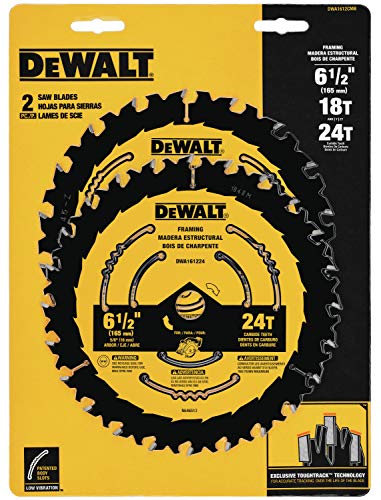
DEWALT’s 6-1/2-inch blade offers a choice of 18 or 24 teeth and features a patent-pending toughtrack design for accurate blade tracking. Built with high-density tungsten carbide and a tough coat anti-stick coating, this blade aims to deliver long life and reduced friction. It’s well suited for general wood cutting and framing tasks where dependable performance matters.
- Best for: General wood cutting and framing where consistent tracking is important.
- Why chosen: Toughtrack design aids precise alignment through long cuts.
- Caution: 18T version may require more passes on dense stock than a higher-tooth option.
Buying Guide
What should I consider when choosing a 6-inch saw blade?
Teeth count affects cut quality and speed. Higher tooth counts (40–60T) give cleaner finishes on plywood and trim, while lower counts (18–24T) cut faster through framing lumber. Kerf width matters: thinner kerfs require less force and generate less waste but can be less forgiving on difficult stock. Arbor compatibility (usually 1/2″ or 5/8″) is essential to ensure a proper fit with your saw.
Material and coating considerations
Carbide-tipped teeth extend blade life in hardwood and plywood. Anti-stick coatings reduce gumming when cutting resinous wood. Some blades feature stabilizer vents or laser-cut expansion slots to minimize vibration, improving accuracy and comfort during longer jobs.
Performance tips for best results
- Match tooth count to the task: rough framing with 18–24T, finish work with 40–60T.
- Use the correct arbor size and clamp the workpiece securely to prevent binding.
- Keep blades clean and free of pitch buildup to maintain cutting efficiency.
Which blade should I choose?
For a balanced kit, consider a 60T blade for finish work on cabinets and trim, paired with a 24T blade for quick framing or rough cuts. If you anticipate a lot of plywood and veneer work, a 40–60T blade with a durable coating can reduce tear-out and extend life. If you need flexibility without changing blades, blades offering both 24T and 60T options provide versatility for mixed tasks.
FAQ
- What blade is best for framing? A blade with 18–24 teeth is typically faster for framing lumber, but may leave rougher edges on sheet goods.
- Do I need a special coating on a circular saw blade? Anti-stick coatings help reduce gum buildup on resinous woods, improving cut quality and blade life.
- Is a thinner kerf always better? Thinner kerfs reduce material waste and saw load, but can be less forgiving on very dense stock.
- Can I use a 6-1/2″ blade on a 7-1/4″ saw? Some 6-1/2″ blades are designed to be compatible with many saws that accept a 1/2″ or 5/8″ arbor; always verify your saw’s arbor and plate alignment.
- Should I choose one blade for all tasks? A dedicated finish blade for trim and cabinetry and a separate faster-cutting blade for framing typically yields better results.
- What is kerf precision and why does it matter? A narrow kerf reduces material waste and saw load, enabling faster, smoother cuts with less effort.