Finding the right 40-tooth circular saw blade can dramatically improve cut quality and blade life across common framing and finishing tasks. This guide highlights five top options from trusted brands, focusing on carbide durability, kerf, vibration reduction, and compatibility with standard 5/8-inch arbors. Each blade is evaluated on its core performance features to help you choose the right fit for framing, finishing, and general woodworking projects.
| Product | Brand |
|---|---|
| DEWALT Circular Saw Blade, 6 1/2″ 40 Tooth | DEWALT |
| SKIL 7-1/4″ 40-Tooth Carbide Tipped | Skil |
| Diablo 7-1/4″ x 40 Tooth Finish Blade | Freud/Diablo |
| WEN 10-Inch 40-Tooth Carbide-Tipped | WEN |
| RIDONG 6-1/2″ 40 Tooth (5-Pack) | RIDONG |
DEWALT Circular Saw Blade, 6 1/2″ 40 Tooth Framing

The DEWALT 6 1/2″ 40-tooth blade features a patent-pending ToughTrack design to help maintain accurate tracking over the blade’s life. Its body slots reduce vibration for a steadier cut and a high-density tungsten carbide edge delivers toughness, wear-resistance, and a longer blade life. This blade is well-suited for framing tasks where clean, accurate crosscuts are essential, and it performs reliably across hardwoods and softwoods with reasonable resistance to chip-out.
SKIL 7-1/4″ 40-Tooth Carbide Blade

The SKIL 7-1/4″ 40-tooth carbide-tipped blade is designed for longer life, with carbide teeth that can outlast many standard steel blades—up to about 60 times longer in some comparisons. It’s compatible with typical 7-1/4″ circular saws (5280-01/5180-01/5080-01) and comes as a complete 40-tooth carbide blade ready for immediate use on framing and finishing tasks where smooth crosscuts are needed.
Diablo 7-1/4″ 40-Tooth Finish Blade

Diablo’s 7-1/4″ 40-tooth finish blade employs TiCo Hi-Density carbide teeth for smooth crosscuts through hardwood, softwood, and plywood. Its Perma-Shield coating reduces heat and gumming while extending blade life, and a super-thin laser-cut kerf minimizes material loss, delivering fast, clean cuts with a refined finish. Ideal for finish carpentry and precise trim work where appearance matters.
WEN BL1040 40-Tooth Carbide-Tipped Blade
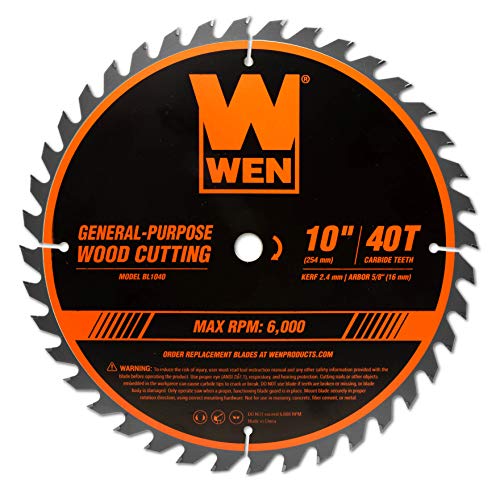
The WEN BL1040 is a 10-inch blade with a 5/8-inch arbor and a high RPM rating up to 6000, making it versatile for miters and table saws. Its ultrathin 1/10-inch kerf reduces resistance and heat buildup, enabling clean, efficient cuts through both hard and soft woods. This blade is a practical option for broader saw setups that require a fine finish with minimal waste.
FOXBC 6-1/2″ 40-Tooth Precision Blade

FOXBC’s 6-1/2″ 40-tooth blade offers a fine finish with a 5/8″ arbor and a 0.059″ kerf for fast, precise cuts. The blade is designed for compatibility with both corded and cordless circular saws, and targets general wood cutting including softwood, hardwood, plywood, MDF, OSB, and laminated products. Its finish-oriented design makes it suitable for cabinetry and decorative trim work where consistent cuts are important.
Buying Guide
- Tooth geometry and kerf: A 40-tooth blade provides a balance between speed and smoothness. Look for a thin kerf (0.059″ or similar) to reduce waste and heat buildup, especially on finishing cuts.
- Carbide quality: TiCo or high-density carbide teeth offer longer life and better edge retention. Consider blades with protective coatings (Perma-Shield or similar) to minimize gumming and corrosion.
- Blade body design: Vibration-reducing features, anti-vibration slots, and accurate tracking designs help ensure cleaner cuts, particularly in framing and rough carpentry.
- Material compatibility: Check the blade’s suitability for hardwood, softwood, plywood, MDF, and OSB. Some blades excel in crosscuts, others in general-purpose or finishing cuts.
- Arbor size and compatible saws: Most 40-tooth blades use a 5/8″ arbor. Confirm your saw’s arbor compatibility and consider alternate diameters if you’re using a combination of miter and table saws.
- Finish versus quick cuts: If your priority is finish quality, choose blades marketed for smooth crosscuts and low tear-out. For framing, prioritize durability and resistance to wear.
- Cost versus value: Higher carbide density and coatings often drive up cost but extend blade life. For frequent use, investing in a quality blade reduces replacement frequency and improves consistency.
- Maintenance: Regularly clean the blade and check for pitch and resin buildup. Proper storage in a dry environment prolongs blade life and performance.
Across these options, you’ll find blades optimized for framing and finishing tasks with reliable life, excellent cut quality, and compatibility with common American saws. Evaluate your typical materials and preferred finish to select the best 40-tooth blade for your workshop workflow.