Looking for a 30 degree framing nailer that combines reach with reliability? This guide highlights five top 30° nailers that balance power, weight, and versatility for framing, decking, and rough carpentry. The selections cater to professionals needing all‑day comfort, as well as DIYers tackling larger projects. Each product is evaluated for best use cases, benefits, and practical limitations to help you choose confidently.
Summary of recommended models:
| Product | Best For | Key Strength | Notes |
|---|---|---|---|
| Metabo HPT NR90ADS1 | General framing and subflooring | Selective actuation, light at 7 lbs | Versatile for many framing tasks |
| Makita XNB07Z | Cordless, mobile framing | Brushless motor, 30° clipped head | Battery not included |
| Metabo HPT NR1890DCA | Clexible cordless framing | Paper tape, brushless motor | Standalone battery solution |
| meite SN3483F | Hard-to-reach bays and overhead framing | 90-nail magazine, 30° angled magazine | Durable, clean operation |
| Carpenter Air Tools CHF9034 | Budget-friendly entry for 30–34° tasks | Heat-treated aluminum housing | 7-year warranty noted |
Metabo HPT Framing Nailer NR90ADS1 (30°)

The NR90ADS1 serves general framing tasks with a 30° paper‑collated nailer design. It weighs about 7 pounds, balancing power with reduced user fatigue for all‑day use. Selective actuation lets users switch quickly between sequential and contact nailing, supporting both precise placements and rapid runs. Best for professional framers and serious DIY projects where versatility matters, such as flooring, wall framing, and roof decking. A potential limitation is the need for compatible nails and possible adjustments for varied decking or sheathing jobs.
Makita XNB07Z 30° Framing Nailer

Makita’s 30° clipped‑head framing nailer is cordless, using an 18V LXT battery. It drives up to 1,000 nails per charge and offers a 2‑mode selector for sequential or bump fire, making it suitable for long wall runs and overhead work. This model is best for users prioritizing mobility and minimal hoses or compressors; however, battery life and charging time are practical considerations for extended jobs. It excels where a portable, battery‑powered solution is a benefit.
Metabo HPT NR1890DCA 18V Cordless 30° Framing Nailer Kit

This cordless 30° framing nailer kit uses a brushless motor to deliver efficient driving of 2″ to 3-1/2″ paper‑tape nails. It supports fast performance with up to three nails per second and offers tool‑less depth adjustment plus a selective actuation switch. Weighing around 8.2 pounds without the battery, it’s well suited for tight spaces where a compressor is impractical. The main caveat is battery dependence; performance hinges on battery health and charge level.
meite SN3483F 30° Framing Nailer

The meite 30° framing nailer combines a lightweight 8.5‑lb design with a 90‑nail capacity magazine and a dual‑mode trigger for speed or precision. The 30° angled magazine helps reach tight bays, between joists, and over trusses where straight magazine guns struggle. It’s a strong choice for professional crews who value sustained grip and consistent loading. A potential limitation is that some users may prefer a larger magazine or different nail types depending on the project scope.
Carpenter Air Tools CHF9034 30–34° Framing Nailer
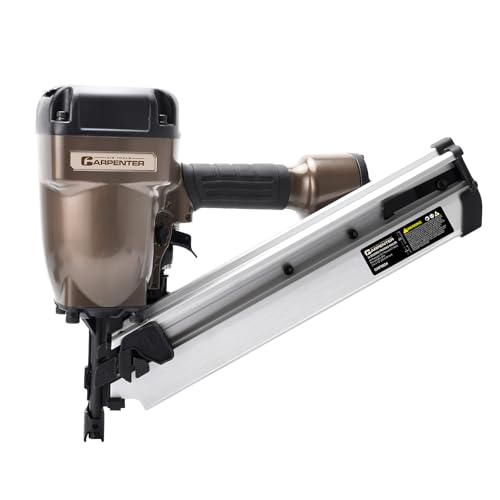
The CHF9034 offers a 30–34° paper‑collated framing solution with a focus on durability, featuring heat‑treated aluminum housing and tool‑free depth adjustment. Its lightweight feel and comfortable grip support extended framing sessions, making it favorable for framing, decking, and roof work. The lower market prominence means potential buyers should verify availability and parts support when selecting this option.
Buying Guide: How To Choose A 30° Framing Nailer
- Drive system and power: Consider pneumatic versus cordless models. Pneumatic nailers excel when a compressor is available, offering consistent power. Cordless models provide mobility and cleaner sites but rely on battery life and charges.
- Magazine angle and capacity: A 30° angled magazine improves access to tight bays, joist spaces, and roof trusses. Higher nail magazine capacity reduces reloads on long framing runs.
- Trigger options: Dual‑mode (sequential and bump) triggers boost control and speed. Sequential helps with precise placements, while bump fire accelerates large runs.
- Weight and balance: Lighter tools reduce fatigue on long jobs. Look for balanced tools around 7–8.5 lbs for all‑day use.
- Depth adjustment: Tool‑free depth control enables quick changes for different materials, such as plywood, softwood, or engineered lumber.
- Nail compatibility: Confirm the nail type (paper tape vs plastic collated) and the range of nail sizes (2″ to 3-1/2″ typical) to match your projects.
- Maintenance and parts availability: Check ease of service, availability of replacement parts, and warranty coverage for durability on tough job sites.
FAQ
- What is a 30° framing nailer best used for?
It is ideal for tight spaces such as roof trusses, wall bays, and between joists where straight guns don’t fit, enabling efficient framing and decking work.
- Should I choose cordless or pneumatic nailers?
Cordless offers mobility and less setup time; pneumatic provides steady power for continuous use. Your job site power availability and duration will guide the choice.
- What nail sizes do 30° nailers typically drive?
Most models drive 2″ to 3-1/2″ nails, with some supporting up to 3-1/2″ depending on the magazine and tool design.
- Is a high magazine capacity important?
Yes, for long framing runs it reduces reloads and keeps workflow steady, especially on wall and floor framing.
- Do 30° nailers require special nails?
Most use paper tape or plastic collated nails designed for angle magazine designs; verify compatibility with your chosen tool.
- What is selective actuation and why does it matter?
Selective actuation lets you switch between sequential and bump firing, balancing precision with speed for different framing tasks.