Answering the right question for buyers who want reliable 160mm blades: these picks cover crosscuts, ripping, plywood, and general purpose tasks. The top picks are best for professionals and DIYers who prioritize clean cuts, minimal waste, and compatibility with common saws. This guide highlights five blades, detailing who they’re best for and why they stand out.
| Product | Best For | Why It Stands Out |
|---|---|---|
| Freud LU87R006M20 | Ripping and fast feed | Thin kerf and TiCo carbide optimize performance and material removal. |
| CMT Orange Tools 273.160.56H ITK Plus | Finish and crosscuts | Thin kerf reduces waste; ideal for fine finish on delicate woods. |
| CMT 271.160.24H ITK Plus | General ripping and crosscuts | Thin, light blade body for accurate cuts across woods. |
| Freud LU79R006M20 | Plywood and melamine | Hi-ATB geometry yields splinter-free finishes on panels. |
| Oshlun SBFT-160048 48T FesPro | Crosscuts on hardwoods | Professional-grade carbide and ATB geometry for clean, precise cuts. |
Freud LU87R006M20: 160mm Thin Kerf Rip Blade

Best for ripping tasks, this 160mm blade uses a 20mm arbor and a .098″ kerf. The ATB grind with a 20° hook angle provides aggressive material removal, while the TiCo HI-Density carbide supports long blade life. The thin kerf design allows faster feeding with less waste, making it suitable for plywood and softwood ripping.
Who it’s best for: professionals and DIYers who frequently rip across sheet goods and require efficient material removal with fewer passes. Why chosen: the combination of thin kerf, TiCo carbide, and ripping geometry yields strong performance in ripping applications. Limitation: not ideal for heavy crosscuts or non-wood composites where a finer crosscut blade performs better.
CMT ORANGE TOOLS 273.160.56H ITK PLUS

This 160mm blade emphasizes finish cuts. It features a thin-kerf design to minimize waste and is particularly suitable for precise cuts in hardwoods and delicate woods. The blade works with miter saws, table saws, and cordless configurations.
Who it’s best for: woodworkers needing slim waste and smoother finishes on finish-grade cuts. Why chosen: the thin kerf reduces resistance, improving cut quality and reducing overall material waste. Caution: blade compatibility depends on arbor size and machine type, so verify your saw’s arbor before purchasing.
CMT 271.160.24H ITK Plus RIP and Crosscut
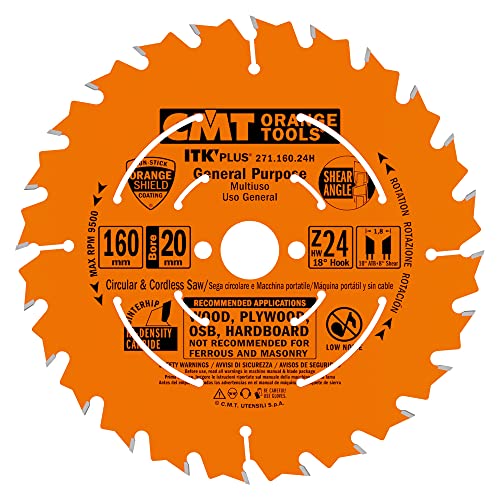
A versatile 160mm option designed for both ripping and crosscuts. Blade body thickness 1.2 mm with a 20 mm bore offers stable performance for general-purpose tasks. Best for mixed-cut jobs where one blade handles both passes with adequate cleanups.
Who it’s best for: woodworkers needing a single blade for multiple cut types. Why chosen: balanced geometry supports consistent results across common woodworking tasks. Limitation: not specialized for ultra-fine finishes or non-wood materials.
Freud LU79R006M20: 160mm Thin Kerf Ultimate Plywood & Melamine

Designed for plywood and melamine, this blade uses a Hi-ATB grind and a 2° hook angle with a .087″ kerf. The 48-tooth configuration yields smooth finishes on sheet goods, reducing chipping and splintering. It’s a solid choice when sheet stock quality matters most.
Who it’s best for: cabinetry and panel work where clean edges are essential. Why chosen: Hi-ATB tooth design minimizes tear-out on laminated and veneered panels. Caution: higher tooth counts can mean slower feed on very hard hardwoods compared to rip-focused blades.
Oshlun SBFT-160048 48T FesPro Crosscut

Designed for crosscuts on hardwoods, this 48-tooth blade features a fine tooth profile with a 20mm arbor and ATB geometry. It’s compatible with Festool TS 55 EQ, DeWalt DWS520, and Makita SP6000K, and is suitable for precise crosscuts in sheet goods and veneer panels.
Who it’s best for: professionals needing a crosscut blade that fits common Festool and competing track saws. Why chosen: professional-grade C-3 carbide and ATB geometry support clean, accurate cuts. Limitation: optimized mainly for crosscuts rather than aggressive ripping.
Buying Guide
Key considerations when choosing a 160mm saw blade:
- Cut type: Choose blades with specific tooth geometry for ripping, crosscutting, or mixed tasks. Thin kerf blades reduce waste and require less power.
- Arbor and bore: Ensure the blade’s arbor size (often 20mm for these blades) matches your saw’s arbor. Some machines require adapters.
- Material compatibility: Plywood, melamine, hardwood, and non-ferrous metals each benefit from different tooth configurations (ATB, Hi-ATB, C-3 carbide).
- Coating and carbide: TiCo or other premium carbides extend blade life in demanding cuts. Consider Hi-ATB or ATB designs for finish quality.
- Machine type: Some blades are optimized for specific saws or track saws. Verify compatibility with Festool TS series or Makita/DeWalt units.
- Finishes and waste: Thin kerf blades cut with less waste but may require more precise setup. Heavier blades offer durability for rough work but produce more waste.
Frequently Asked Questions
- What is kerf, and why does it matter?
Kerf is the width of the cut the blade makes. A thinner kerf reduces waste and requires less power, improving feed rate and efficiency.
- Are 160mm blades universal for track saws?
Not always. Confirm arbor size (often 20mm) and compatibility with your saw model or track system.
- What blade is best for plywood?
Blades with Hi-ATB or ATB geometry and a finer tooth count typically deliver splinter-free finishes on plywood and melamine.
- Can I use a ripping blade for crosscuts?
Ripping blades perform well for rough cuts but crosscuts benefit from blades designed for finish quality to minimize tear-out.
- How does tooth count affect cut quality?
Higher tooth counts yield smoother finishes but may cut more slowly. For fast ripping, lower tooth counts are often preferred.