Choosing the right 14-inch table saw blade can dramatically impact cutting accuracy, finish quality, and overall efficiency in a shop. This guide highlights five leading 14-inch blades, covering a mix of general purpose and specialty options. Each blade profile is paired with practical usage notes to help you select the best blade for your tasks, from ripping and cross-cutting to laminate work and metal-cutting prep.
| Product | Brand | Teeth | Arbor | Best For |
|---|---|---|---|---|
| SUNFUL 14 Inch Miter/Table Saw Blades 80T | SUNFUL | 80 | 1″ | General purpose wood cutting, nails in wood resistant |
| Freud LM72R014 | Freud | 30 | 1″ | Ripping, heavy-duty cuts |
| Freud LU97R014 | Freud | 108 | 1″ | Laminate and melamine |
| HARFINGTON 14″ Blade with 100 Teeth | HARFINGTON | 100 | 1.18″ | General purpose, smooth finish |
| Amana Tool DT14840 | Amana Tool | 84 | 1″ | Sliding table applications |
The selections below provide a cross-section of blade designs and tooth geometries to suit different woodshop tasks, including high-precision laminates, softwood and hardwood cutting, and general-purpose ripping. Each entry includes a clickable Amazon link for quick reference and an image to help you visually identify the blade style.
SUNFUL 14 Inch 80T Miter/Table Saw Blade

The SUNFUL 14-inch blade features 80 carbide tips with a 1″ arbor. Its 80-tooth configuration is ideal for general-purpose wood cutting, offering balanced performance for both miter and table saw tasks. The 100% YG8 carbide tips are aimed at durability, and the blade is described as delivering up to 50% longer cutting life than some competitors. Users can expect smoother cuts with reduced chipping in softwood and reasonable performance in hardwood, especially when paired with proper feed rates and sharpness maintenance.
Freud LM72R014 14″ 30T Heavy-Duty Rip Blade

Freud’s LM72R014 uses a 1″ arbor and a 14″ diameter with 30 teeth. The extra-large, flat tooth design is optimized for ripping, producing fast removal of material with a smoother finish that typically requires less sanding. The TiCo HI-Density carbide blend provides long life and consistent performance under heavy loads. This blade is well-suited for ripping long sheets of lumber or thick stock where minimal tear-out and efficient chip removal are prioritized.
Freud LU97R014: 14″ 108T Laminate/Melamine Blade

The LU97R014 is designed for laminate and melamine work, featuring 108 teeth with a triple-chip grind (TCG) and a tiny -3° negative hook angle optimization. The 1″ arbor and 14″ diameter pair with a thin kerf to minimize waste when cutting panel materials. This blade excels at producing clean, precise cuts in laminate countertops, cabinet faces, and other veneered materials where a flawless edge is essential.
HARFINGTON 14″ 100-Tooth General-Purpose Blade

This 14″ blade by HARFINGTON offers 100 carbide-tipped teeth on a 1.18″ arbor. The tighter tooth count compared to a standard ripping blade makes it a strong choice for smooth, precise cuts in softwood and hardwood alike. The carbide tips help resist wear and dulling, while the tooth geometry is designed to minimize vibration and heat buildup for a more controlled cutting experience.
Amana Tool DT14840 Carbide Tipped Sliding Table Blade
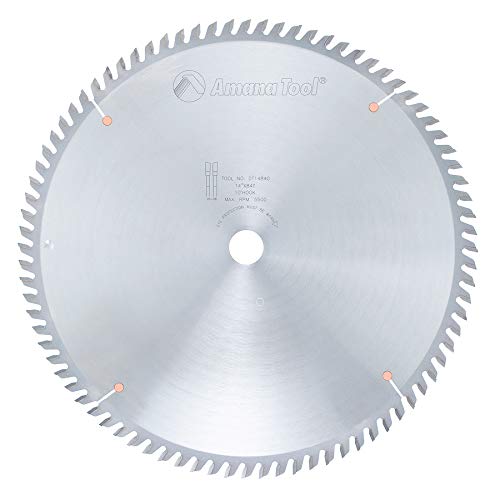
The DT14840 blade from Amana Tool has 84 teeth on a 14″ diameter with a 1″ bore. Designed for sliding table applications, this blade focuses on clean, precise cuts with minimal resistance. The carbide tips are engineered for durability, enabling longer blade life under repeated cross-cut and rip-cut operations in plywood, MDF, and hardwood panels. It suits cabinetry and detailed woodworking where fine edge quality matters most.
Amana Tool DT14108-30: 14″ 108T ATB Blade
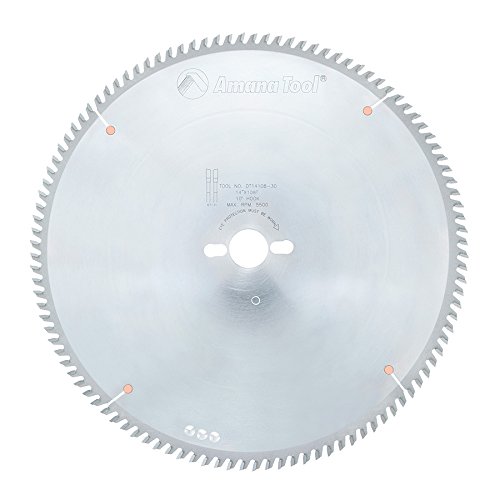
Amana’s DT14108-30 features 108 teeth with a 3″ bore option, providing a versatile configuration for high-precision cutting with ATB tooth geometry. This blade is suitable for cutting sheet goods, plywood, and veneer-laden panels. Its carbide tips deliver consistent performance across repeated cycles, helping maintain sharpness and edge quality over time.
Buying Guide
Key considerations when choosing a 14-inch table saw blade include tooth geometry, tooth count, and the intended material. Higher teeth numbers like 108T and 84T are ideal for fine finishes on laminates, plywood, and melamine, reducing chipping and tear-out. Lower tooth counts, such as 30T, are better for aggressive ripping and faster stock removal, though they may require more sanding for a smooth finish.
Arbor size and kerf thickness affect compatibility and cut quality. Most 14-inch blades use a 1″ arbor; verify your saw’s specifications before purchasing. A thin-kerf blade reduces material waste and requires less power, which is advantageous for portable saws. Carbide-tipped blades extend life and resist dulling under heavy use, especially when cutting harder woods or laminated panels.
Laminate and melamine blades typically adopt a triple-chip grind (TCG) or similar geometry to minimize chipping along the cut line. Metal-cutting blades for mild steel and non-ferrous metals feature different tooth configurations and coatings to manage heat and burr formation. For mixed-shop tasks, a set that includes both general-purpose and laminate blades helps streamline project workflows.
Maintenance matters: keep blades sharp, clean, and properly aligned. Regularly check the arbor nut tension and ensure proper blade alignment to prevent burn marks and uneven cuts. When switching between materials, inspect for residue or pitch buildup and clean the blade to maintain performance.
In summary, selecting the right 14-inch blade depends on the primary material you work with and the finish you require. A 108T laminate blade excels in veneers and panels, while a 30T ripping blade delivers speed for rough cuts. A well-balanced kit includes at least one laminate/ATB blade, one ripping blade, and a general-purpose blade with a comfortable balance of speed and finish.