The best 12 inch circular saw blades deliver clean, precise cuts with long life. This guide highlights five top options suited for different wood projects and tool types. Choose this for fine finish work, heavy ripping, or general-purpose cutting, depending on your needs. The top picks include blades optimized for finish quality, reduced vibration, and high tooth counts for smooth surfaces. This is ideal for American hobbyists and professionals seeking reliable performance across miter saws and table saws.
| Product | Best For | Arbor | Tooth Count |
|---|---|---|---|
| DEWALT 12 Inch 80T Carbide DWA11280 | Fine finish and accuracy | 1 inch | 80 |
| OA-BRES 12-Inch 100-Tooth ATB | Ultra-fine finish wood cutting | 1 inch | 100 |
| WEN BL1280 80-Tooth Finisher | Professional finish cuts | 1 inch | 80 |
| WEN BL1248 48-Tooth Carbide | General-purpose with clean cuts | 1 inch | 48 |
| REVVSTARK 100T Carbide | Durable, fast cutting | 1 inch | 100 |
DEWALT 12 Inch 80T Carbide Circular Saw Blade

Best for fine finish work and high precision. The DEWALT DWA11280 features up to three times longer life and improved finish quality, courtesy of carbide teeth and a patented body-slot design to reduce vibration. The tooth geometry is optimized for accuracy in crosscuts and rips on hardwoods and softwoods. Best for professional carpentry and cabinetry projects where clean edges matter. A potential limitation is that higher tooth counts can slow aggressive ripping on very hard materials compared to lower-tooth blades.
OA-BRES 12-Inch 100-Tooth ATB Blade

Best for ultra-fine finishes and smooth cuts. This 12-inch blade uses Alternating Top Bevel teeth for efficient, precise wood cutting with a 1-inch arbor. Its durable alloy steel with tungsten carbide teeth provides wear resistance and longevity for finish carpentry, cabinetry, and hobby woodworking. Choose this if you frequently cut hardwoods and require very clean edges. Limitation: the higher tooth count can reduce material removal speed on dense woods compared to lower-tooth blades.
WEN BL1280 12-Inch 80-Tooth Finish Blade
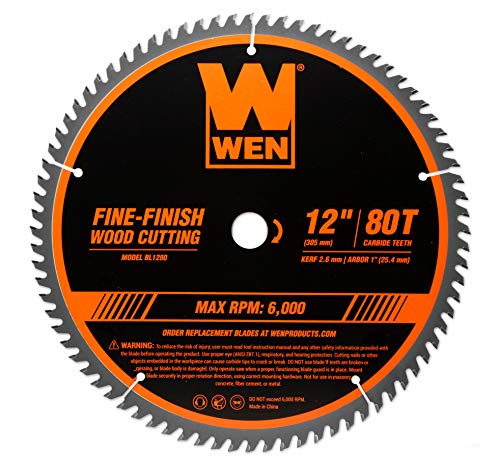
Best for professional finish cuts on miter and table saws. The WEN BL1280 blade runs up to 6000 RPM and features an ultra-thin 1/10-inch kerf for reduced tear-out and clean, accurate cuts. Its 80 teeth balance speed and finish quality well for softwoods and many hardwoods. Avoid this if you need aggressive stock removal on very dense materials, where a lower-tooth blade would perform better.
WEN BL1248 12-Inch 48-Tooth Carbide Blade

Best for general-purpose cutting with clean edges. The 48-tooth blade from WEN offers reliable performance for both miter and table saw tasks, with a 1-inch arbor and a robust construction suitable for a range of softwoods and hardwoods. It’s a solid all-around choice if you want a blade that handles ripping and crosscuts reasonably well. Limitation: fewer teeth may result in rougher finishes on highly figured or very hard woods compared to finer-tooth blades.
REVVSTARK Circular Saw Blade 100T

Best for durable, fast cutting with high finish quality. The Revvstark 12-inch blade uses 100 carbide teeth and a 1-inch arbor, rated up to 6500 RPM. Its laser-cut kerf and strong carbide teeth deliver true cuts with resistance to wear and heat, making it suitable for long sessions of wood cutting and edge finishing. Limitation: general-use blades may not excel in extreme end-cutting scenarios or non-wood materials where specialized blades perform better.
Buying Guide
What should you consider when choosing a 12 inch blade?
Tooth count is a key factor. Higher tooth counts (60–100T) are better for fine finishes; lower counts (40–48T) cut faster but leave smoother edges with less refinement. Kerf thickness affects material removal and chatter; ultra-thin kerfs reduce waste but can be more prone to deflection on dense stock.
Material and coating
Carbide-tipped teeth extend blade life and cut quality, especially on hardwoods. Some blades add coatings to reduce friction and heat buildup. For most finish work, carbide teeth with a precision grind yield the best results.
Arbor compatibility
Most 12-inch blades use a 1-inch arbor. Always verify arbor size and ensure your saw accepts that blade. Some blades include adapters or are compatible with 1/2-inch arbors on older equipment.
Work type and environment
Finish carpentry, cabinetry, and fine woodworking benefit from high-tooth blades and stabilized bodies to minimize vibration. For rough ripping or framing, a lower tooth count blade may be preferred for speed and aggressiveness.
Durability and life
Look for blades with reinforced bodies, laser-cut stabilizers, and robust carbide teeth. Higher-quality bodies resist warping and maintain flatness for true cuts over long runs.
Maintenance tips
- Keep blades clean and free of pitch buildup after use.
- Store blades in their protective cases or on blade racks to avoid dulling edges.
- Use proper feed rate and keep stock supported to prevent binding and heat build-up.
FAQ
- What blade is best for fine finish on a 12-inch saw?
Answer: Blades with 60–100 teeth, carbide tips, and precise grind for smooth edges, like the 100T ATB or 80–100T carbide blades, are typically best. - Can I use a 12-inch blade on a smaller saw?
Answer: Only if your saw accepts a 1-inch arbor and a 12-inch blade; otherwise, use a blade matched to your saw’s size. - Is a higher tooth count always better for finishes?
Answer: Generally yes for finish quality, but it can reduce cutting speed on hard materials. Balance tooth count with project needs. - What is the advantage of a thin kerf blade?
Answer: It requires less power and produces less waste, resulting in smoother cuts with less resistance. - Should I choose a general-purpose blade or a specialized finish blade?
Answer: For cabinetry and fine woodworking, a finish-focused blade with higher teeth is preferred; for rough ripping, a general-purpose blade may be more efficient.