Looking for a reliable 12-gallon air compressor that balances power, noise, and portability? This guide highlights five solid choices and explains who they’re best for. Each option offers a 12-gallon or close-capacity tank, oil-free operation, and practical features for inflation, nail guns, painting, and light automotive work. The buyer is typically a DIY enthusiast, a hobbyist tradesperson, or a small shop user who wants steady performance without constant maintenance.
| Product | Best For | Why It Stands Out |
|---|---|---|
| CRAFTSMAN 12-Gallon Ultra Quiet | Quiet home shop | 1.5 HP, 150 PSI, portable with wheels |
| VEVOR 13-Gallon | General home and DIY | 2 HP, fast buildup, 66 dB |
| Stealth 12 Gallon Quiet | Low-noise environments | 68 dB, 150 PSI, portable |
| RyanTek 15-Gallon | Inflation and light finishing | 66 dB, 4.5 CFM @ 90 PSI |
| HASIENDA 12-Gallon | Oil-free efficiency | 150 PSI, brushless motor |
CRAFTSMAN Air Compressor 12 Gallon Ultra Quiet

This model delivers 1.5 HP and a maximum 150 PSI, with a fast 45-second tank recovery for stable pressure. It is oil-free, reducing maintenance and suited for spaces with limited access to lubrication. The 12-gallon tank plus a portable design makes it ideal for small shops and garages where space matters. Best for: homeowners and hobbyists who want quiet operation without sacrificing performance.
Best for moderate-demand tasks such as tire inflation, light framing, and spray projects. Caution: keep an eye on runtime guards if you frequently operate with multiple high-demand tools together.
VEVOR 13-Gallon Air Compressor

This 13-gallon unit uses a 2 HP motor to deliver rapid air buildup—under 3 minutes—making it a strong all-rounder for tire inflation, light woodworking, auto repairs, and spray painting. It operates at a quiet 66 dB thanks to oil-free technology. Best for: home workshops that need higher airflow without a loud footprint. A practical choice for moving between rooms due to two reinforced wheels.
Limitation: slightly larger tank may reduce portability compared with smaller 12-gallon variants.
Stealth 12 Gallon Quiet Air Compressor
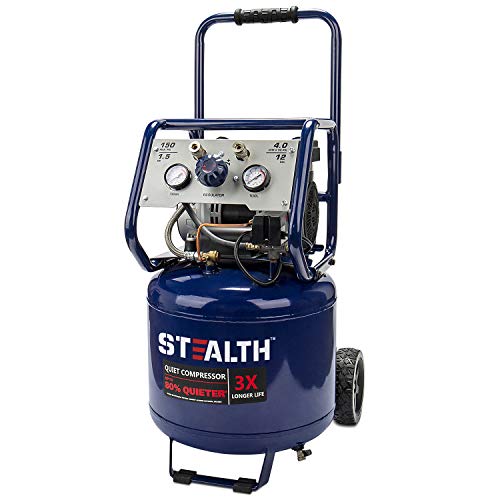
Equipped with a 1.5 HP induction motor, this unit offers a maximum 150 PSI with delivery of 5 CFM at 40 PSI and 4 CFM at 90 PSI. It emphasizes a quiet operation and long life, with a target for jobs where minimal noise is essential. Best for: indoor projects and light finishing where steady, quieter performance matters. Caution: check the recovery speed if you run multiple tools simultaneously at high pressure.
Klutch 20-Gallon Air Compressor

Though a 20-gallon tank, this unit is included for comparison due to its robust 2 HP motor and reliable performance with a practical oil-free pump. It offers quick recovery and a strong 90 PSI rating suitable for frame nailing and workshop tasks. Best for: bigger garages that need a balance of power and portability. Limitation: larger footprint than typical 12-gallon models.
Metabo HPT 8-Gallon Trolley Air Compressor

This option provides 225 PSI from an 8-gallon tank and 5.0 CFM at 90 PSI, making it a strong candidate for heavy-duty tasks when you need high pressure in a compact trolley design. Best for: professional setups or demanding tasks in smaller spaces where mobility is key. Caution: not a direct 12-gallon alternative, but useful for comparison of high-pressure, high-output designs.
MZB 13.2-Gallon Ultra Quiet

This model delivers up to 115 PSI with a steel tank and oil-free pump. It emphasizes ultra-quiet operation at about 70 dB and has built-in wheels with a robust handle for mobility. Best for: indoor workshops and residential settings where neighbor noise is a concern. Limitation: slightly lower maximum pressure compared with some 150 PSI units.
Buying Guide
What should you ask before buying a 12-gallon air compressor?
- What will I power with it? If you plan to run multiple nail guns or spray tools, choose higher CFM at your target PSI and ensure the compressor can recover quickly.
- How important is noise? For indoor garages or shared spaces, prioritize models marketed as quiet or with decibel ratings around 66–68 dB.
- Is mobility a priority? Look for oil-free, lightweight designs with wheels or trolley configurations to move between work spots.
- What maintenance is required? Oil-free pumps reduce upkeep, but check for brushless motors or components that extend life in busy shops.
- What is the maximum pressure needed? Most home and light professional work uses 90–125 PSI; 150 PSI units offer more headroom for demanding tools.
- Tank size and recovery time matter. A 12–13 gallon tank with fast recovery minimizes downtime between tool cycles.
Comparison Snapshot
- Best for quiet operation: Stealth 12 Gallon Quiet and MZB Ultra Quiet
- Best for high-output tasks: VEVOR 13-Gallon and Metabo HPT 8-Gallon (high PSI)
- Best value for portability: CRAFTSMAN 12-Gallon Ultra Quiet
Key Features At A Glance
- Tank size: 12–13 gallons is common; consider if you need more than 12 gallons for longer jobs.
- Portability: wheels, handles, and compact footprints help in small workshops.
- Oil-free design: reduces maintenance and oil mist in the workspace.
- Noise levels: quieter units typically range from 66–68 dB.
- Max PSI and CFM: ensure the unit meets your tool requirements, especially for spray painting and framing nailers.
FAQ
- Q: Do I need a 12-gallon model for tire inflation only? A: A smaller unit could suffice, but 12 gallons provide faster air delivery for multiple tires without frequent cycling.
- Q: Is oil-free always better? A: Oil-free reduces maintenance, but some users prefer oil-litted designs for heavy, continuous use; for home use, oil-free is typically sufficient.
- Q: Can I run a spray gun with these units? A: Yes, many 12–13 gallon models offer sufficient CFM at 90 PSI for light to medium spray applications.
- Q: Are quiet models more expensive? A: Not necessarily; many quiet models price competitively with standard counterparts, with added benefit of lower noise.
- Q: How important is tank size? A: Larger tanks reduce cycling and provide steadier air for longer sessions, especially with nailers and spray tools.
- Q: Do these compressors require regular maintenance? A: Oil-free pumps minimize maintenance, but periodic checks on air filters and valves help maintain performance.