Looking for the right 10 inch circular saw blade to deliver clean, precise cuts across softwoods, hardwoods, and plywood? This guide highlights top options with different tooth counts and finishes, helping you pick the blade that matches your project needs. Best uses vary from rough framing to fine finish work, so we’ve grouped picks by each blade’s strongest fit. The table below summarizes key options for quick comparison and decision making.
| Product | Tooth Count | Best For | Arbor | Kerf |
|---|---|---|---|---|
| WEN BL1060 | 60 | Fine finishing on soft/hardwoods | 5/8 in | 0.098 in (2.4 mm) |
| Diablo D1060X | 60 | Ultra-smooth cuts, demanding projects | 5/8 in | 0.098 in (2.4 mm) |
| WEN BL1032-2 | 32/60 | General cuts plus fine finishes (double blade pack) | 5/8 in | 0.098 in (2.4 mm) |
| DEWALT DWA11040 | 40 | Fine finish with long life | 5/8 in | 0.059 in (1.5 mm) — Ultra-thin kerf varies by model |
| WEN BL1080 | 80 | Ultra-fine finishes on delicate parts | 5/8 in | 0.098 in (2.4 mm) |
These blades cover a range of needs from fast rough-cutting to ultra-smooth finish work. The common 5/8 inch arbor ensures compatibility with most 10 inch saws, and kerf differences influence material waste and cut quality. Use the table as a quick reference when you’re deciding between a fast-cutting blade and a blade designed for final finishing.
WEN BL1060 10-Inch 60-Tooth Fine-Finish Blade
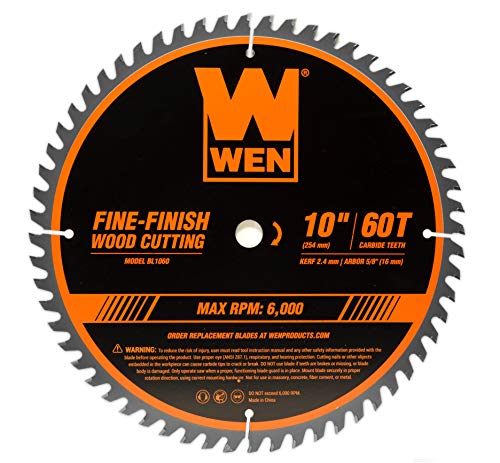
Tooth count and kerf are tuned for clean, precise cuts in both soft and hard woods. Best for: finishing work on molding, trim, and cabinetry where clean edges matter. Why selected: Ultra-thin 1/10 inch kerf reduces waste and requires less power for each pass. Limitation: Not ideal for aggressive ripping where very fast stock removal is required.
Diablo D1060X Fine Finish Blade

Designed for ultra-smooth cuts with durable carbide tips, this blade excels in fine finish tasks and challenging profiles. Best for: carpentry that demands precise, glass-smooth edges. Why selected: Shock-resistant design helps resist impact during demanding jobs. Caution: The blade data emphasizes durability—verify compatibility with your saw’s RPM range before use.
WEN BL1032-2 10-Inch Blade Set

This two-pack includes a 32-tooth blade for general cuts and a 60-tooth blade for fine finishes, both at 10 inches with a 5/8 inch arbor. Best for: project workflows that require quick switching between fast stock removal and high-quality finishes. Why selected: The compact set reduces downtime between blade changes. Caution: The 32-tooth blade is not optimized for ultra-smooth finishes compared to the 60-tooth blade.
DEWALT 10-Inch 40-Tooth Fine Finish Blade

DEWALT’s 40-tooth design emphasizes long blade life with precise finishes on hardwoods and plywood. Best for: carpentry and cabinetry projects requiring clean edges on a variety of woods. Why selected: Claims up to triple-life in some contexts thanks to optimized tooth geometry. Limitation: Higher tooth count can reduce aggressive stock removal on very dense woods.
WEN BL1080 10-Inch 80-Tooth Ultra-Fine Finish Blade

High-tooth-count blades produce ultra-smooth finishes, ideal for molding, paneling, and cabinet trim. Best for: projects prioritizing edge quality over fast material removal. Why selected: Ultra-fine kerf and 80 teeth deliver exceptional finish with minimal chipping. Caution: Higher tooth count can slow material removal on very dense stock.
Revvstark 10 Inch 80T Table Saw Blade
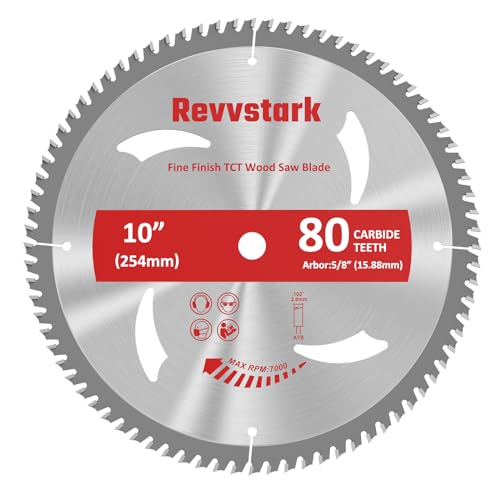
With 80 teeth and a durable alloy steel body, this blade aims for clean, quick finishes on a range of woods. Best for: users needing high-quality edges on finish work. Why selected: Strong carbide teeth for wear resistance. Limitation: The 80-tooth design may not perform as efficiently as lower-tooth blades on heavy ripping.
Buying Guide: Key Purchase Considerations
- Tooth count and finish needs: Higher tooth counts (60–80T) are better for fine finishes; lower counts (32–40T) remove stock faster but leave rough edges.
- Kerf thickness: Ultra-thin kerf saves material and power, but can be more prone to deflection on very thick stock. Consider your saw’s motor and HP.
- Arbor compatibility: Most 10″ blades use a 5/8″ arbor. Confirm arbor size with your saw to avoid fit issues.
- Material compatibility: Blades with carbide tips deliver longer life on hardwoods and plywood. For softwoods, standard carbide blades are often sufficient.
- Heat resistance and durability: Blades with reinforced carbide tips or special shock resistance are useful for demanding jobs and repeated cuts.
- Cut quality vs. speed: If finishing work is the priority, choose blades with higher tooth count and refined tooth geometry. For framing, a lower tooth blade may be preferable.
FAQ
- What is the best 10 inch blade for finishing work?
Blades with 60–80 teeth, such as those in the 60T and 80T categories, provide the smoothest finishes with minimal chipping.
- Are ultra-thin kerf blades safer for beginners?
Thin kerf blades reduce resistance and may be easier to push, but require steadier control to prevent deflection.
- Can I mix 10″ blades on the same saw?
Yes, you can switch between blades, but ensure RPM compatibility and arbor fit for any blade you use.
- What should I consider for heavy ripping vs. fine finishing?
Choose a lower tooth count (e.g., 32–40T) for ripping, and switch to higher tooth counts (60–80T) for finishes.
- Do carbide-tipped blades last longer?
Carbide tips generally offer better wear resistance and longer life across dense woods and frequent cuts.
- Is a blade’s RPM rating important?
Yes. Use blades rated for your saw’s RPM to avoid overheating, warping, or breakage.