
The right 3-3/8 inch circular saw blade can deliver clean, fast cuts across wood, plastic, and other softer materials. This guide highlights five top 3-3/8″ blades, focusing on teeth count, arbor size, and durability to help you pick the best option for compact saws and DIY projects.
- Product Spotlight: 5 selected blades optimized for 3-3/8″ saws
- Teeth counts ranging from 36T to 80T for a balance of speed and finish
- Arbor compatibility across common 3/8″ and 7/16″ options
| Product | Brand | Teeth | Arbor | Best For |
|---|---|---|---|---|
| Luckyway 3 Inch Circular Saw Blades 36T | Luckyway | 36T | 3/8″ | General wood and light plastic |
| FOXBC 3 Inch 80T Circular Saw Blade | FOXBC | 80T | 3/8″ | Smooth plywood and veneer |
| 3PACK 3-Inch 36T TCT Blade | Janchi | 36T | 3/8″ | Budget heavy-duty cutting |
| CRALY 3-3/8 Inch 36 Teeth Blade | CRALY | 36T | 15 mm | Fine finish wood cutting |
| Makita 792299-8 3-3/8-Inch 50T | Makita | 50T | 3-3/8″ | General purpose cordless saws |
Luckyway 3 Inch 36T Blade

Luckyway offers a 3″ blade with 36 teeth, designed for 3/8″ arbors and a kerf of 0.059″ (1.5 mm). The tungsten carbide teeth deliver wear and heat resistance for tougher materials, with a maximum RPM up to 19,500. Supplied as a 3-pack, these blades are ideal for clean cuts in wood, plastic, PCV, acrylic, and aluminum, enabling efficient cutting with reduced power requirements for improved control.
FOXBC 3 Inch 80T Blade, 5 Pack

FOXBC’s 3″ blade with 80 teeth produces a finer cut, making it suitable for smooth results on plywood, OSB, veneer, plastic, and similar materials. It features a 3/8″ arbor and comes in a 5-pack. It is compatible with a wide range of compact saws such as Dremel Saw-MAX and Ridgid Ultra-Saws, offering versatile performance for various cutting tasks.
Janchi 3-Pack 3-Inch 36T Blade

Janchi’s 3-pack includes 3-inch blades with 36 teeth on a 3/8″ arbor. These carbide-tipped blades are designed for heavy-duty cutting across wood, plastic, PCV, acrylic, and aluminum. The blades emphasize long life and affordability, offering a balance between performance and cost for frequent use.
CRALY 3-3/8 Inch 36T Blade

CRALY offers a 3-3/8″ blade with 36 carbide-tipped teeth and a 15 mm arbor, featuring a 1.2 mm kerf and Black Ice coating. The blade emphasizes non-stick properties, laser-cut expansion slots, and stabilizer vents to improve life and reduce drag. It is suitable for plywood, MDF, OSB, laminates, and other composite panels.
Makita 721003-8 3-3/8″ 50T
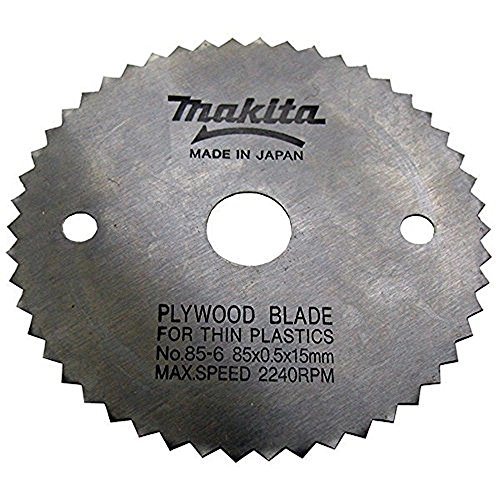
Makita’s 3-3/8″ blade comes with 50 teeth for general-purpose cutting. It is built with durable steel and designed for cordless saws to maximize cuts per charge. While positioned as a versatile choice, its focus is reliable, consistent performance across common woodworking tasks in compact saw setups.
Buying Guide: Key Considerations For 3-3/8 Inch Blades
When selecting a 3-3/8″ saw blade, consider the following factors to optimize performance for your projects.
- Teeth count and cut quality: Higher tooth counts (e.g., 80T) yield smoother finishes on plywood and veneers, while lower tooth counts (36T) cut faster on rough material or metals with less effort, requiring more finishing work later.
- Arbor size compatibility: Most of the blades listed use a 3/8″ arbor, but some assortments include 7/16″ bushings or 15 mm arbors. Ensure your saw’s arbor matches the blade or use the included adaptors.
- Kerf thickness: Thin kerf blades (0.059″ or around 1.5 mm) reduce the cutting force and allow for quicker, easier cuts, especially on softer materials.
- Coatings and wear resistance: Carbide-tipped blades with non-stick or specialized coatings resist heat buildup during extended cuts, extending blade life.
- Material compatibility: Not all blades handle plastics or aluminum equally. Look for blades explicitly rated for wood, PVC, acrylic, and similar materials when mixing substrates.
- Durability and life span: Carbide blades generally last longer under heavy use and maintain sharpness after multiple cuts, reducing blade changes during a project.
- Application context: For cabinetry and precision work, prioritize 80T blades for clean finishes; for rough framing, 36T blades may be more efficient.
In choosing between the options above, consider your primary materials, the horsepower and RPM of your compact saw, and how often you’ll swap blades. Each blade family offers a different balance of speed, finish quality, and cost, helping you tailor your toolkit to your typical projects.